Adaptive curvature seal coupling wedge applied to ultrasonic phased array probe

An ultrasonic phased array and self-adaptive technology, which is applied in the direction of material analysis, measuring devices, and instruments using sound waves/ultrasonic waves/infrasonic waves. The effect of high noise ratio

CN104422734AInactive Publication Date: 2015-03-18CAPITAL AEROSPACE MACHINERY +1
8 Cites 2 Cited by

Patent Information

Authority / Receiving Office
CN · China
Patent Type
Applications(China)
Current Assignee / Owner
Publication Date
2015-03-18
Estimated Expiration
Not applicable · inactive patent

Smart Images

  • Figure 1
    Figure 1
  • Figure 2
    Figure 2
  • Figure 3
    Figure 3
Patent Text Reader

Abstract

The invention belongs to an ultrasonic phased array detecting technique and in particular discloses an adaptive curvature seal coupling wedge applied to an ultrasonic phased array probe. The adaptive curvature seal coupling wedge applied to the ultrasonic phased array probe comprises a wedge main body and a support frame, wherein the wedge main body is provided with a liquid filling cavity penetrating through the upper surface and the lower surface; a limit table is arranged on the upper end surface of the liquid filling cavity; the wedge main body is provided with a liquid inlet exhaust passage used for connecting the liquid filling cavity to the outside world; the inner surface of the support frame is formed by the extension of the inner wall of the liquid filling cavity; a pressing plate is arranged outside the support frame in a sleeving manner; an integrated sealing layer is arranged between the pressing plate and the wedge main body. A novel coupling mode is provided, an ultrasonic wave emitted by the probe is transmitted to the sealing layer through liquid in the liquid filling cavity, and transmitted to a detected object by penetrating through the sealing layer; a large curved surface workpiece needing to be detected by adopting a total immersion method can be subjected to partial immersion testing through the sealing wedge, and the device capability requirements such as multi-shaft automation and large detection range are reduced.
Need to check novelty before this filing date? Find Prior Art

Description

technical field

[0001] The invention belongs to ultrasonic phased array detection technology, in particular to a sealing coupling wedge. Background technique

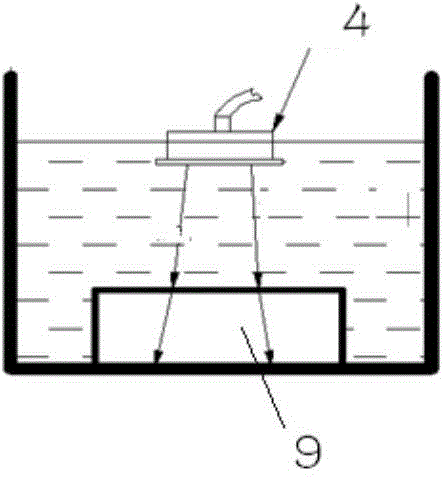
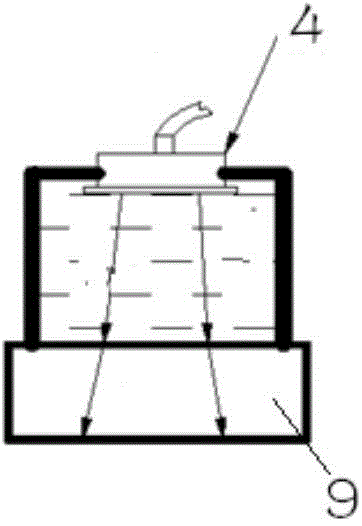
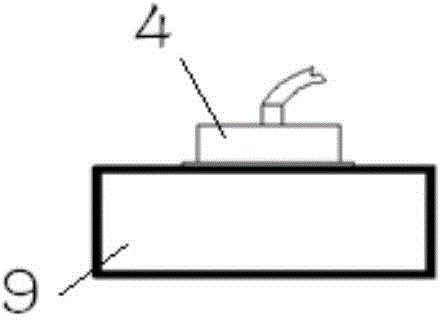
[0002] Ultrasonic phased array technology In the process of product testing, a coupling medium (coupling agent) needs to be filled between the detection probe and the product, and the ultrasonic wave emitted by the probe can be effectively transmitted to the detection product through the coupling agent with good sound permeability. middle. The selection of couplant and the method of coupling by means of wedges are called coupling methods. Commonly used coupling methods for ultrasonic phased arrays include liquid immersion method (including full and partial liquid immersion) and contact method (direct contact and wedge contact). The coupling methods are shown in Figure 1. The liquid immersion method is to immerse the probe and the detection workpiece in a liquid coupling agent (usually water), or partially immerse th...

Examples

Embodiment Construction

[0033] The present invention will be described in further detail below in conjunction with the accompanying drawings and specific embodiments.

[0034] Such as Figure 3 ~ Figure 5 As shown, the upper and lower surfaces of the wedge body 1 are planes parallel to each other, and a liquid-filled chamber 2 passing through the upper and lower surfaces is processed in the wedge body 1, and the upper end surface of the liquid-filled chamber 2 is processed with a limit platform 3 , the width of the limiting platform 3 is d 2 , the angle between the upper surface of the liquid-filled chamber 2 and the upper surface of the wedge is the interface angle α. The liquid-filled chamber 2 is in the shape of a hexahedron, the length of the upper end surface is less than or equal to the length of the lower end surface, and the width of the upper end surface is less than or equal to the width of the lower end surface.

[0035] The length of the interface of the limiter 3 is L which is the same...