AI technical title is built by Patsnap AI team. It summarizes the technical point description of the patent document.
A technology of member ports and aggregation groups, applied in the field of communication, can solve the problem that the energy-saving state cannot be maintained all the time or cannot be maintained.
Active Publication Date: 2017-12-15
NEW H3C TECH CO LTD
View PDF4 Cites 0 Cited by
Summary
Abstract
Description
Claims
Application Information
AI Technical Summary
This helps you quickly interpret patents by identifying the three key elements:
Problems solved by technology
Method used
Benefits of technology
Problems solved by technology
In this way, when the aggregation group uses the hash algorithm to share traffic, if each member port of the aggregation group is enabled with the EEE function and is in the selected state, each port may have traffic in and out, which will cause EEE The energy-saving state cannot be maintained all the time, or cannot be maintained for a relatively long time
Method used
the structure of the environmentally friendly knitted fabric provided by the present invention; figure 2 Flow chart of the yarn wrapping machine for environmentally friendly knitted fabrics and storage devices; image 3 Is the parameter map of the yarn covering machine
View more
Image
Smart Image Click on the blue labels to locate them in the text.
Viewing Examples
Smart Image
Click on the blue label to locate the original text in one second.
Reading with bidirectional positioning of images and text.
Smart Image
Examples
Experimental program
Comparison scheme
Effect test
Embodiment 1
[0029] In this embodiment, the routing device includes four physical ports, and the port numbers are 1, 2, 3, and 4 respectively. The theoretical bandwidth of each physical port is 1Gbps. Add 4 physical ports to an aggregation group. All member ports in the aggregation group are selected, and each member port in the aggregation group is enabled with the EEE function.
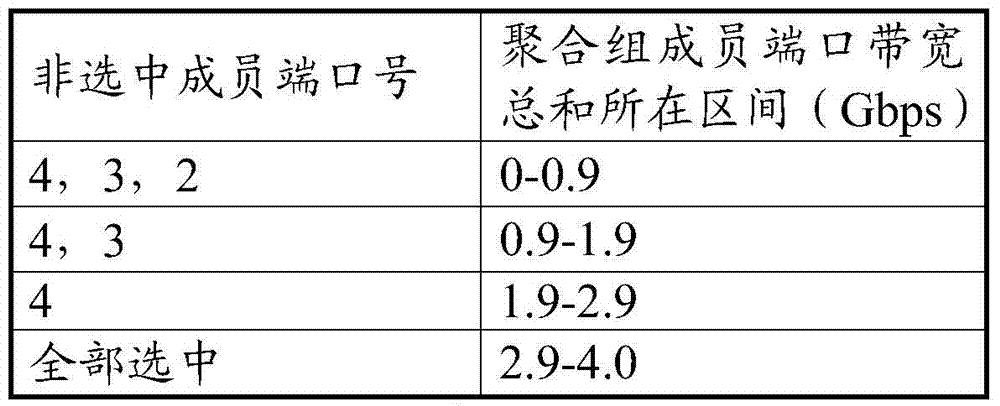
[0030] Set the corresponding relationship between the number of unselected member ports and the sum of the bandwidth of the member ports of the aggregation group according to the theoretical bandwidth of each member port in the aggregation group in advance, as shown in Table 1:
[0031]
[0032] Table 1
[0033] In Table 1, when the actual bandwidth sum of the member ports of the aggregation group is 0-0.9Gbps, the member ports 4, 3, and 2 are switched to the unselected state; when the actual bandwidth sum of the member ports of the aggregation group is 0.9-1.9Gbps, the member ports Ports 4 and 3 are switche...
Embodiment 2
[0041] In this embodiment, the routing device includes four physical ports, and the port numbers are 1, 2, 3, and 4 respectively. The theoretical bandwidth of each physical port is 1Gbps. Add 4 physical ports to an aggregation group. In the aggregation group, only member port 1 is in the selected state, and other member ports are in the non-selected state, and each member port in the aggregation group uses Can EEE function.
[0042] According to the theoretical bandwidth of each member port in the aggregation group, the corresponding relationship between the number of unselected member ports and the sum of the bandwidth of the member ports of the aggregation group is set in advance, as shown in Table 1.
[0043] After the routing device receives the message, it enters the cache, and monitors the actual bandwidth sum of the member ports of the aggregation group by triggering the clock in real time, and at the same time determines which member port each message is forwarded to t...
the structure of the environmentally friendly knitted fabric provided by the present invention; figure 2 Flow chart of the yarn wrapping machine for environmentally friendly knitted fabrics and storage devices; image 3 Is the parameter map of the yarn covering machine
Login to View More
PUM
Login to View More
Abstract
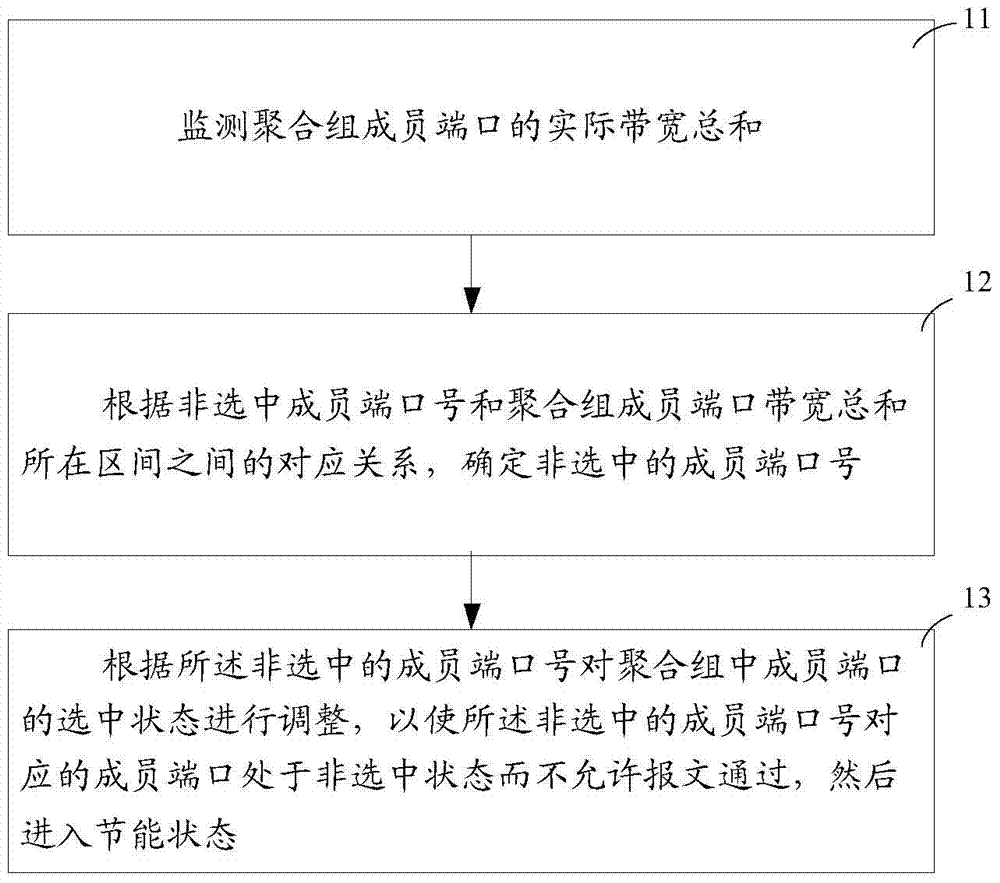
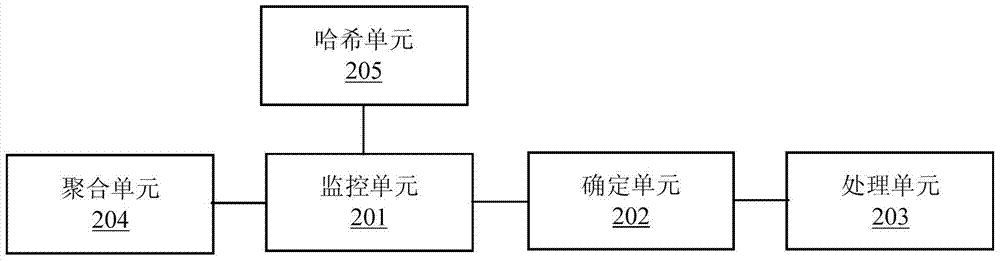
The invention discloses an energy-saving method, and is applied to routing equipment. The method includes: monitoring the sum of actual bandwidth of aggregation group member ports; determining non-selected member port numbers according to the corresponding relation between the non-selected member port numbers and a section where the sum of the bandwidth of the aggregation group member ports is; and adjusting selected states of member ports in the aggregation group according to the non-selected member port numbers, so that member ports corresponding to the non-selected member port numbers are in non-selected states and do not allow messages to pass, thereby entering an energy-saving state. The invention also discloses an energy-saving device. By adoption of the energy-saving method and device, forwarding is not influenced while energy-saving efficiency is improved.
Description
technical field [0001] The invention relates to the field of communication technologies, in particular to an energy-saving method and device. Background technique [0002] EEE (Energy-Efficient Ethernet) is an energy-saving standard defined by IEEE 802.3az. When the port is idle, it reduces the power consumption of the physical layer (PHY) and MAC chips, thereby achieving energy-saving and environmental protection effects. For the single use of EEE function, as long as a port of a general routing device receives or sends a message, it will trigger its energy-saving state to change to a non-energy-saving state, which is not efficient in saving energy. Through actual verification, it is found that the power can be reduced by 20% to 30% in the energy-saving state. [0003] Port aggregation technology is a technology commonly used in packet forwarding at present. This technology first adds the physical port of the Ethernettransceiver to the aggregation group and becomes a memb...
Claims
the structure of the environmentally friendly knitted fabric provided by the present invention; figure 2 Flow chart of the yarn wrapping machine for environmentally friendly knitted fabrics and storage devices; image 3 Is the parameter map of the yarn covering machine
Login to View More
Application Information
Patent Timeline
Application Date:The date an application was filed.
Publication Date:The date a patent or application was officially published.
First Publication Date:The earliest publication date of a patent with the same application number.
Issue Date:Publication date of the patent grant document.
PCT Entry Date:The Entry date of PCT National Phase.
Estimated Expiry Date:The statutory expiry date of a patent right according to the Patent Law, and it is the longest term of protection that the patent right can achieve without the termination of the patent right due to other reasons(Term extension factor has been taken into account ).
Invalid Date:Actual expiry date is based on effective date or publication date of legal transaction data of invalid patent.


 Login to View More
  Login to View More