One-way sliding type vibration and noise reduction rubber bearing for rail transit bridge

A one-way sliding, rail transit technology, applied in bridges, bridge parts, bridge construction, etc., can solve the problem of large-scale horizontal displacement without protective measures, and achieve the effect of reducing bridge deflection, reasonable design and simple structure

CN104947579BActive Publication Date: 2017-03-08WUHAN UNIV OF TECH +2
6 Cites 1 Cited by

Patent Information

Authority / Receiving Office
CN · China
Patent Type
Patents(China)
Current Assignee / Owner
Publication Date
2017-03-08

Smart Images

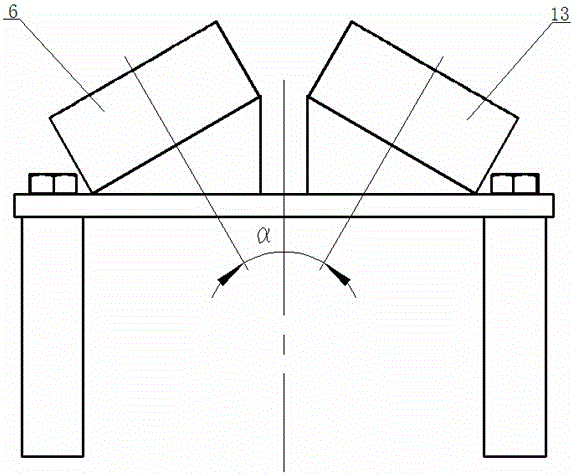
  • Figure 1
    Figure 1
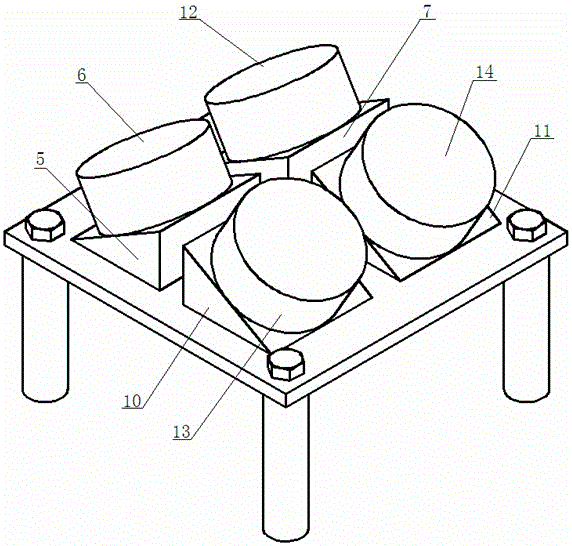
  • Figure 2
    Figure 2
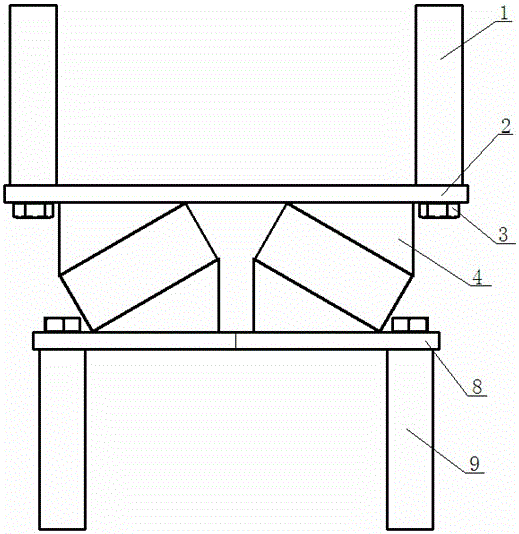
  • Figure 3
    Figure 3
Patent Text Reader

Abstract

A one-way slide type vibration and noise reduction rubber support of rail transit bridge comprises an upper support plate (2) and a lower support plate (8), wherein the lower wedge fixing block I (5) and the lower wedge fixing block III (10) on the lower support plate (8) are opposite to each other, the lower wedge fixing block II (7) and the lower wedge fixing block IV (11) on the lower support plate (8) are opposite to each other, the bottom of the upper support plate (2) is correspondingly provided with four upper wedge fixing blocks (4), a vulcanized rubber plate I (6) is disposed between the lower wedge fixing block I (5) and the corresponding upper wedge fixing block (4), a vulcanized rubber plate II (12) is disposed between the lower wedge fixing block II (7) and the corresponding upper wedge fixing block (4), a vulcanized rubber plate III (13) is disposed between the lower wedge fixing block III (10) and the corresponding upper wedge fixing block (4), and a vulcanized rubber plate IV (14) is disposed between the lower wedge fixing block IV (11) and the corresponding upper wedge fixing block (4). The one-way slide type vibration and noise reduction rubber support has the advantages that sufficient vertical rigidity and vertical vibration reduction damping are guaranteed, and weak vibration of rails during operation is weakened.
Need to check novelty before this filing date? Find Prior Art

Description

technical field

[0001] The invention relates to a rubber bearing, more specifically to a one-way sliding vibration-reducing and noise-reducing rubber bearing of a rail transit bridge, and belongs to the technical field of bridge vibration reduction and isolation. Background technique

[0002] At present, in the field of seismic isolation of buildings and bridges, there has been some research on strong vibrations such as earthquakes and corresponding seismic products have been developed. However, with the popularization of rail transit such as urban light rail and subway, it not only brings convenience to the city, but also brings vibration and noise to the buildings and residents around the rail. The weak vibration and noise generated have a negative impact on the buildings around the track and the human body. Therefore, higher requirements for vibration and noise reduction are put forward in the construction of rail transit. However, the existing rail transit bridge vibrat...

Examples

Embodiment Construction

[0016] The present invention will be further described in detail below in conjunction with the accompanying drawings and specific embodiments.

[0017] see figure 1 , figure 2 with Figure 4 , a one-way sliding type vibration-reducing and noise-reducing rubber bearing of a rail transit bridge, comprising an upper bearing plate 2 and a lower bearing plate 8; the upper bearing plate 2 is provided with four upper anchor rods 1, Four lower anchor rods 9 are arranged under the lower support plate 8 . The lower support plate 8 is provided with a lower wedge-shaped fixed block with the same structure 5. The lower wedge-shaped fixed block 7. The lower wedge-shaped fixed block 10 and the lower wedge-shaped fixed block 11, and the lower wedge-shaped fixed block 5 and the lower wedge-shaped fixed block 10 relatively arranged, the lower wedge-shaped fixed block 7 and the lower wedge-shaped fixed block 11 relatively arranged, the lower wedge-shaped fixed block 5 and th...