
Maltose inducible trehalose synthase synthesis engineering bacterium, method for preparing same and application
A technology of trehalose synthase and maltose, which is applied in the direction of bacteria, transferase, and the use of vectors to introduce foreign genetic materials, etc., can solve the problems of toxicity, high cost, and high xylose price
- Summary
- Abstract
- Description
- Claims
- Application Information
AI Technical Summary
Problems solved by technology
Method used
Image

Examples
Embodiment 1
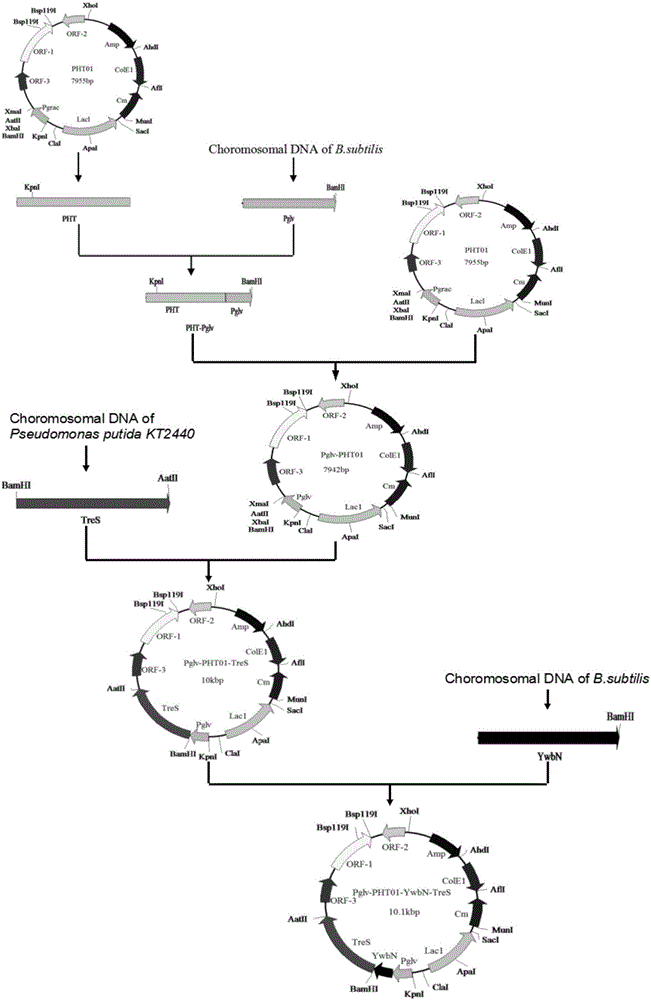
[0136] The maltose promoter comprising the maltose operon derived from the Bacillus subtilis 168 (Bacillus subtilis 168) genome, the peroxidase gene signal peptide DNA fragment or phosphodiesterase derived from the heme DyP type of Bacillus subtilis (Bacillus subtilis) The gene signal peptide DNA fragment and the trehalose synthase gene expression element derived from Pseudomonas putida KT2440 were cloned into the shuttle plasmid PHT01.
[0137] 1. Construction of recombinant plasmid Pglv-PHT01
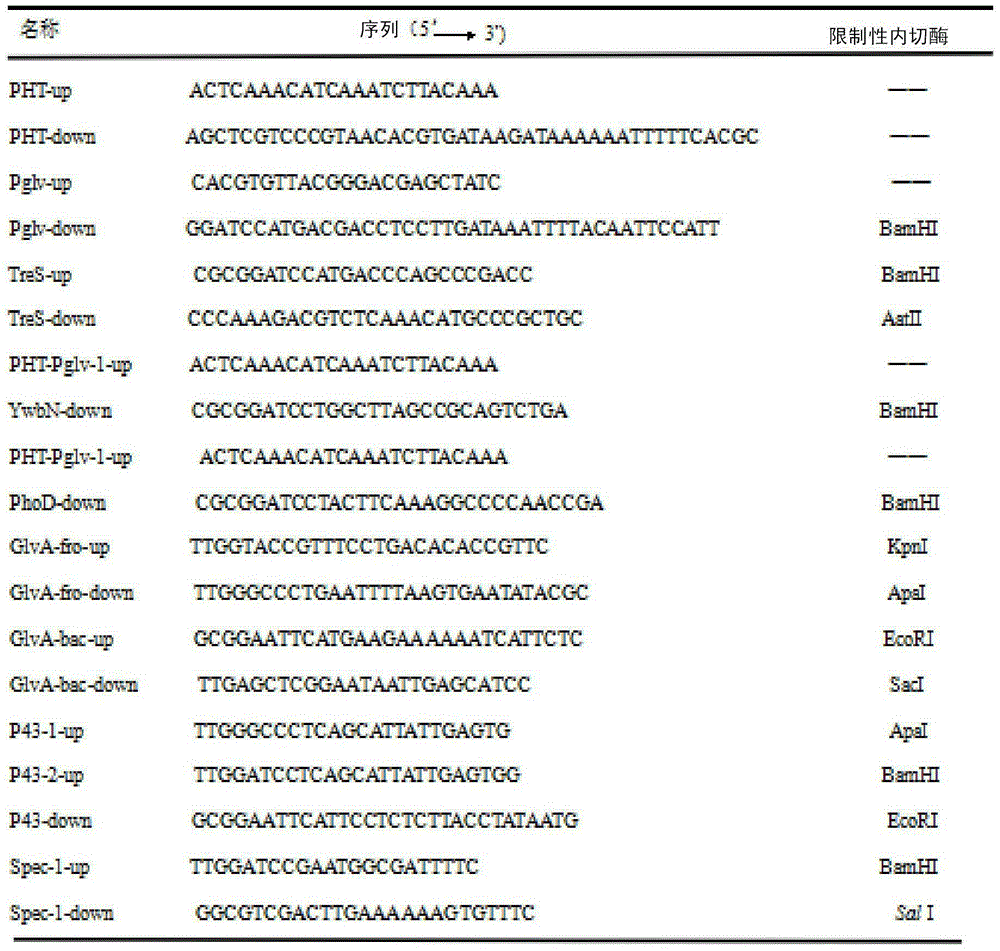
[0138] According to the maltose promoter Pglv sequence annotated in Genbank, two pairs of primers were designed for the PHT01 plasmid and Pglv respectively:
[0139] PHT-up: 5'-ACTCAAACATCAAAATCTTACAAA-3'
[0140] PHT-down:5'-AGCTCGTCCCGTAACACGTGATAAGATAAAAAAATTTTTCACGC-3'
[0141] Pglv-up: 5'-CACGTGTTACGGGACGAGCTATC-3'
[0142] Pglv-down: 5'- GGATCC ATGACGACCTCCTTGATAA TTTACAATTCCATT-3' (where the single underline is the restriction site, and the double underline is the site-dir...
Embodiment 2
[0155] The P43 promoter derived from the overlapping promoter of Bacillus subtilis (Bacillus subtilis), the spectinomycin resistance gene derived from the plasmid pDG1728 and the homology arms at both ends of the maltose promoter were integrated into the corresponding sites of pE3 to obtain the integrated plasmid pCYL25.
[0156] 1. Construction of integration plasmid pCYL25
[0157] Genomic DNA of Bacillus subtilis WB800n was extracted and used as a template to amplify Bacillus subtilis with two sets of primers [GlvA-fro-up and GlvA-fro-down and GlvA-bac-up and GlvA-bac-down] The 500bp upstream GAf fragment and the 500bp downstream GAb fragment of the maltose promoter in the genome. The GAf and GAb fragments were recovered and cloned into pGEMT-Vector respectively to obtain pGEMT-GAf and pGEMT-GAb.
[0158] Using the genomic DNA of Bacillus subtilis WB800n as a template, the P43 promoter was amplified by PCR with primers P43-1-up and P43-down, and cloned into pGEMT-Vector to...
Embodiment 3
[0163] The production of trehalose synthase, the operation steps are as follows:
[0164] 1) Preparation of the first-class species: pick the single colony of the above-mentioned Bacillus subtilis genetically engineered strain from the LB plate containing 20ug / mL of neochloramphenicol, and cultivate it overnight in 3mLLB liquid medium at 37°C and 200rpm, and the resulting strain is the first-class kind;
[0165] 2) Preparation of the secondary species: the primary species was inoculated in 800 mL LB liquid medium containing 20 ug / mL of neochloramphenicol, and cultivated at 37°C and 200 rpm until the OD600 was between 0.8-1.0 (about 4-5 hours);
[0166] 3) Preparation of the third-level species: inoculate the second-level species into an 80LLB liquid fermenter at 37°C, control the pH to about 7.0 with citric acid and NaOH, ventilate and stir, control the dissolved oxygen at 20-30%, and cultivate until the OD600 is Between 0.8-1.0 (about 4-5 hours);
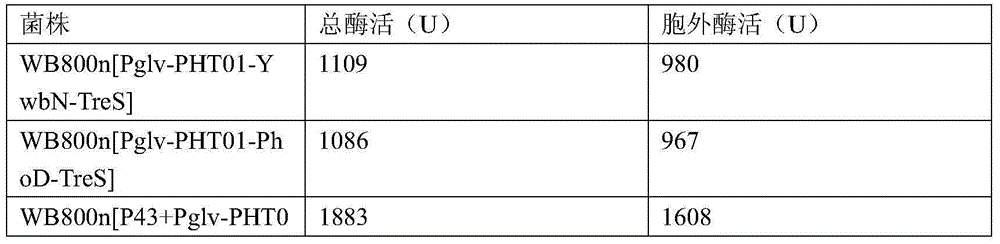
[0167] 4) Fermentation in...
PUM
 Login to View More
 Abstract
Description
Claims
Application Information
 Login to View More