Method and circuit for realizing fast Fourier transform/fast Fourier inverse transform
What is AI technical title?
AI technical title is built by Patsnap AI team. It summarizes the technical point description of the patent document.
A technology of inverse Fourier transform and Fourier transform, which is applied in the field of data transformation and can solve the problems of complete loss of data and reduction of calculation accuracy.
Active Publication Date: 2018-12-07
MONTAGE SEMICON SHANGHAI CO LTD +1
View PDF3 Cites 0 Cited by
Summary
Abstract
Description
Claims
Application Information
AI Technical Summary
This helps you quickly interpret patents by identifying the three key elements:
Problems solved by technology
Method used
Benefits of technology
Problems solved by technology
However, the above algorithm has problems in accuracy, especially when the data distribution is uneven, the operation accuracy will be greatly reduced
This is because, when the dynamic range between the data is greater than the data bit width, in order to ensure that the maximum value can be represented, all data may be scaled and rounded, resulting in a complete loss of smaller data
Method used
the structure of the environmentally friendly knitted fabric provided by the present invention; figure 2 Flow chart of the yarn wrapping machine for environmentally friendly knitted fabrics and storage devices; image 3 Is the parameter map of the yarn covering machine
View more
Image
Smart Image Click on the blue labels to locate them in the text.
Viewing Examples
Smart Image
Click on the blue label to locate the original text in one second.
Reading with bidirectional positioning of images and text.
Smart Image
Examples
Experimental program
Comparison scheme
Effect test
Embodiment 1
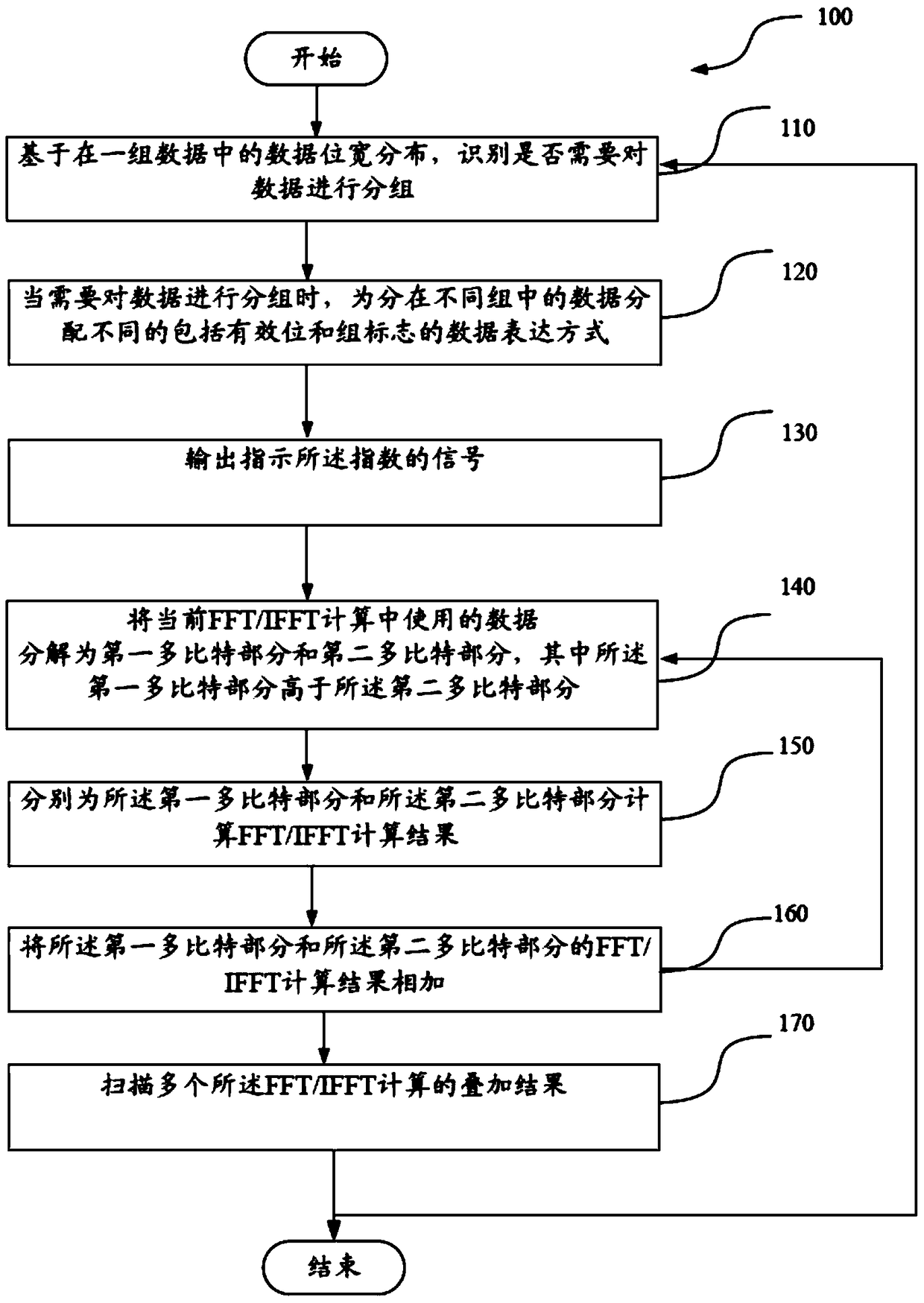
[0022] For example, the bit width Ns of the FFT / IFFT calculator is 12 bits. The data size (that is, the bit width) used by the first-level calculation result is 15 bits (Ns+3 bits), and the number of data with a bit width of 15 bits is 2, that is, M3=2, 14 bits (Ns+2 bits) , corresponding to M2=3, 13 bits (Ns+1 bit), corresponding to M1=23, and less than or equal to (≤) Ns bits, including 10 bits, 8 bits, 6 bits, and 3 bits, corresponding to M0=100. Let the threshold be 10. According to the data distribution, the number of data with a bit width greater than 13 bits is 5, and the number of data with a bit width greater than or equal to 13 bits is 28, and the threshold is 10. Therefore, the number of data with a bit width greater than 13 bits is less than the threshold 10, and the number of data with a bit width greater than or equal to 13 bits is greater than the threshold 10. Then according to Table 1, x=1, the corresponding gain is 2 -1 .
Embodiment 2
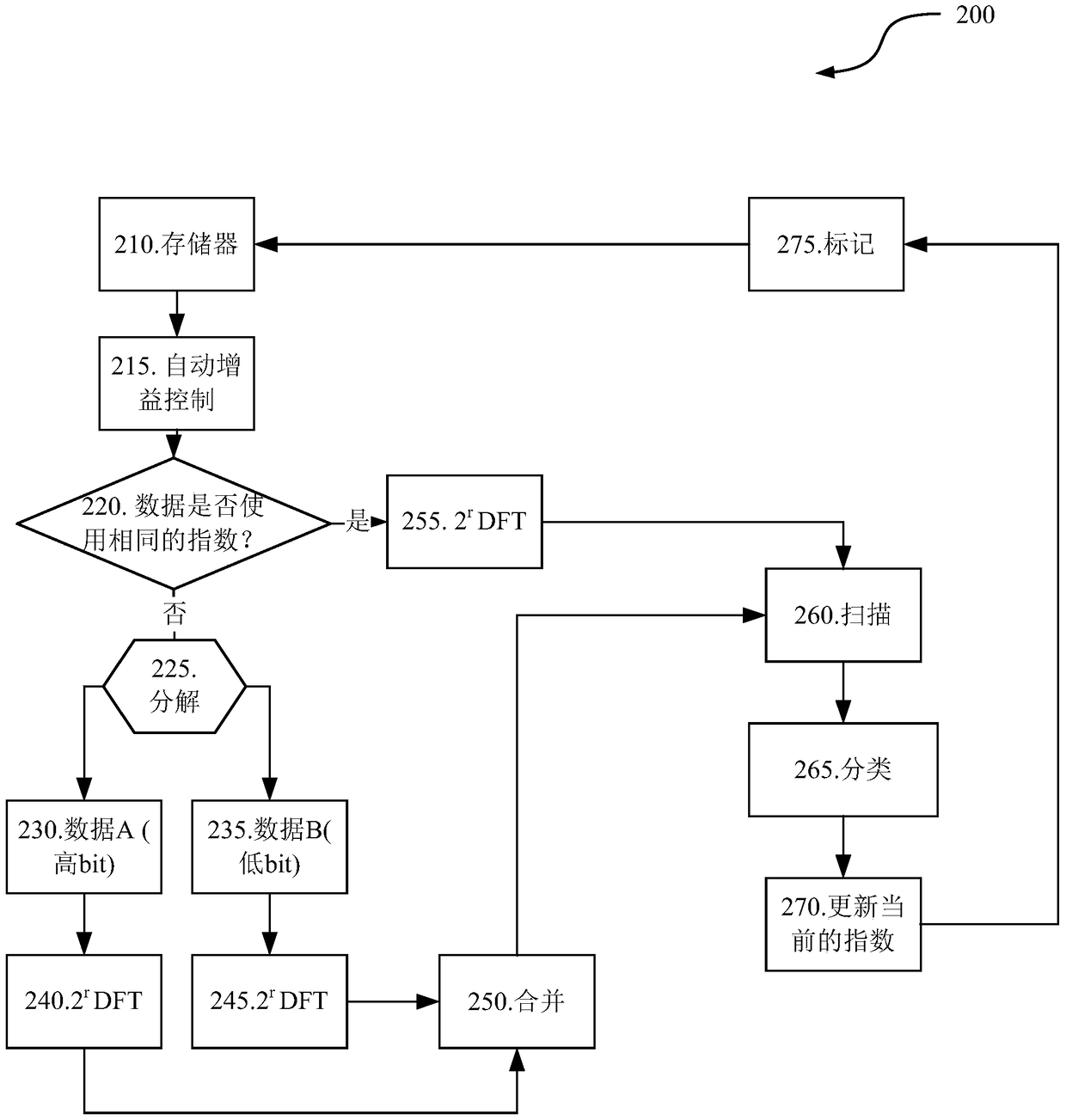
[0024] Threshold is still 10. In another embodiment, for example, the bit width Ns of the FFT / IFFT calculator is still 12 bits. The data size (that is, the bit width) used in the first-level calculation is 15 bits (Ns+3 bits), and the number of data with a bit width of 15 bits is 18, that is, M3=18, 14 bits (Ns+2 bits) , corresponding to M2=3, 13 bits (Ns+1 bit), corresponding to M1=23, and ≤Ns bits, including 10 bits, 8 bits, 6 bits, and 3 bits, corresponding to M0=84. Because the number of data with any bit width is greater than the threshold 10, that is, the distribution of data is uniform, therefore, there is no need to group the data. Therefore, the gain is consistent with that obtained by the traditional method, which is 2 -3 .
[0025] In summary, it can be noticed that when the data is uniform, there will be quite a lot of data at the maximum bit width, generally more than the set threshold, and the AGC gain 1 of the control group will be the same as the AGC gain 2 ...
the structure of the environmentally friendly knitted fabric provided by the present invention; figure 2 Flow chart of the yarn wrapping machine for environmentally friendly knitted fabrics and storage devices; image 3 Is the parameter map of the yarn covering machine
Login to View More
PUM
Login to View More
Abstract
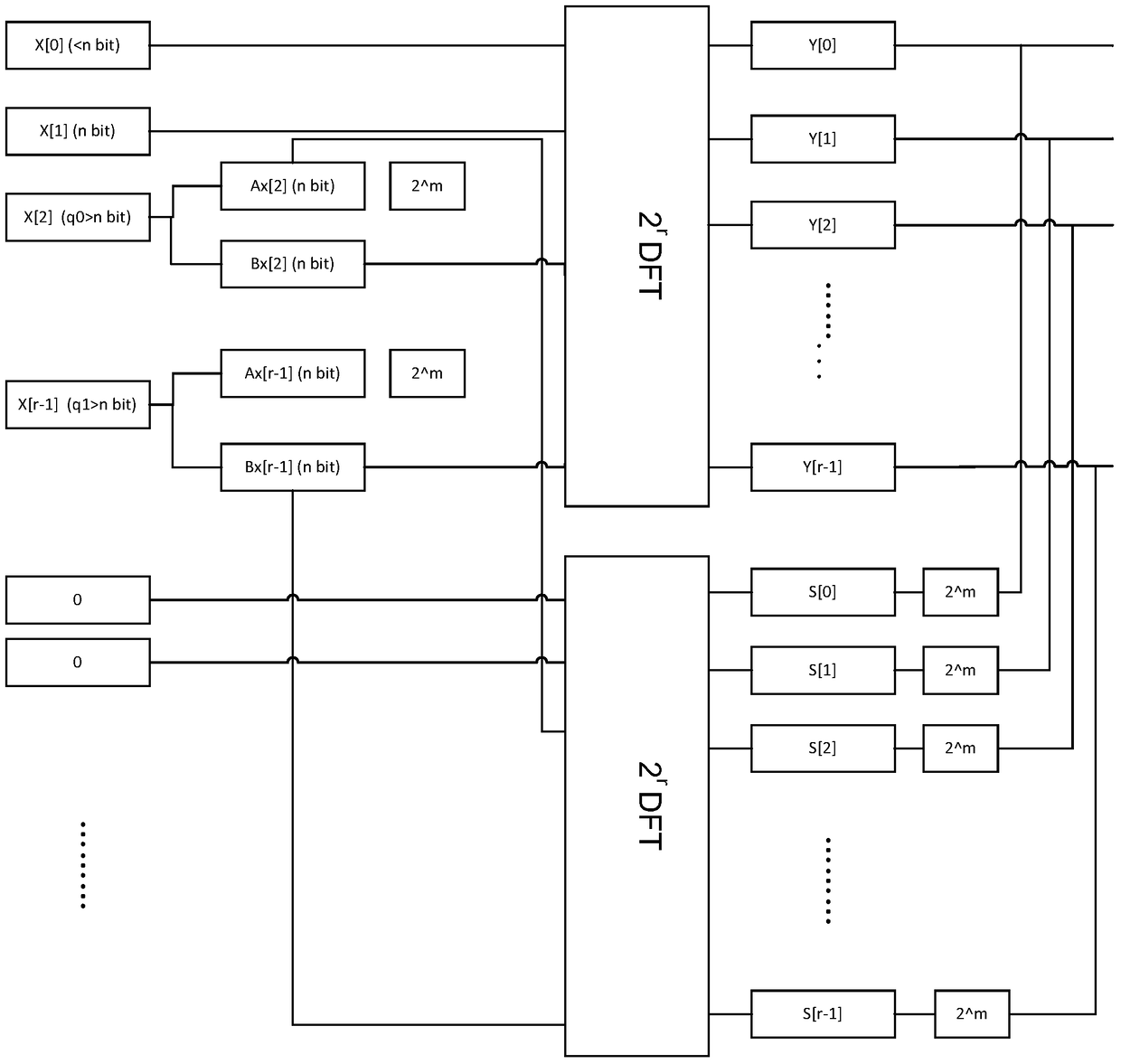
A method for implementing fast Fourier transform / inverse fast Fourier transform, including identifying whether data needs to be grouped based on the data bit width distribution in a set of data, and when the data needs to be grouped, it is divided into assigning different data representations including significant bits and group flags to data in different groups, wherein data in one group has the same index and data in different groups has different indices; and outputting a signal indicating the index; For each of the plurality of short-sequence FFT / IFFT calculations, decomposing the data used in the current short-sequence FFT / IFFT calculation into at least a first multi-bit part and a second multi-bit part; respectively the first multi-bit part and the second multi-bit part Computing the FFT / IFFT calculation results of the two multi-bit parts; adding the FFT / IFFT calculation results of the first multi-bit part and the second multi-bit part; scanning the superposition results of multiple short sequence FFT / IFFT calculations in one stage.
Description
technical field [0001] The invention relates to data transformation, in particular to a method and circuit for realizing fast Fourier transform / fast Fourier inverse transform. Background technique [0002] The operation of FFT / IFFT satisfies Pasval's theorem, that is, the energy of the output data is N times the energy of the input data. This shows that if a lossless operation requires a large storage space, the operator also needs a large bit width. In order to save resources, the maximum value of the overall data is generally scanned after each iteration is completed, and the overall data is multiplied or divided by a constant power of 2 to determine the constant according to the maximum value, and the effective data with less bit width is saved. Compensate the same factor on the iteration result. This common method is called automatic gain. However, the above algorithms have problems in accuracy, especially when the data distribution is uneven, the operation accuracy w...
Claims
the structure of the environmentally friendly knitted fabric provided by the present invention; figure 2 Flow chart of the yarn wrapping machine for environmentally friendly knitted fabrics and storage devices; image 3 Is the parameter map of the yarn covering machine
Login to View More
Application Information
Patent Timeline
Application Date:The date an application was filed.
Publication Date:The date a patent or application was officially published.
First Publication Date:The earliest publication date of a patent with the same application number.
Issue Date:Publication date of the patent grant document.
PCT Entry Date:The Entry date of PCT National Phase.
Estimated Expiry Date:The statutory expiry date of a patent right according to the Patent Law, and it is the longest term of protection that the patent right can achieve without the termination of the patent right due to other reasons(Term extension factor has been taken into account ).
Invalid Date:Actual expiry date is based on effective date or publication date of legal transaction data of invalid patent.


 Login to View More
  Login to View More