Position detection device
A detection device and a technology for noise detection, applied in optics, instruments, electrical and digital data processing, etc., can solve the problems that the differential amplifier cannot fully eliminate the influence of noise and the intensity of noise.
- Summary
- Abstract
- Description
- Claims
- Application Information
AI Technical Summary
Problems solved by technology
Method used
Image



Examples
no. 1 approach
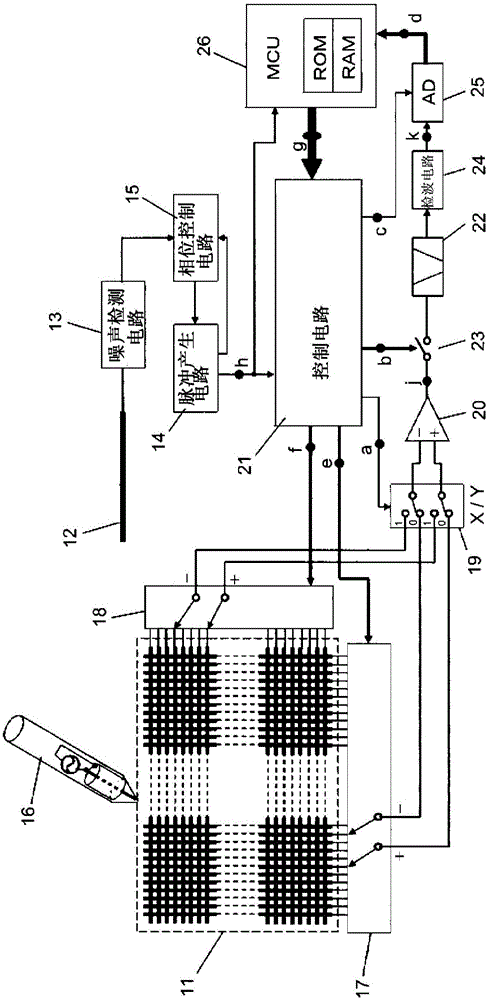
[0040] figure 1 It is a block diagram of the first embodiment of the position detection device of the present invention. figure 1 Among them, 11 is a transparent sensor, which is provided with an X electrode formed by arranging a plurality of ITO (Indium Tin Oxide: indium tin oxide) lines (line) in the X-axis direction of the X and Y coordinates of the transparent sensor 11, and A Y electrode formed by arranging a plurality of ITO lines in the Y axis direction of the X and Y coordinates. The transparent sensor 11 is integrally arranged with a not-shown LCD (Liquid Crystal Display: liquid crystal display) panel, and the position detection area of the transparent sensor 11 coincides with the display area of the LCD panel. In addition, the X electrode and the Y electrode on the transparent sensor 11 are connected by an ACF (Anisotropic conductive film: anisotropic conductive film), and are connected to a printed circuit board not shown via a flexible substrate not shown.
...
no. 2 approach
[0107] Figure 12 It is a configuration diagram of a position detection device according to a second embodiment of the present invention, showing an example of the case of detecting and inputting a finger's touch position. Figure 12 in, with figure 1 The same structural elements are denoted by the same reference numerals. That is, 11 is a transparent sensor, 12 is a noise detection electrode, 13 is a noise detection circuit, 14 is a pulse generation circuit, 15 is a phase control circuit, 21 is a control circuit, 22 is a bandpass filter circuit, 23 is a switch, 24 is a Detection circuit, 25 is an AD conversion circuit, and 26 is a microprocessor.
[0108] 32 is an X selection circuit for selecting one of the X electrodes of the transparent sensor 11 , and 33 is a Y selection circuit for selecting one of the Y electrodes of the transparent sensor 11 . 34 is a signal transmitter that generates and outputs a signal of a certain frequency. The output signal of the signal tran...
PUM
 Login to View More
 Abstract
Description
Claims
Application Information
 Login to View More