
Strain of biocontrol Streptomyces and application thereof
A technology of streptomyces and mold, applied in application, bacteria, biocide and other directions, can solve the problems of environmental pollution, human health, adverse effects, pesticide residues, etc.
- Summary
- Abstract
- Description
- Claims
- Application Information
AI Technical Summary
Problems solved by technology
Method used
Image

Examples
Embodiment 1
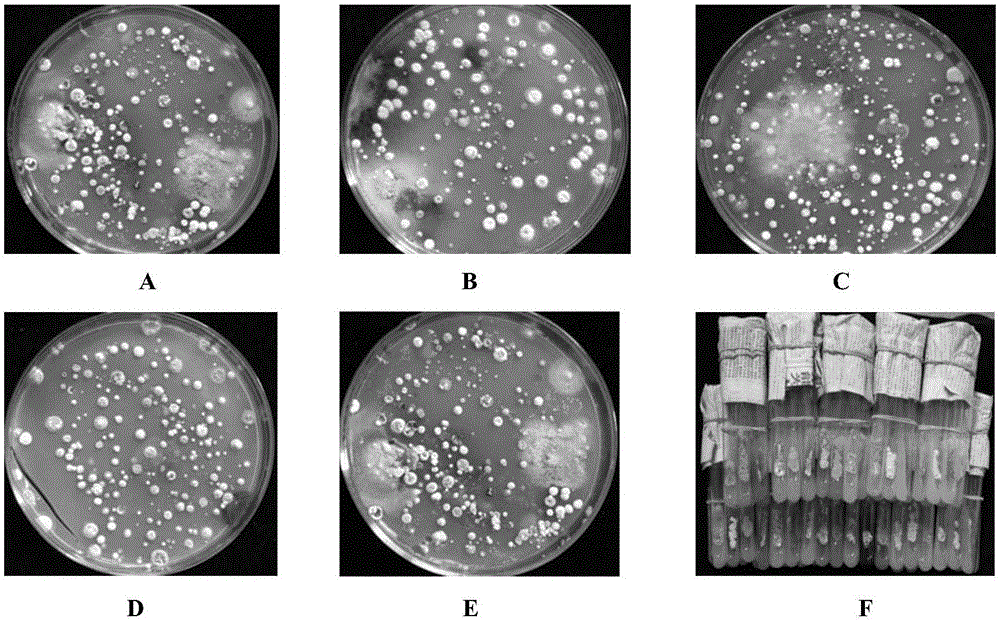
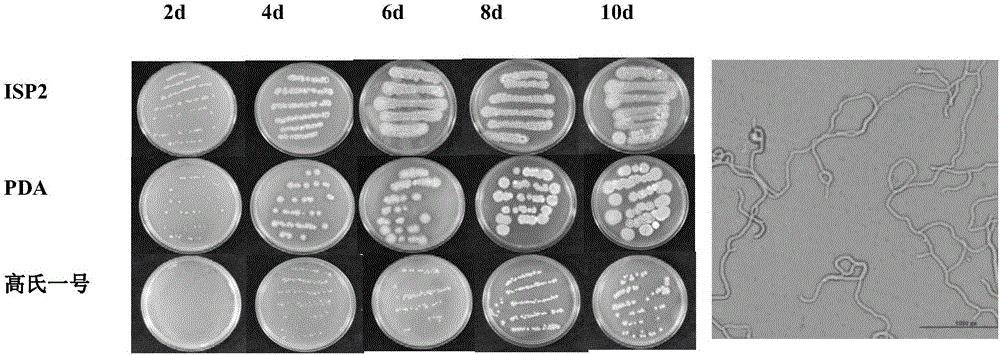
[0102] Example 1, Isolation and Identification of Blastomycin Streptomyces JZB130180
[0103] 1.1 Strain isolation
[0104] Soil samples collected from the high-altitude area of Leigong Mountain in Guizhou Province, China were subjected to dry heat treatment, dried at room temperature for 1-2 weeks, and after being ground and sieved, each soil sample was treated in a blast drying oven at 100°C for 1 hour before to separate. Accurately weigh 1g of the soil sample and put it into a 50ml sterile Erlenmeyer flask filled with 9ml sterile saline solution and small glass beads. -1 Concentration diluent, and then use a 1ml pipette to draw 10 -1 Transfer the concentration diluent into a 9ml sterile Erlenmeyer flask, shake well and serve as 10 -2 Concentration diluent, and so on, diluted to 10 -3 concentrated diluent. After the sample suspension is prepared, use a sterile pipette to draw 10 -2 Concentration and 10 -3 Each 0.1ml of the concentration dilution solution was put int...
Embodiment 2
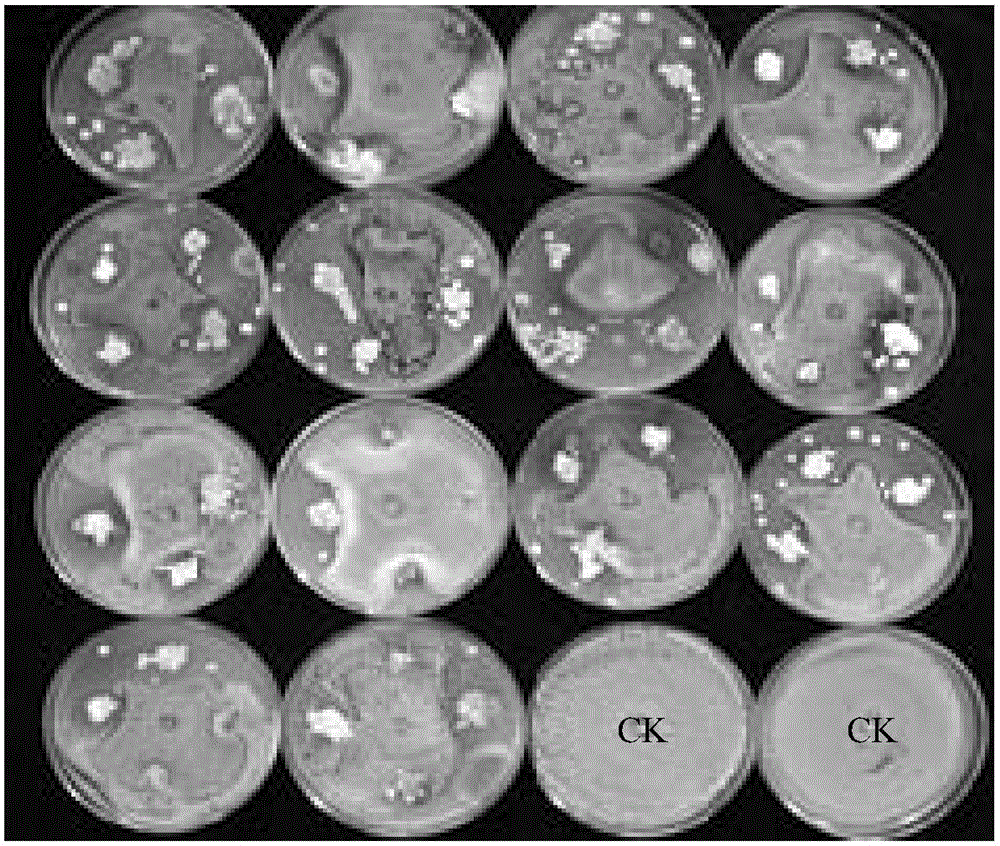
[0115] Embodiment 2, the bacteriostatic spectrum determination of rice blastomyces streptomyces (Streptomyces blastmyceticus) JZB130180
[0116] Test medium:
[0117] LB agar medium: tryptone 10.0g, yeast extract 5.0g, NaCl 10.0g, agar 15.0g, distilled water 1000mL, pH 7.0~7.2;
[0118] LB liquid medium: except that agar is not added, the others are made with LB agar medium.
[0119] KB medium: peptone 20.0g, glycerol 10.0mL, K 2 HPO 4 1.50g, MgSO 4 ·7H 2 O 1.50g, agar 15.0g, distilled water 1000mL, KOH to adjust the pH value to 7.2;
[0120] All the above-mentioned media were autoclaved at 121°C for 20 minutes.
[0121] experiment method:
[0122] (1) The antibacterial effect on plant pathogenic fungi was determined by the plate confrontation method. The specific operation steps are as follows: first culture the bacterial strain JZB130180 and various plant pathogenic fungi (Table 2) on the PDA medium for 4-5 days respectively, and use a sterile puncher with a diamete...
Embodiment 3
[0129] Example 3, Determination of Biocontrol-related Activity of Bacterial Strain JZB130180
[0130] 1. Test medium: CAS medium (detection of siderophilicity) consists of 4 solutions (sterilized separately before mixing). Solution 1 (CAS / HDTMA solution) includes CAS solution: 60.5mg CAS (chrome azure) dissolved in 50mL water; iron solution: contains 1mmol / L FeCl 3 ·6H 2 10mmol / L HCl solution of O, pH 2.0; HDTMA solution: 72.9mg cetyltrimethylammonium bromide dissolved in 40mL water; mix 50mL CAS solution with 10mL iron solution, add 40mL HDTMA solution and stir well , sterilize the obtained blue-black liquid, which is the CAS / HDTMA solution; solution 2 (Salts / Buffer solution): dissolve 30.24g Pipes in 750mL Salts solution (KH 2 PO 4 0.3g, NaCl0.5g, NH 4 Cl 1.0g), adjust the pH to 6.8 with 50% (W / V) KOH, add 15g of agar and dilute to 800mL with distilled water, cool to 50°C after autoclaving; solution 3 (750mL): glucose 2g, mannitol 2g, MgSO 4 ·7H 2 O 493mg, CaCl 2 11...
PUM
| Property | Measurement | Unit |
|---|---|---|
| diameter | aaaaa | aaaaa |
Abstract
Description
Claims
Application Information
 Login to View More