Accurate detection and separation method for multi-component LFM signal

A separation method and signal detection technology, applied in digital transmission systems, electrical components, modulated carrier systems, etc., can solve problems such as resolution limitations, difficult signal component detection and effective separation

CN106534014AInactive Publication Date: 2017-03-22AIR FORCE UNIV PLA
3 Cites 8 Cited by

Patent Information

Authority / Receiving Office
CN · China
Patent Type
Applications(China)
Current Assignee / Owner
Publication Date
2017-03-22
Estimated Expiration
Not applicable · inactive patent

Smart Images

  • Figure 1
    Figure 1
  • Figure 2
    Figure 2
  • Figure 3
    Figure 3
Patent Text Reader

Abstract

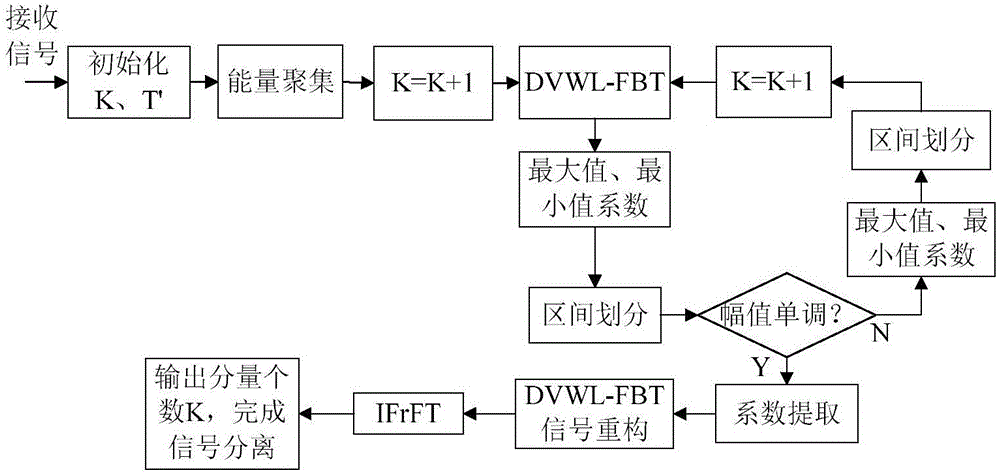
The invention provides an acurate detection and separation method for a multi-component LFM signal. The method comprises the steps of firstly, subjecting a received signal to FrFT, searching the energy peak and the corresponding fractional fourier domain of the signal, and conducting the coarse detection on the components of the signal; secondly, subjecting the signal to DVWL-FB series expansion, determining a DVWL-FB coefficient minimum value and a DVWL-FB coefficient maximum value to obtain a coefficient interval, and continuously updating the coefficient amplitude characteristics of the interval for signal detection and correction; thirdly, extracting the DVWL-FB coefficients of a finally divided interval for signal reconstruction, and subjecting a reconstructed signal to IFrFT to obtain an original single-component signal in the time-frequency domain. The above first step and the above second step are repeated until no significant energy concentration peak occurs. Based on the method, multi-component LFM signals, similar in frequency, can be accurately detected and effectively separated. The method has obvious advantages in the aspects of signal detection accuracy, signal separation accuracy, low signal-to-noise ratio, robustness and the like.
Need to check novelty before this filing date? Find Prior Art

Description

technical field

[0001] The invention relates to signal and information processing technology, in particular to a method for accurate detection and separation of multi-component LFM signals. Background technique

[0002] As large-scale and complex radar systems are put into use, the electromagnetic environment becomes increasingly complex, and a large number of radar pulses overlap to form a multi-component linear frequency modulated (LFM) signal. Effective detection and separation of multi-component LFM signals, as the key issues of effective identification and parameter extraction of radar signals, has received more and more attention in modern electronic countermeasures and reconnaissance systems. The detection and separation of multi-component LFM signals are mainly divided into parametric methods and non-parametric methods, and the non-parametric methods are mainly based on time-frequency distribution. Barbarossa (BARBAROSSA S.) etc. first used the Wigner-Hough transfor...

Examples

example

[0128] Example: simulation experiment of interferometric 3D imaging and micro-motion feature extraction of space cone targets

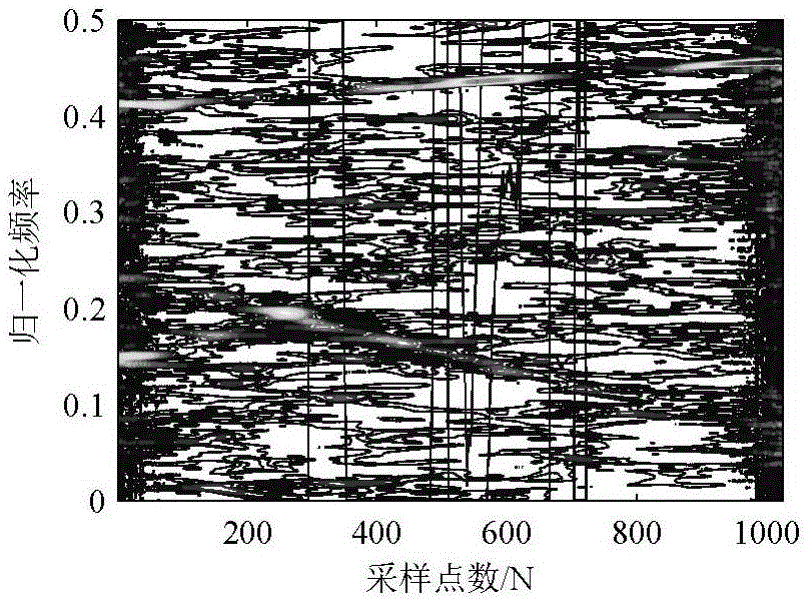
[0129] Simulation parameter setting: Under the condition of signal-to-noise ratio SNR=-8dB, signal observation time T=20μs, sampling frequency F s = 51.2MHz. Components 1 :f 1 =12MHz,μ 1 =-4.25×10 11 Hz / s, a1 = 1.5; component s 2 :f 2 =7MHz,μ 2 =6×10 11 Hz / s, a 2 = 1.5; component s 3 :f 3 =21MHz,μ 3 =1.25×10 11 Hz / s, a 3 = 1; component s 4 :f 4 =20.9MHz,μ 4 =1.25×10 11 Hz / s, a 4 =1. where s 1 with s 2 The time-frequency distribution of overlaps in the time-frequency domain, s 3 with s 4 For signals with similar frequencies, their modulation frequencies are the same, and the initial frequency differs only by 0.1MHz. Simulation is carried out for the parameters set above. Under theoretical conditions and SNR=-8dB, the multi-component LFM signal model with similar frequencies is as follows: image 3 shown.

[0130] image 3 (a)...