

Multifunctional superhydrophobic particles for chemical adhesion and blooming
A hydrophobic, multifunctional technology used in nanotechnology for materials and surface science, chemical instruments and methods, organic chemistry, etc. to solve problems such as inefficiencies
Active Publication Date: 2017-10-13
VELOX FLOW
View PDF4 Cites 4 Cited by
- Summary
- Abstract
- Description
- Claims
- Application Information
AI Technical Summary
Problems solved by technology
Also, the generation of these polymer surfaces is inefficient because the particles are embedded in the polymer rather than at the surface to provide superhydrophobic properties
Method used
the structure of the environmentally friendly knitted fabric provided by the present invention; figure 2 Flow chart of the yarn wrapping machine for environmentally friendly knitted fabrics and storage devices; image 3 Is the parameter map of the yarn covering machine
View moreImage
Smart Image Click on the blue labels to locate them in the text.
Smart ImageViewing Examples

Examples
Experimental program
Comparison scheme
Effect test
Embodiment
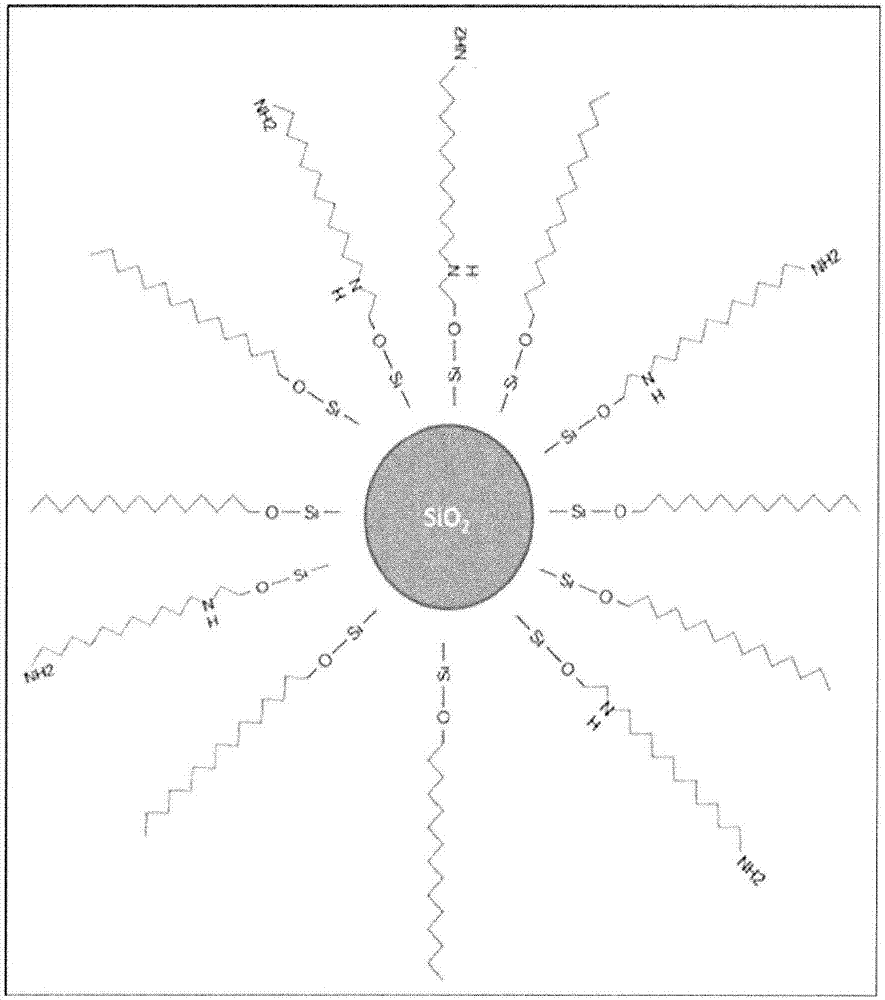
[0168] Preparation of compositions comprising monofunctional silica particles:
the structure of the environmentally friendly knitted fabric provided by the present invention; figure 2 Flow chart of the yarn wrapping machine for environmentally friendly knitted fabrics and storage devices; image 3 Is the parameter map of the yarn covering machine
Login to View More PUM
| Property | Measurement | Unit |
|---|---|---|
| Surface area | aaaaa | aaaaa |
| Surface area | aaaaa | aaaaa |
| Coverage | aaaaa | aaaaa |
Login to View More
Abstract
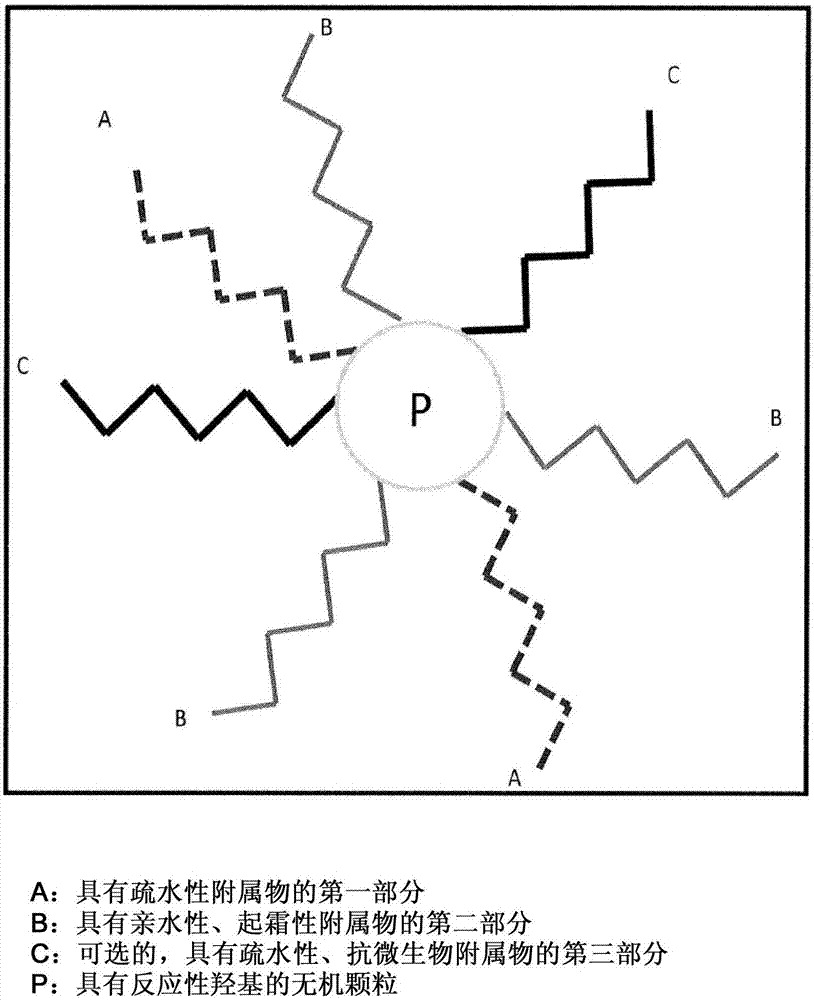
Provided herein is a multifunctional particle and methods of forming the same. The multifunctional particle includes a surface of the particle; a first moiety coupled to the surface and having at least one substantially hydrophobic appendage; and a second moiety coupled to the surface and having at least one appendage comprising a reactive functional group and a substantially hydrophilic repeating unit, whereby the particle is substantially superhydrophobic as a result of the substantially hydrophobic appendage, chemically reactive as a result of the reactive functional group, and migratory to a surface of a substantially hydrophobic matrix in which the particle may be included as a result of the substantially hydrophilic repeating unit. Additionally, antimicrobial functional groups may be coupled to the surface.
Description
Background technique [0001] Particles such as diatomaceous earth nanoparticles (DE) can be functionalized with the help of fluorocarbons or saturated hydrocarbons to become superhydrophobic, but due to the highly non-reactive self-assembled monolayer (SAM) of fluorocarbons or saturated hydrocarbons , these particles have been unable to chemically bond to anything. Current coating technologies typically add fluorinated diatomaceous earth (FDE) to the polymer solution. The particles are held by mechanical force and can be easily wiped off the surface, resulting in a surface that does not have durable superhydrophobic characteristics. Polymeric surfaces are usually highly porous and very rough. Also, the generation of these polymer surfaces is inefficient because the particles are embedded in the polymer rather than at the surface to provide superhydrophobic properties. Contents of the invention [0002] A simplified overview of one or more implementations is presented below...
Claims
the structure of the environmentally friendly knitted fabric provided by the present invention; figure 2 Flow chart of the yarn wrapping machine for environmentally friendly knitted fabrics and storage devices; image 3 Is the parameter map of the yarn covering machine
Login to View More Application Information
Patent Timeline
 Login to View More
 IPC IPC(8): C09C3/12C09C1/30C07F7/08
CPCC07F7/0834C09C1/3081B82Y30/00C01P2004/03C08G18/4833C08G59/1477C09D183/08
Inventor彼得·克雷格·维尼玛
OwnerVELOX FLOW