
Coriolis force experiment demonstration instrument
A demonstration instrument, Coriolis force technology, applied in the field of Coriolis force experimental demonstration instrument, can solve problems such as incomprehension, and achieve the effect of convenient teaching, simple and practical instrument, and easy to understand
- Summary
- Abstract
- Description
- Claims
- Application Information
AI Technical Summary
Problems solved by technology
Method used
Image

Examples
Embodiment 1
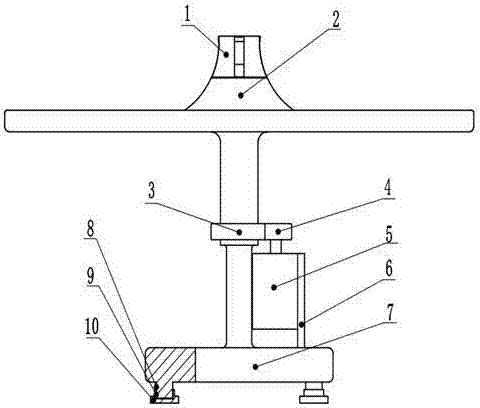
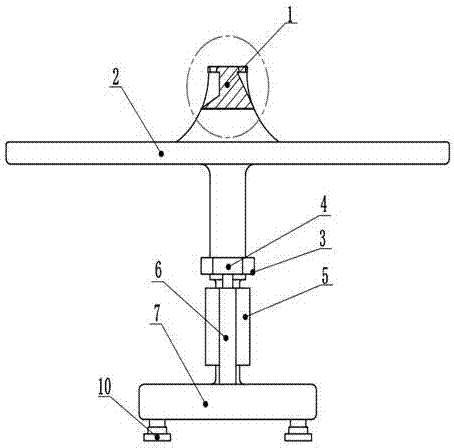
[0019] Embodiment 1: as figure 1 , 2 , 3, 4, 5, and 6, a Coriolis force experiment demonstration instrument includes a rotary turntable mechanism, a power transmission mechanism, and a base support mechanism. The rotary turntable mechanism includes a rotary central axis 1 and a turntable 2, and the power transmission mechanism includes a small Gear 3, large gear 4, speed regulating motor 5, fixed block 6, base support mechanism includes base 7, adjustable support angle 10;
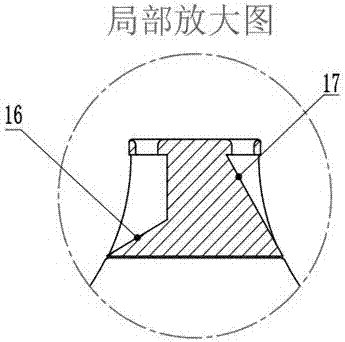
[0020] There are four particle inlets 11 on the top of the rotary central shaft 1, the rotary central shaft 1 passes through the center of the turntable 2 and its lower end is installed on the base 7, and the corresponding rotary central shafts 1 below the four particle inlets 11 are respectively opened. There are 15° inclined grooves 13, 30° inclined grooves 16, 45° inclined grooves 12, and 60° inclined grooves 17. The surfaces of each inclined groove and the transition surface of the turntable 2 are tan...
PUM
 Login to View More
 Abstract
Description
Claims
Application Information
 Login to View More