

Aeroengine after-repair performance prediction method based on stacked autoencoder deep learning network
A deep learning network, aero-engine technology, used in forecasting, data processing applications, geometric CAD, etc., can solve problems such as large performance forecast errors
- Summary
- Abstract
- Description
- Claims
- Application Information
AI Technical Summary
Problems solved by technology
Method used
Image



Examples
specific Embodiment approach 1
[0028] Embodiment 1: The method for predicting the post-repair performance of an aero-engine based on a stacked self-encoding deep learning network includes the following steps:
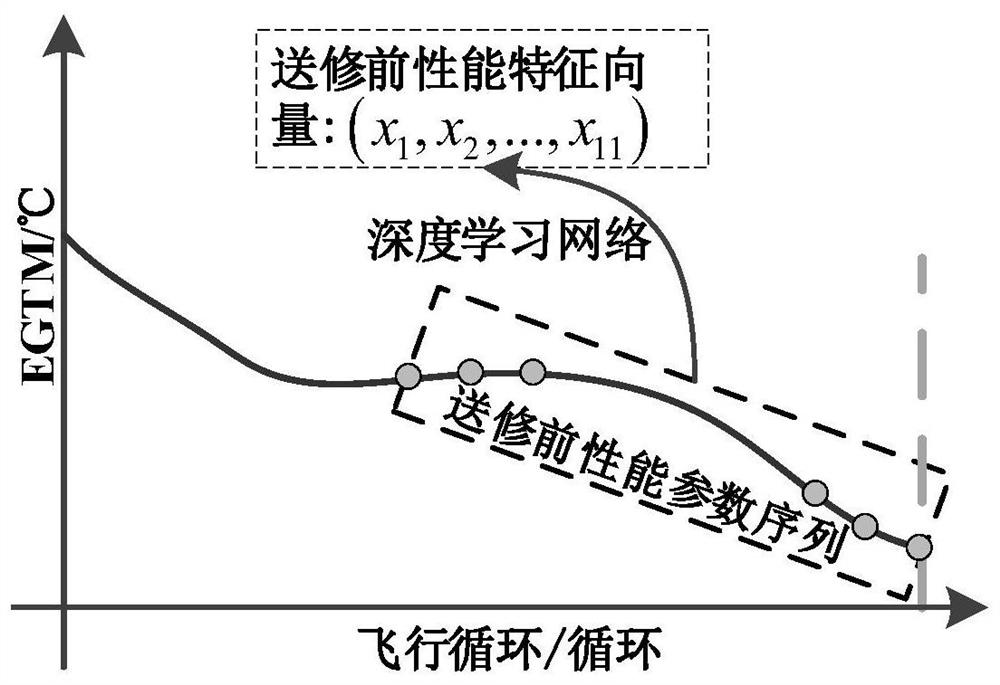
[0029] Step 1: Use the stacked self-encoding deep learning network to extract the features of the aero-engine performance parameter sequence before sending it for repair and the maintenance depth of the aero-engine unit, and obtain the s×c dimension eigenvector matrix P of the performance parameters before sending it for repair. s×c and the s × d dimension of the cell repair depth eigenvector matrix R s×d ;s is the number of engine maintenance cases, c is the eigenvector matrix P of performance parameters before sending for repair s×c The number of columns (s is the number of rows); d is the unit maintenance depth feature vector matrix R s×d the number of columns;
[0030] Step 2: Combine the feature vector of performance parameters before sending for repair and the feature vector of unit maintenan...
specific Embodiment approach 2
[0057] Embodiment 2: The difference between this embodiment and Embodiment 1 is that in the step 1, the sequence of performance parameters of the aero-engine before sending it for repair is specifically:
[0058] where the x s,m For the s-th engine maintenance case (one engine maintenance is a maintenance case), the exhaust temperature margin value of the m-th flight cycle before sending it for repair.
[0059] Other steps and parameters are the same as in the first embodiment.
specific Embodiment approach 3
[0060] Embodiment 3: The difference between this embodiment and Embodiment 1 or 2 is that: in the step 1, the original information matrix of the maintenance depth of the aero-engine unit body is specifically: where the y s,n It represents the quantity of maintenance depth information for the nth unit of the sth engine maintenance case.
[0061] Other steps and parameters are the same as in the first or second embodiment.
PUM
 Login to View More
 Abstract
Description
Claims
Application Information
 Login to View More