
Method for removing semi-volatile organic pollutants in soil through Fenton-like oxidation process
An organic pollutant and semi-volatile technology, applied in the field of environmental engineering, can solve the problems of polluted groundwater and the migration of pollutants to the ground, and achieve the effects of less secondary pollution, easy implementation and wide sources.
- Summary
- Abstract
- Description
- Claims
- Application Information
AI Technical Summary
Problems solved by technology
Method used
Image

Examples
Embodiment 1
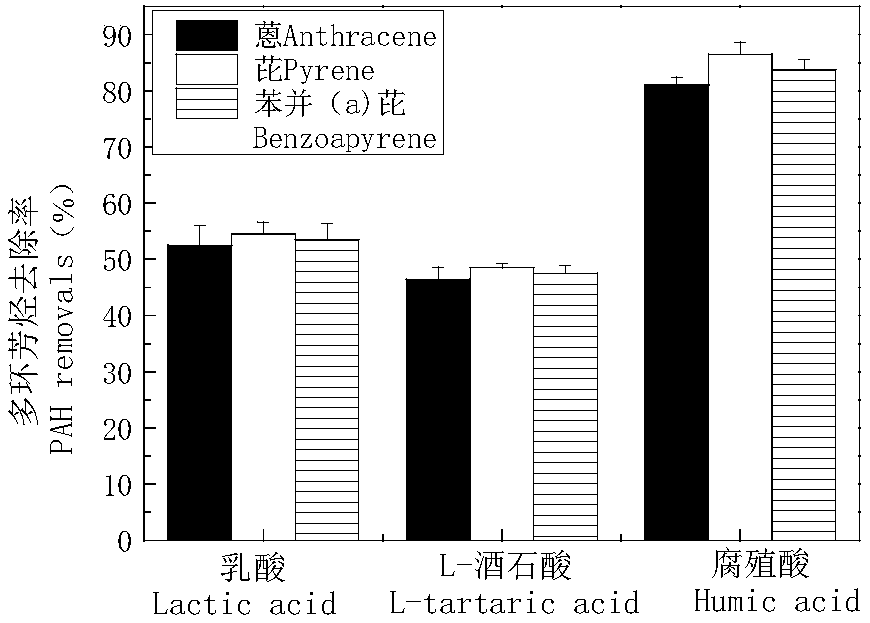
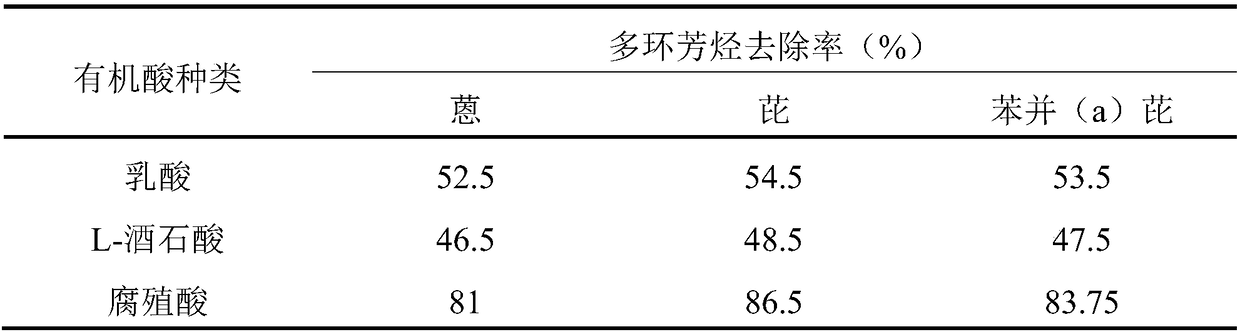
[0035] Removal Effects of Different Organic Acids on Polycyclic Aromatic Hydrocarbons in Fenton’s-like Reaction System
[0036] In PAH-contaminated soil with a moisture content of 30% (the concentrations of anthracene, pyrene, and benzopyrene in the soil are respectively 50mol / kg), a certain amount of organic acid and FeSO 4 , adding H dropwise under constant temperature magnetic stirring 2 o 2 . The amount of organic acid is 0.25mol / kg, FeSO 4 The dosage is 0.12mol / kg, Na 2 CO 4 The dosage is 1.0 mol / kg; the reaction time is 40 minutes, and the reaction temperature is 30°C. The removal effects of the Fenton’S-like reaction system with different organic acids on the removal of PAHs in soil are shown in Table 1.
[0037] Table 1 Removal effect of different organic acids on PAHs in Fenton’S reaction system
[0038]
Embodiment 2
[0040] Influence of Reaction Temperature on Effect of Fenton'S Reaction System in Treating Chemical Plant Contaminated Soil
[0041] Soil samples were collected from a polluted area of a chemical plant. The concentrations of benzo(a)anthracene, benzo(a)pyrene, dibenzo(a,h)anthracene, hexachlorobenzene and chlorobenzene in the soil samples were 15.94 mg / kg, 4.53mg / kg, 5.29mg / kg, 35.24mg / kg, 112.33mg / kg.
[0042] Mix polluted soil with water to make mud with a moisture content of 40%, add Fenton’s reaction system, the amount of humic acid is 0.3mol / kg, FeSO 4 The dosage is 0.3mol / kg, Na 2 CO 4 The dosage is 3.0mol / kg; the reaction is stirred and reacted at 15-60°C for 60min, and the removal rates of various pollutants at different temperatures are shown in Table 2.
[0043] Table 2 The effect of reaction temperature on the effect of Fenton'S-like reaction system on the treatment of chemical plant polluted soil
[0044]
[0045]
Embodiment 3
[0047] Influence of reaction time on the effect of Fenton's reaction system on the treatment of chemical plant polluted soil
[0048] Using the polluted soil sample described in Example 3, the soil is mixed with water to make a slurry with a water content of 40%, and the Fenton's reaction system is added. The amount of humic acid is 0.3mol / kg, FeSO 4 The dosage is 0.3mol / kg, Na 2 CO 4 The dosage is 3.0mol / kg; the reaction is stirred and reacted at 30°C for 30-150min, and the removal rates of various pollutants under different reaction times are shown in Table 3.
[0049] Table 3 The effect of reaction time on the effect of Fenton'S-like reaction system on the treatment of chemical plant polluted soil
[0050]
PUM
 Login to View More
 Abstract
Description
Claims
Application Information
 Login to View More