
A kind of preparation method of carbon-supported porous hollow platinum-iridium alloy nanoparticle catalyst
A technology of alloy nanoparticles and platinum-iridium alloys, applied in structural parts, electrical components, battery electrodes, etc., can solve problems such as the preparation method of porous hollow platinum-iridium alloy nanocatalysts, and achieve enhanced synergistic catalysis and lattice distortion effects , reduce costs, improve the effect of catalytic performance
- Summary
- Abstract
- Description
- Claims
- Application Information
AI Technical Summary
Problems solved by technology
Method used
Image

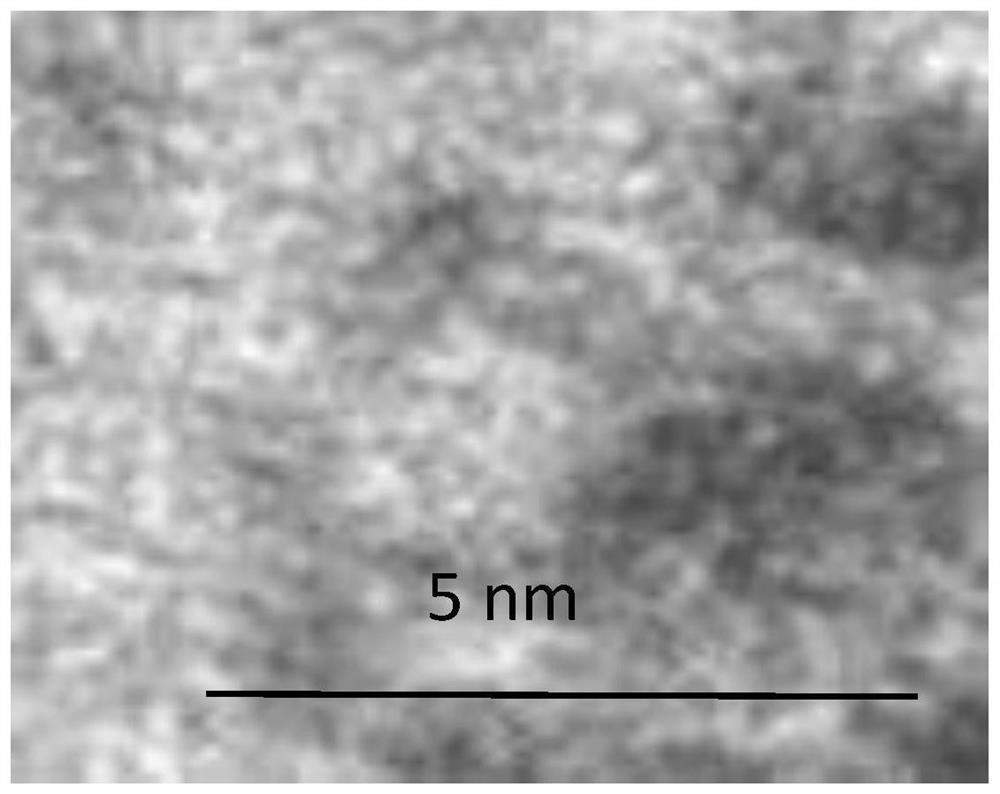
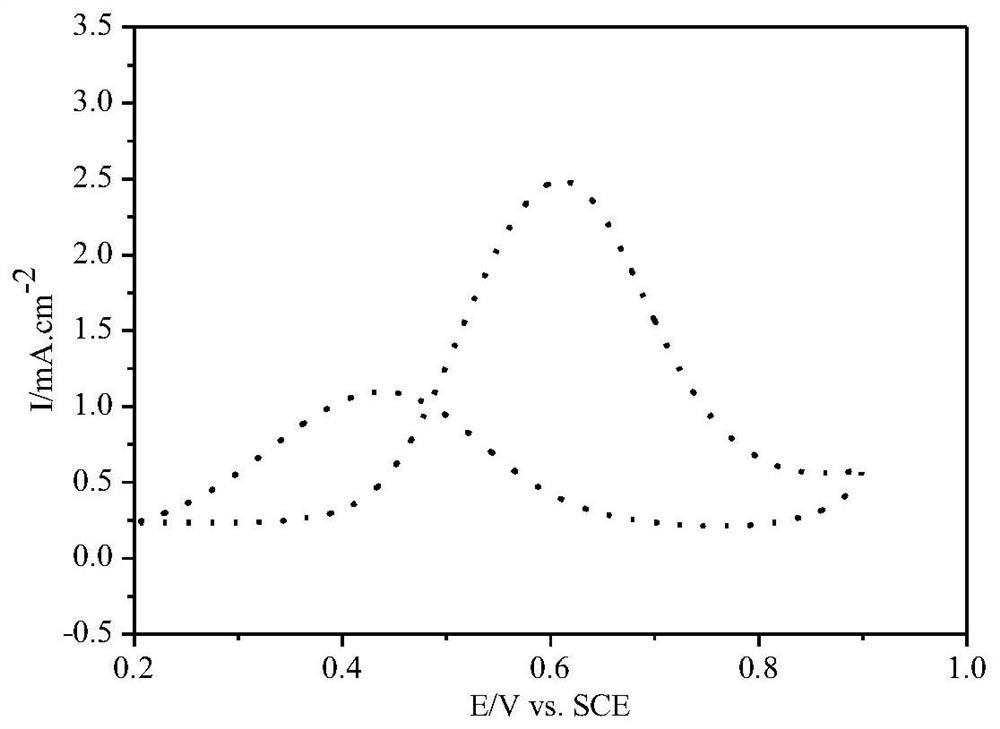
Examples
Embodiment 1
[0038](1) Preparation of Au @ ptir alloy nanoparticle colloid solution
[0039]a) 1 volume of 2.0 × 10⁻⁴Mol / L of Haucl4Aqueous solution, 10 volumes of 0.05 mol / L of polyethylene glycol (PEG-400), 20 volumes of 0.5 mol / L of aqueous acetone aqueous solution, poured into the quartz bottle to obtain a mixture;
[0040]Haucl4The aqueous solution is a precursor, and polyethylene glycol is a dispersant, acetone is a reducing agent;
[0041]b) Place the mixture in the quartz bottle in ultraviolet photoloration for 2 to 25 minutes; the ultraviolet wavelength is 300 nm;
[0042]Ultra-absorbing, threatened acetone produces a reducing hydroxyl radical, reducing Au3+To 0 valence, thereby forming nano-gold particles;
[0043]c) 0.25 volumes of 0.25 parts by volume of 2.0 × 10 in quartz flask-4Mol / L H2PTCL6 aqueous solution with 0.5 volume of 2.0 × 10⁻⁴Mol / L of H2IRCL6Aqueous solution mix;
[0044]d) Quartz bottle was added 0.1-20 bonnet 0.01 mol / L of 2,7-dihydroxyornedaphthalene solution, and the aqueo...
Embodiment 2
[0058]a) 1 volume of 2.0 × 10⁻⁴Mol / L of Haucl4Aqueous solution, 1 volume of 0.05 mol / L of polyethylene glycol (PEG-400), 1 volume of 0.5 mol / L of acetone aqueous solution, poured into the quartz bottle to obtain a mixture;
[0059]b) Place the mixture in the quartz bottle to irradiate under ultraviolet light; the ultraviolet wavelength is 300 nm;
[0060]c) 0.75 volumes of 0.0 × 10 in quartz bottle-4Mol / L of H2PTCL6 aqueous solution with 0.25 volume of 2.0 × 10⁻⁴Mol / L of H2IRCL6Aqueous solution mix;
[0061]d) 1 volume of 0.01 mol / L of 2,7-dihydroxylnaphthalene solution is added to the quartz bottle, and the aqueous sodium hydroxide is added to the albumin, transferred to the ultraviolet light on the ultraviolet light for 120 minutes to obtain Au @Ptir alloy nanoparticle colloid solution; the albumin means that the pH of the system is greater than 7; the wavelength of the ultraviolet light is 254 nm;
[0062](2) Modified multi-walled carbon nanotubes
[0063]The multi-wall carbon nanot...
PUM
| Property | Measurement | Unit |
|---|---|---|
| wavelength | aaaaa | aaaaa |
| wavelength | aaaaa | aaaaa |
| wavelength | aaaaa | aaaaa |
Abstract
Description
Claims
Application Information
 Login to View More