AI technical title is built by Patsnap AI team. It summarizes the technical point description of the patent document.
An engine coolant and organic technology, applied in the field of engine coolant, can solve the problems of cavitation corrosion, blackening of cast aluminum, etc., and achieve the effects of less environmental pollution, low foam and good anti-corrosion performance
Active Publication Date: 2020-12-11
SHANGHAI TIANLAN BIOTECH
View PDF11 Cites 0 Cited by
Summary
Abstract
Description
Claims
Application Information
AI Technical Summary
This helps you quickly interpret patents by identifying the three key elements:
Problems solved by technology
Method used
Benefits of technology
Problems solved by technology
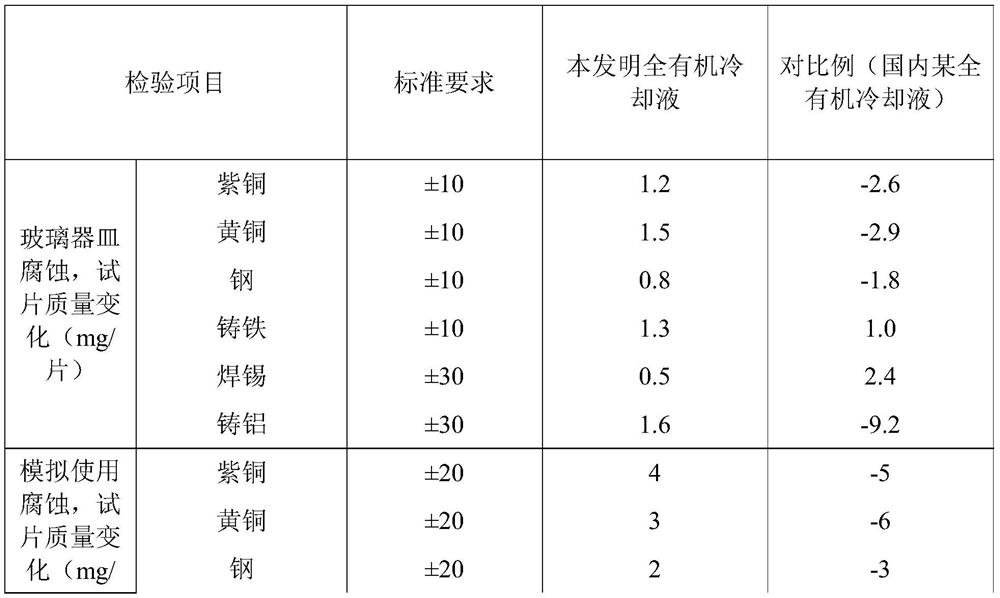
Solved the problems of cast aluminum blackening, cavitation corrosion and coolant reserve stability
Method used
the structure of the environmentally friendly knitted fabric provided by the present invention; figure 2 Flow chart of the yarn wrapping machine for environmentally friendly knitted fabrics and storage devices; image 3 Is the parameter map of the yarn covering machine
View more
Image
Smart Image Click on the blue labels to locate them in the text.
Viewing Examples
Smart Image
Click on the blue label to locate the original text in one second.
Reading with bidirectional positioning of images and text.
Smart Image
Examples
Experimental program
Comparison scheme
Effect test
Embodiment 1
[0038]The raw material components and their mass fractions are: ethylene glycol 86%, neodecanoic acid 1.2%, sebacic acid 1.5%, tolyltriazole 0.5%, triethylene glycol monobutyl ether phosphate 0.6%, Triethylene glycol monomethyl ether phosphate 0.2%, imidazole 0.8%, polyether defoamer 0.05%, potassium hydroxide to adjust the pH value to 8, the balance is deionized water, heat and stir until uniform and transparent, and then filter to obtain Coolant of the present invention.
Embodiment 2
[0040] The raw material components and their mass fractions are: ethylene glycol 78%, octanoic acid 1.8%, isononanoic acid 0.5%, suberic acid 0.5%, dodecanedioic acid 1.5%, benzotriazole 0.8%, diethyl 0.9% glycol monobutyl ether phosphate, 1.4% imidazole, 0.1% polyether defoamer, potassium hydroxide to adjust the pH value to 8, and the balance is deionized water, heat and stir until uniform and transparent, and then filter to obtain the present invention of coolant.
Embodiment 3
[0042] The raw material components and their mass fractions are: ethylene glycol 93%, nonanoic acid 0.5%, capric acid 1.3%, suberic acid 0.4%, benzotriazole 0.1%, tolyltriazole 0.2%, Triethylene glycol monobutyl ether phosphate 0.05%, diethylene glycol monomethyl ether phosphate 0.02%, imidazole 0.3%, polyether defoamer 0.2%, potassium hydroxide to adjust the pH value to 8, and the balance is deionized water, heated and stirred until uniform and transparent, and then filtered to obtain the cooling liquid of the present invention.
the structure of the environmentally friendly knitted fabric provided by the present invention; figure 2 Flow chart of the yarn wrapping machine for environmentally friendly knitted fabrics and storage devices; image 3 Is the parameter map of the yarn covering machine
Login to View More
PUM
Login to View More
Abstract
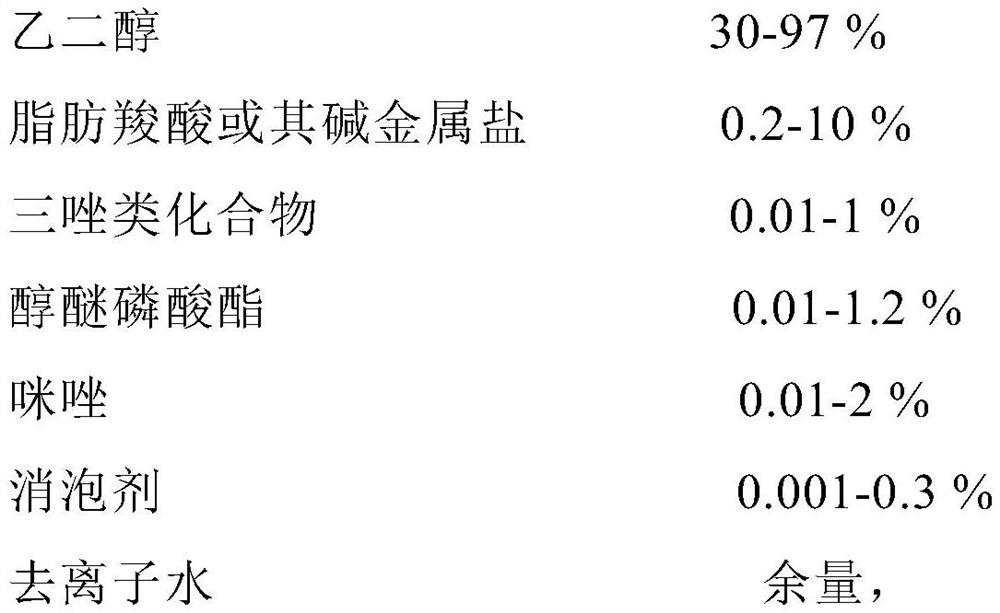
The present invention relates to full organic-type engine cooling liquid. The full organic-type engine cooling liquid comprises the following raw material components in weight percentages: 30-97% of ethylene glycol, 0.2-10% of fatty carboxylic acid or alkali metal salts thereof, 0.01-1% of a triazole compound, 0.01-1.2% of alcohol ether phosphate, 0.01-2% of imidazole, 0.001-0.3% of a defoamer andthe balance deionized water. Compared with the prior art, the provided cooling liquid has good multi-metal anticorrosive performance to engines, does not contain nitrite, borate, nitrate, silicate and amine compounds, has little environmental pollution, improves the reserve stability and anti-hard water ability of the cooling liquid, solves problems of blackening of cast aluminum, cavitation corrosion, etc., and can ensure long-term operation of an engine cooling system.
Description
technical field [0001] The invention relates to an engine coolant, in particular to an all-organic light-load engine coolant, which belongs to the technical field of chemical industry. Background technique [0002] With the development of the automobile industry, in order to reduce the weight of the body and increase fuel economy, aluminum alloys are gradually used in the cooling system of automobile engines and other engine components, and the quality requirements for engine coolant are also getting higher and higher. Therefore, one of the research focuses on engine coolant is to prevent pitting corrosion and surface crevice corrosion of aluminum-magnesium alloys. At the same time, out of consideration for environmental protection and human beings, some countries and automobile manufacturers have put forward higher requirements on the composition and performance of the coolant, and the engine coolant contains ammonium salts, borates, and nitrous acid. Environmentally harmf...
Claims
the structure of the environmentally friendly knitted fabric provided by the present invention; figure 2 Flow chart of the yarn wrapping machine for environmentally friendly knitted fabrics and storage devices; image 3 Is the parameter map of the yarn covering machine
Login to View More
Application Information
Patent Timeline
Application Date:The date an application was filed.
Publication Date:The date a patent or application was officially published.
First Publication Date:The earliest publication date of a patent with the same application number.
Issue Date:Publication date of the patent grant document.
PCT Entry Date:The Entry date of PCT National Phase.
Estimated Expiry Date:The statutory expiry date of a patent right according to the Patent Law, and it is the longest term of protection that the patent right can achieve without the termination of the patent right due to other reasons(Term extension factor has been taken into account ).
Invalid Date:Actual expiry date is based on effective date or publication date of legal transaction data of invalid patent.



 Login to View More
  Login to View More