
Application of methylmalonic acid in preparation of nematode pesticide
A technology of methylmalonic acid and pesticides, applied in the field of agricultural microbiology, can solve problems such as control difficulties
- Summary
- Abstract
- Description
- Claims
- Application Information
AI Technical Summary
Problems solved by technology
Method used
Image

Examples
Embodiment 1
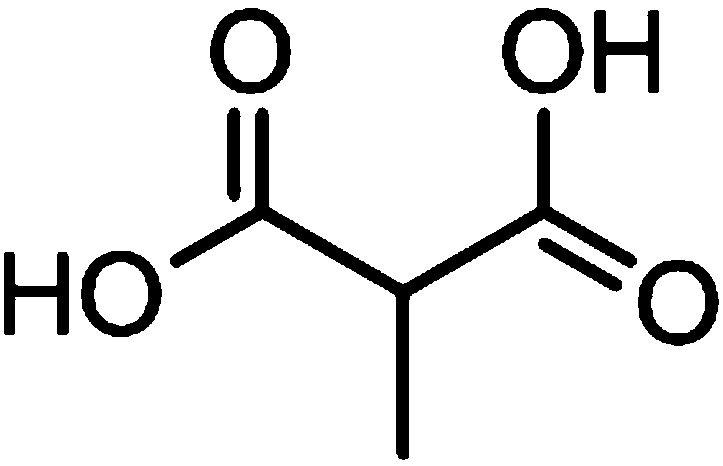
[0025] Structural verification of nematicidal methylmalonic acid
[0026] 1. Methylmalonic acid was purchased from Sigma.
[0027] 2. Nuclear Magnetic Resonance (NMR)
[0028] The structure of methylmalonic acid was detected by nuclear magnetic resonance: using deuterium water (D2O) as solvent, the hydrogen spectrum (H NMR) and carbon spectrum ( 13 C NMR), Table 1 is the NMR data.
[0029] Table 1 Two-dimensional NMR data of methylmalonic acid
[0030]
Embodiment 2
[0032] The application of methylmalonic acid in the preparation of root-knot nematode insecticide, the application process is as follows:
[0033] The root-knot nematodes infected with root-knot nematodes were picked from the roots of tomatoes, and egg masses were placed in a 96-well plate to incubate at 20°C to observe the hatching of root-knot nematodes. Rinse the nematodes with sterile water, add 20 μL of 1 mg / mL methylmalonic acid aqueous solution to the 96-well plate, and add pure water at the same time, adjust the final concentration of methylmalonic acid in the orifice plate to 1000, 100, 25, 16.67, 12.5, 10, 1 μg / mL, 40 nematodes were added to each well, the total bioassay system was 200 μL, pure water was used as a control, and each group was repeated 3 times. Cultured in a 16°C incubator, the LC of methylmalonic acid on Meloidogyne incognita 50 The value is shown in Table 1, which is 13.11 μg / mL.
[0034] Table 1 Insecticidal activity of methylmalonic acid against ...
Embodiment 3
[0039] The application of methylmalonic acid in the preparation of Caenorhabditis elegans insecticide, the application process is as follows:
[0040] Add 20 μL of 1 mg / mL methylmalonic acid aqueous solution to the 96-well plate, and add purified water at the same time, adjust the final concentration of methylmalonic acid in the orifice plate to 1000, 100, 25, 16.67, 12.5, 10, 1 μg / mL, 40 nematodes were added to each well, the total bioassay system was 200 μL, pure water was used as a control, and each group was repeated 3 times. The LC of Caenorhabditis elegans by methylmalonic acid was cultured in a 16°C incubator 50 The value is shown in Table 2, which is 1.20 μg / mL.
[0041] Table 2 Insecticidal activity of methylmalonic acid against Caenorhabditis elegans
[0042]
[0043]
[0044] Using the above method, the applicant tested the insecticidal effect of betaine, and the LC of betaine to Caenorhabditis elegans was tested. 50 It was 14.75 μg / ml.
PUM
 Login to View More
 Abstract
Description
Claims
Application Information
 Login to View More