AI technical title is built by PatSnap AI team. It summarizes the technical point description of the patent document.
A palletizing device and pallet technology, applied in the field of pallet-free offline palletizing device, can solve the problems of wasting human resources, unnecessary block rotation process, unstable brick stacking, etc., and achieve the effect of eliminating horizontal and vertical gaps
Active Publication Date: 2020-11-27
浙江诺丰环保科技有限公司
View PDF8 Cites 0 Cited by
Summary
Abstract
Description
Claims
Application Information
AI Technical Summary
This helps you quickly interpret patents by identifying the three key elements:
Problems solved by technology
Method used
Benefits of technology
Problems solved by technology
[0003] Most domestic manufacturers use pallets for bundled transportation when transporting brick stacks, and some manufacturers use pallet-free bundled transportation methods, but the middle lifting holes can only be manually placed to place vacant positions, and then stacked into a whole stack, and then bundled and packaged , which not only greatly affects production efficiency, but also wastes human resources. There are problems in the three palletizing methods widely used at present: low efficiency of manual palletizing, high personnel cost and unstable brick stacking due to manual errors; automatic palletizing Mechanical palletizing, most of them cannot be completely and automatically stacked into brick stacks with lifting holes, and a vacant position needs to be manually reserved at the lifting holes of the stacking, and there are devices that can be completely and automatically stacked into bricks with lifting holes The principle mechanism is different from that of the present invention; intelligent robot arm stacking, currently there is no device that can stack bricks with lifting holes
The stacking process involved in this invention patent is suitable for relatively large concrete blocks. Due to the single brick pushing mechanism, the brick layer cannot be pushed by default, and the bricks cannot be automatically stacked into brick stacks with lifting holes. The current fully automatic stacking machine has the function of stacking by rotating 90 degrees, and the block rotation process in this stacking process is no longer necessary
Method used
the structure of the environmentally friendly knitted fabric provided by the present invention; figure 2 Flow chart of the yarn wrapping machine for environmentally friendly knitted fabrics and storage devices; image 3 Is the parameter map of the yarn covering machine
View more
Image
Smart Image Click on the blue labels to locate them in the text.
Viewing Examples
Smart Image
Click on the blue label to locate the original text in one second.
Reading with bidirectional positioning of images and text.
Smart Image
Examples
Experimental program
Comparison scheme
Effect test
example 1
[0077] In order to stack a floor brick with a size of 200*100*60, each layer of bricks is designed to have 6 rows and 12 columns (to ensure that the overall outline of the single layer of bricks is a square), and the size of the bricks after removing the gap is 1200*1200. In order to make the direction of the hole-retaining layer, the bottom layer and the top floor brick consistent, a total of 16 layers are established, and through holes are reserved on the fourth and fifth layers.
[0078] The steps when code the first pile of bricks are as follows:
[0079] The first layer of bricks: the bricks will be sent to the gap removal module, the gap removal module will eliminate the gap between the bricks, send them to the hole retention module, send the bricks of the hole retention module to the palletizing module, and stack the bricks in the palletizing module pile.
[0080] The second layer of bricks: the bricks will be sent to the gap removal module, the gap removal module will...
example 2
[0100] In order to stack a standard brick with a size of 238*51*113, each layer of bricks is designed to have 5 rows and 12 columns, and the size of the bricks after removing the gap is 1190*1122. In order to make the direction of the hole-retaining layer, the bottom layer and the top layer of bricks consistent, nine layers are established, and through holes are left on the second layer.
[0101] The steps when code the first pile of bricks are as follows:
[0102] The first layer of bricks: the bricks will be sent to the gap removal module, the gap removal module will eliminate the gap between the bricks, send them to the hole retention module, send the bricks of the hole retention module to the palletizing module, and stack the bricks in the palletizing module pile.
[0103] The second layer of bricks: Send the future bricks to the gap removal module, which eliminates the gaps between the bricks, and sends them to the hole retention module, leaving the second and fourth row...
the structure of the environmentally friendly knitted fabric provided by the present invention; figure 2 Flow chart of the yarn wrapping machine for environmentally friendly knitted fabrics and storage devices; image 3 Is the parameter map of the yarn covering machine
Login to View More
PUM
Login to View More
Abstract
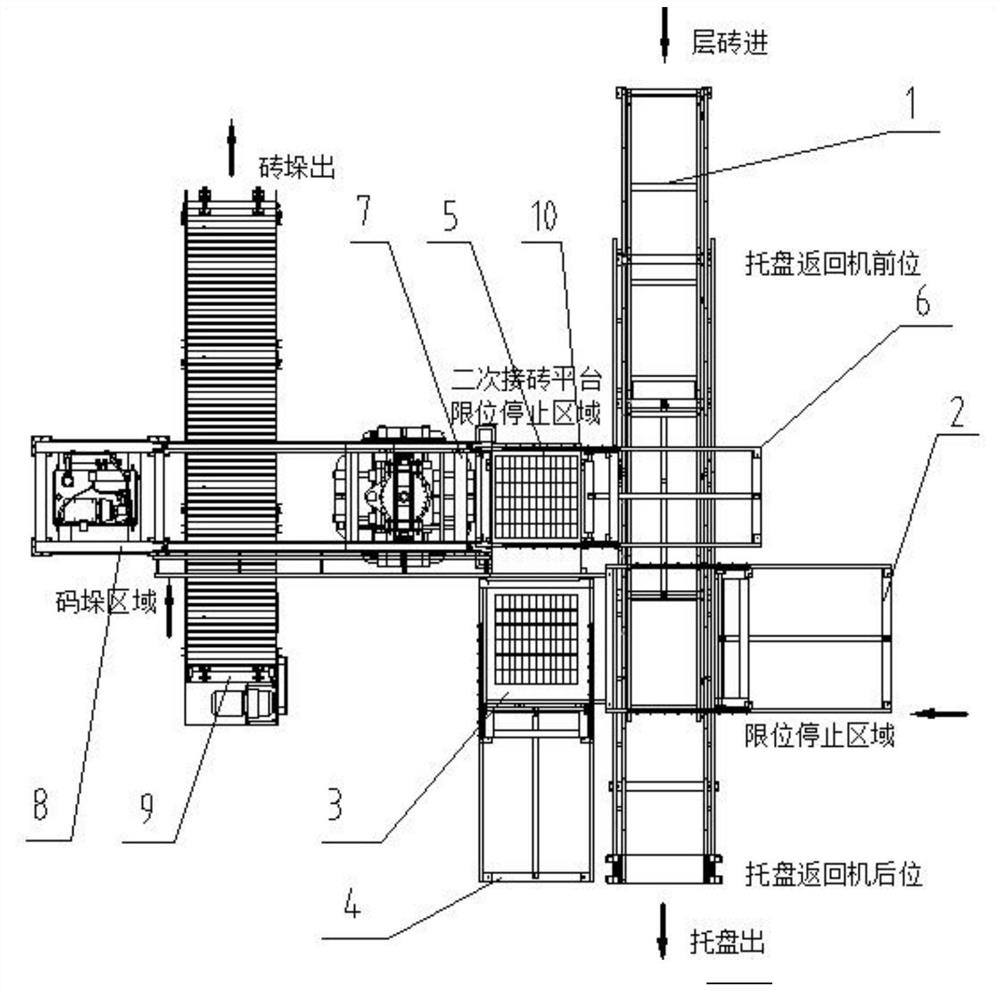
The invention discloses a pallet-free off-line stacking device. The pallet-free off-line stacking device comprises a pallet returning machine, a primary brick push mechanism, a primary brick receivingplatform, a secondary brick push mechanism, a secondary brick receiving platform, a third brick push mechanism, a third brick receiving platform, a fully-automatic green brick stacking machine and apiled brick conveyor. By means of the primary brick push mechanism, bricks on each single layer can be pushed from the pallet returning machine to the primary brick receiving platform. By means of thesecondary brick push mechanism, the bricks on each single layer can be pushed from the primary brick receiving platform to the secondary brick receiving platform. By means of the third brick push mechanism, the bricks on each single layer can be pushed from the secondary brick receiving platform to the third brick receiving platform. By means of the fully-automatic green brick stacking machine, the bricks on each single layer can be clamped and delivered from the third brick receiving platform to the piled brick conveyor. The third brick push mechanism comprises two movable push block platesand multiple third fixing push plates, wherein the movable push block plates are used for pushing the bricks, and the third fixing push plates are used for achieving hole reservation operation of thebricks on each single layer. The pallet-free off-line stacking device is good in operation stability, reliable in stacking process, high in locating precision and capable of automatically stacking thebricks into piled bricks with lifting holes.
Description
technical field [0001] The invention belongs to the field of building material palletizing equipment, and in particular relates to a pallet-free off-line palletizing device. Background technique [0002] At present, in the field of building materials production in our country, when transporting brick stacks, most of them bundle the brick stacks and the pallet at the bottom into a whole, and use a forklift to insert them into the through holes of the pallet to realize the transportation of the brick stacks. Brick stacks will occupy a large number of pallets. After the brick stacks are shipped out of the product factory, due to the limitations of loading and unloading on the construction site, construction and other factors, the recycling cycle of the pallets is long, and the pallets are easily damaged, resulting in a serious shortage of pallet resources. Waste, contrary to the concept of cost saving, low-carbon and environmental protection, and the existing pallet-less brick ...
Claims
the structure of the environmentally friendly knitted fabric provided by the present invention; figure 2 Flow chart of the yarn wrapping machine for environmentally friendly knitted fabrics and storage devices; image 3 Is the parameter map of the yarn covering machine
Login to View More
Application Information
Patent Timeline
Application Date:The date an application was filed.
Publication Date:The date a patent or application was officially published.
First Publication Date:The earliest publication date of a patent with the same application number.
Issue Date:Publication date of the patent grant document.
PCT Entry Date:The Entry date of PCT National Phase.
Estimated Expiry Date:The statutory expiry date of a patent right according to the Patent Law, and it is the longest term of protection that the patent right can achieve without the termination of the patent right due to other reasons(Term extension factor has been taken into account ).
Invalid Date:Actual expiry date is based on effective date or publication date of legal transaction data of invalid patent.



 Login to View More
  Login to View More