Check patentability & draft patents in minutes with Patsnap Eureka AI!

EEG emotion recognition method and system based on rapid screening of meta-learning examples

An emotion recognition and meta-learning technology, applied in the field of EEG emotion recognition, can solve the problem of difficult to realize the rapid adaptation of EEG emotion recognition system across subjects and time, achieve strong representation ability, avoid manual intervention, The effect of fast time adaptation

Active Publication Date: 2021-03-02
INST OF AUTOMATION CHINESE ACAD OF SCI
View PDF11 Cites 2 Cited by
  • Summary
  • Abstract
  • Description
  • Claims
  • Application Information

AI Technical Summary

Problems solved by technology

The problem with feature-based transfer learning is that such methods assume that there are a large number of unlabeled samples in the target domain, which cannot be established in the practical application of EEG emotion recognition: in the traditional experimental paradigm, the emotional labels of EEG samples in the target domain It is the label of external emotional stimuli, therefore, the EEG data is paired with the emotional label
[0005] In general, when the number of samples is insufficient, it is difficult for the existing technology to realize the rapid adaptation of the EEG emotion recognition system across subjects and across time.

Method used

the structure of the environmentally friendly knitted fabric provided by the present invention; figure 2 Flow chart of the yarn wrapping machine for environmentally friendly knitted fabrics and storage devices; image 3 Is the parameter map of the yarn covering machine
View more

Image

Smart Image Click on the blue labels to locate them in the text.
Viewing Examples
Smart Image
  • EEG emotion recognition method and system based on rapid screening of meta-learning examples
  • EEG emotion recognition method and system based on rapid screening of meta-learning examples
  • EEG emotion recognition method and system based on rapid screening of meta-learning examples

Examples

Experimental program
Comparison scheme
Effect test

Embodiment Construction

[0044] The application will be further described in detail below in conjunction with the accompanying drawings and embodiments. It should be understood that the specific embodiments described here are only used to explain related inventions, not to limit the invention. It should also be noted that, for the convenience of description, only the parts related to the related invention are shown in the drawings.

[0045] It should be noted that, in the case of no conflict, the embodiments in the present application and the features in the embodiments can be combined with each other. The present application will be described in detail below with reference to the accompanying drawings and embodiments.

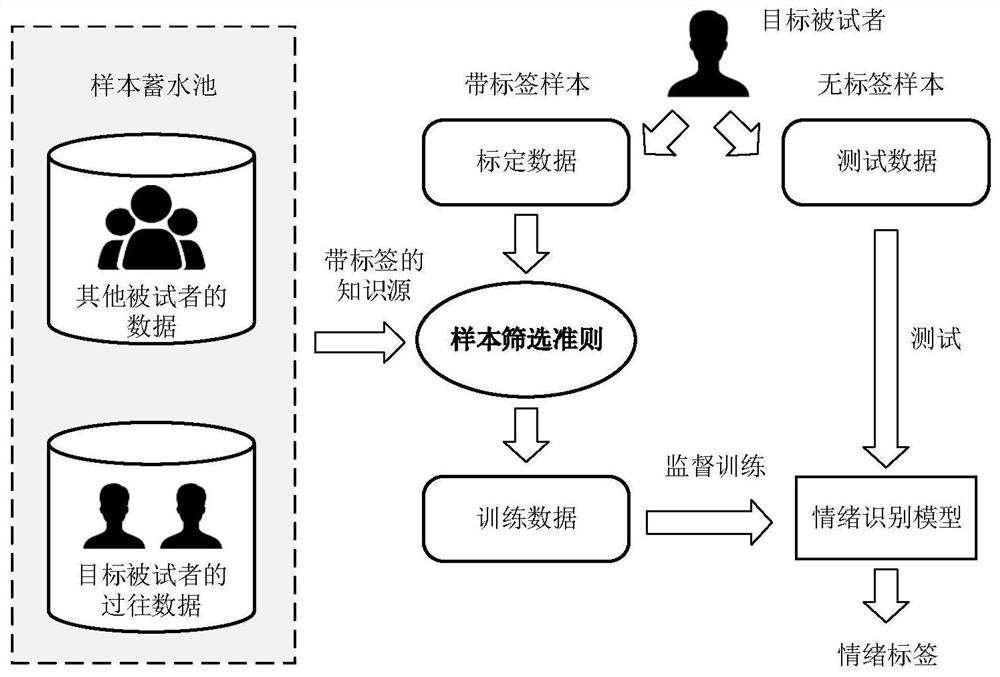
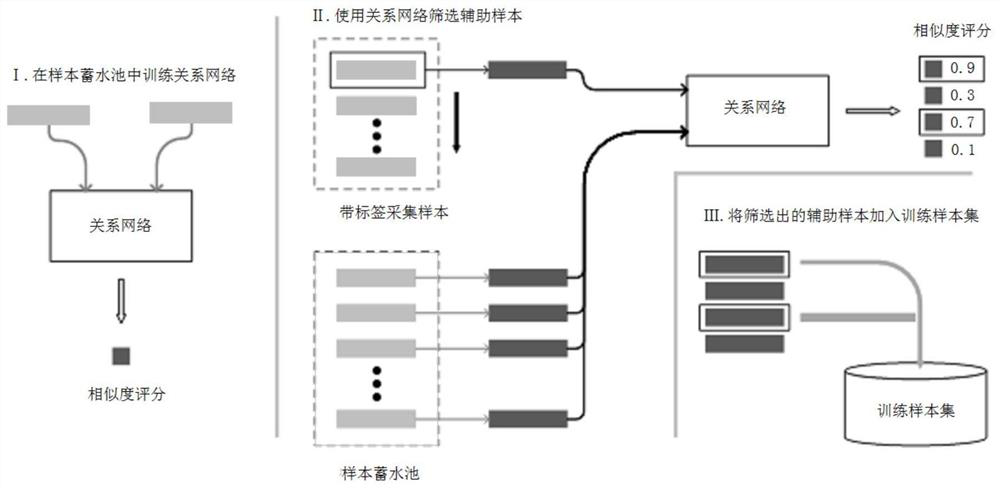
[0046] A kind of EEG emotion recognition method based on the rapid screening of meta-learning examples of the present invention comprises:

[0047] Step S10, acquiring the EEG data of each electrode within a set time as the EEG data to be identified;

[0048] Step S20, respectively...

the structure of the environmentally friendly knitted fabric provided by the present invention; figure 2 Flow chart of the yarn wrapping machine for environmentally friendly knitted fabrics and storage devices; image 3 Is the parameter map of the yarn covering machine
Login to View More

PUM

No PUM Login to View More

Abstract

The invention belongs to the field of brain-computer interface and machine learning, and specifically relates to an EEG emotion recognition method and system based on rapid screening of meta-learning examples, aiming to solve the problem that it is difficult to implement an EEG emotion recognition system when the number of samples is insufficient. The problem of rapid adaptation across subjects and across time. The method of the present invention includes: obtaining the EEG data of each electrode within a set time as the EEG data to be identified; calculating and splicing the feature vectors of each electrode data respectively to obtain the feature vectors to be identified; adopting a trained emotion recognition model, according to the Identify feature vectors, get corresponding sentiment labels and output. The present invention adopts the meta-learning method, which is one of the cutting-edge fields of machine learning, which not only benefits from the powerful representation ability brought by deep learning, but also benefits from the powerful relationship mining ability of meta-learning, and effectively improves the efficiency in the case of insufficient number of labeled samples. The generalization ability of the emotion recognition model under the model improves the speed and accuracy of emotion recognition.

Description

technical field [0001] The invention belongs to the field of brain-computer interface and machine learning, and in particular relates to a method and system for recognizing EEG emotions based on rapid screening of meta-learning examples. Background technique [0002] EEG emotion recognition system is an emerging emotion recognition method and an important part of brain-computer interface research. Compared with traditional emotion recognition methods based on facial expressions, language, actions and texts, EEG emotion recognition is more objective and reliable. In EEG emotion recognition, most methods such as pictures, audio, and video rich in emotional information are used to arouse the emotions of the subjects, and at the same time, multiple electrodes are used to collect electrical signals at multiple locations on the scalp. Response mode in state. Intercept EEG signals collected at multiple locations at a set time interval, and extract various time domain, frequency d...

Claims

the structure of the environmentally friendly knitted fabric provided by the present invention; figure 2 Flow chart of the yarn wrapping machine for environmentally friendly knitted fabrics and storage devices; image 3 Is the parameter map of the yarn covering machine
Login to View More

Application Information

Patent Timeline
no application Login to View More
IPC IPC(8): G06K9/62G06N3/04A61B5/369A61B5/16
CPCG06N3/04A61B5/16A61B5/369G06F18/2155G06F18/214
Inventor 何晖光李劲鹏邱爽
Owner INST OF AUTOMATION CHINESE ACAD OF SCI
Features
  • R&D
  • Intellectual Property
  • Life Sciences
  • Materials
  • Tech Scout
Why Patsnap Eureka
  • Unparalleled Data Quality
  • Higher Quality Content
  • 60% Fewer Hallucinations
Social media
Patsnap Eureka Blog
Learn More