
Operation control method, operation control device, air conditioner and storage medium
A technology of operation control and air conditioner, which is applied in the direction of space heating and ventilation, heating and ventilation control system, heating mode, etc. It can solve the problems of small storage of refrigerant and slow drop of outlet air temperature, etc., to improve the cooling speed, The effect of increasing the amount of refrigerant
- Summary
- Abstract
- Description
- Claims
- Application Information
AI Technical Summary
Problems solved by technology
Method used
Image


Examples
Embodiment 1
[0048] In the above embodiment, it is detected that the air conditioner is in the standby state, and the control and adjustment of the reversing assembly 40 to the first conduction state also includes: if it is detected that the reversing assembly 40 is in the first conduction state for a period greater than or equal to the duration Threshold value, control and adjust the reversing assembly 40 to the second conduction state, so as to close the flow path from the indoor heat exchanger 10 to the reversing assembly 40 .
[0049] In this embodiment, within the set duration threshold, the refrigerant from the side of the indoor heat exchanger 10 has flowed to the discharge end of the compressor 30, and it is enough to make the connection between the side of the outdoor heat exchanger 20 and the side of the indoor heat exchanger 10 The amount of refrigerant quickly reaches a balance. At this time, control and adjust the reversing assembly 40 to the second conduction state to close th...
Embodiment 2
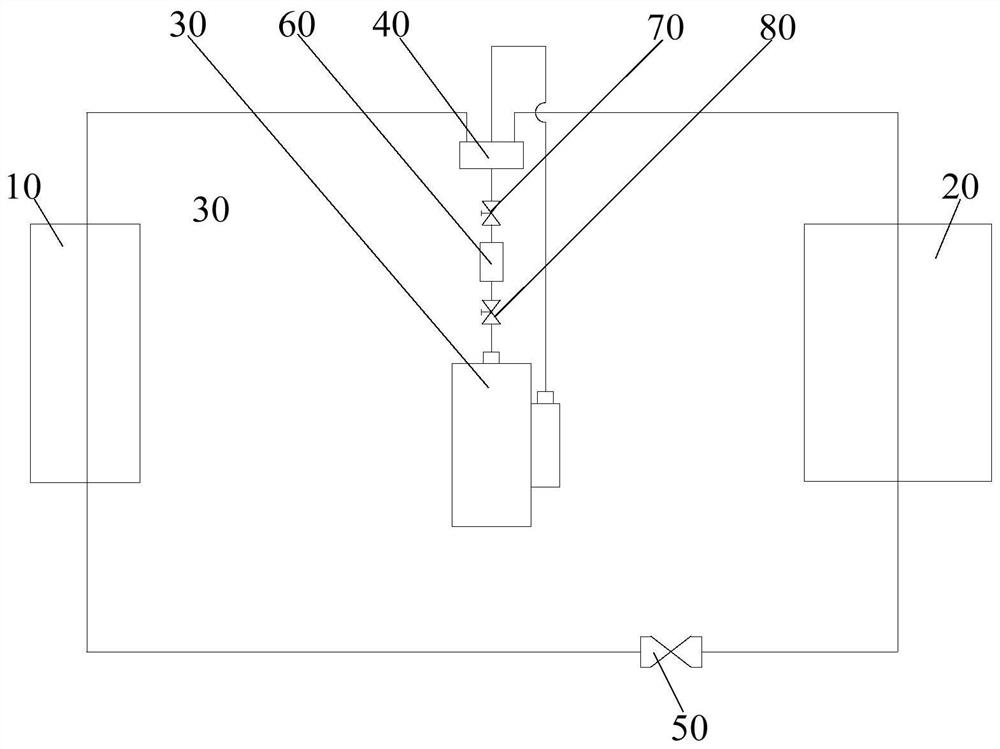
[0051] Such as image 3 As shown, the difference from Embodiment 1 is that: on the basis of Embodiment 1, further, an auxiliary liquid storage tank 60 is connected in series on the flow path between the exhaust end of the compressor 30 and the reversing assembly 40 to assist The liquid storage tank 60 is used to store the refrigerant flowing to the exhaust end.
[0052] In this embodiment, by setting the auxiliary liquid storage tank 60 in series on the flow path between the discharge end of the compressor 30 and the reversing assembly 40, the auxiliary liquid storage tank 60 plays the role of storing refrigerant, improving the performance of the compressor 30. The amount of refrigerant stored at the exhaust end of the exhaust end ensures that when the reversing assembly 40 is controlled and adjusted to the second conduction state, enough refrigerant enters the outdoor heat exchanger 20 to increase the cooling speed of the air conditioner.
Embodiment 3
[0054] Such as image 3 As shown, the difference from Embodiment 2 is that: on the basis of Embodiment 2, further, a first control valve 70 is provided between the auxiliary liquid storage tank 60 and the reversing assembly 40 to respond to the operation command of the cooling mode , control and adjust the reversing assembly 40 to the first conduction state. In the first conduction state, the refrigerant placed in the indoor heat exchanger 10 can flow to the compressor 30 through the reversing assembly 40, specifically including: controlling the opening The first control valve 70 is used to guide the refrigerant in the indoor heat exchanger 10 into the auxiliary liquid storage tank 60 through the reversing assembly 40 in the first conduction state.
[0055] In this embodiment, by setting the first control valve 70 between the auxiliary liquid storage tank 60 and the reversing assembly 40, the first control valve 70 is used to control the disconnection of the flow path between ...
PUM
 Login to View More
 Abstract
Description
Claims
Application Information
 Login to View More