
A kind of Pseudomonas balearicum and its application in treating landfill leachate membrane concentrate
A landfill leachate and Pseudomonas technology, applied to Pseudomonas balearicus, the application of the above-mentioned Pseudomonas balearicus in the treatment of landfill leachate membrane concentrate can solve the problem that microorganisms are difficult to treat and reach the standard , high salinity, high toxicity and other issues, to achieve enhanced sludge denitrification effect, high-efficiency biological denitrification, and stable effluent quality
- Summary
- Abstract
- Description
- Claims
- Application Information
AI Technical Summary
Problems solved by technology
Method used
Image

Examples
Embodiment 1
[0029] Example 1: Isolation and Identification of Bacterial Strains
[0030] The strain EBT-1 is an aerobic denitrifying bacterium with denitrifying activity screened from the activated sludge of the landfill leachate sewage treatment system of the waste incineration plant.
[0031] The separation and screening method is: take out the activated sludge from the landfill leachate (high salt) sewage treatment biochemical system; inoculate 5g of the activated sludge into the DM inorganic salt medium (the salinity in the medium is 100mg / L) of the nitrate nitrogen concentration >3%), cultured on a shaker at a temperature of 35°C and a rotating speed of 150rpm for 1 day to obtain the first bacterial solution; the first bacterial solution was inoculated to a nitrate nitrogen concentration of 200 mg at an inoculum size of 5% (volume fraction) In the DM inorganic salt culture medium (salinity>3% in the culture medium) of 1 / L, at temperature 35 ℃, the shaker that rotating speed is 150rpm...
Embodiment 2
[0037] Embodiment 2: the expanded cultivation of Pseudomonas balearica (Pseudomonas balearica) EBT-1 of the present invention:
[0038] The medium used in the expanded culture includes the following components: 10 g of corn steep liquor (dry powder), 5 g of yeast extract, 10 g of sodium chloride, 2.5 g of anhydrous sodium acetate, 1 g of dipotassium hydrogen phosphate and 0.03 g of magnesium sulfate per liter of water , the initial pH of the medium was 6.5.
[0039] The production process of the culture medium is as follows: dissolve 10 g of corn steep liquor (dry powder), 5 g of yeast extract, 10 g of sodium chloride, 2.5 g of anhydrous sodium acetate, 1 g of dipotassium hydrogen phosphate, and 0.03 g of magnesium sulfate in 1000 g of water, and adjust it with alkali. The pH was 6.5, and it was sterilized at 121° C. for 20 minutes to obtain a culture medium.
[0040] Pseudomonas balearica (Pseudomonas balearica) EBT-1 bacteria mother solution is inoculated in the culture med...
Embodiment 3
[0042] Embodiment 3: the investigation of salinity adaptability of Pseudomonas balearica (Pseudomonas balearica) EBT-1 of the present invention
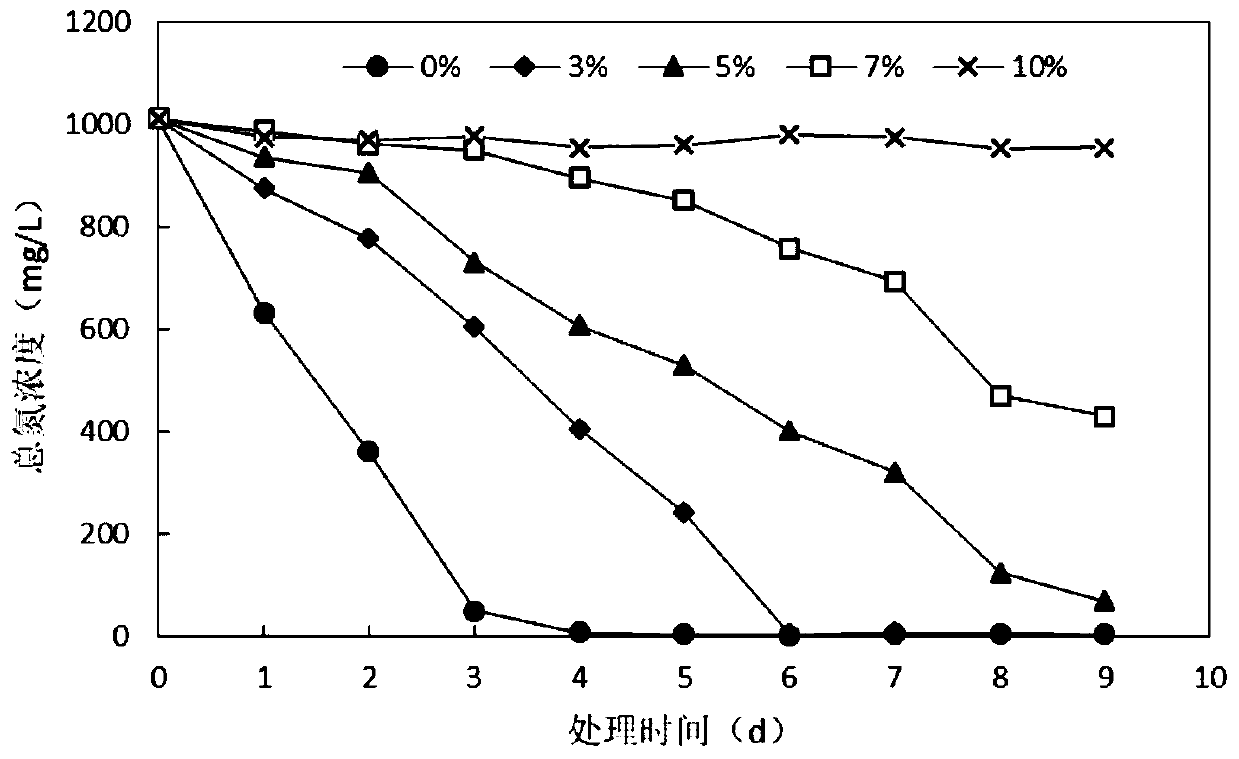
[0043] The Pseudomonas balearica (Pseudomonas balearica) EBT-1 expansion culture solution obtained in Example 2 was centrifuged at 6000 rpm for 5 minutes, and the supernatant was removed to obtain activated cell solids. Set four salinity gradients of 0%, 3%, 7%, and 10%. Per liter of salinity determination distribution water contains the following components in mass fraction: glucose 6.1g, KNO 3 6.07g, KH 2 PO 4 1.5g, K 2 HPO 4 ·3H 2 O 6.0g, MgSO 4 ·7H 2 O 1.0g, NaCl adjusted according to desired salinity. The centrifuged bacterial solid was inoculated into the water for salinity measurement according to the inoculum size of 0.4%, and was shaken at 150 rpm at 30 °C in a 250 mL blue cap bottle.
[0044] Detect the change of total nitrogen during the reaction process under different salinity conditions, the results are shown...
PUM
| Property | Measurement | Unit |
|---|---|---|
| chemical oxygen demand (mass) | aaaaa | aaaaa |
| diameter | aaaaa | aaaaa |
Abstract
Description
Claims
Application Information
 Login to View More