

Method for extracting rubidium, cesium and lithium from sodium chloride slag
A sodium chloride, rubidium and cesium technology, applied in the field of element separation, can solve the problems of low production efficiency of rubidium and cesium extraction
- Summary
- Abstract
- Description
- Claims
- Application Information
AI Technical Summary
Problems solved by technology
Method used
Image

Examples
Embodiment 1
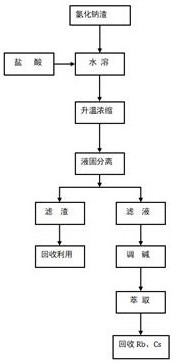
[0030] A method for reclaiming rubidium cesium lithium from sodium chloride slag, comprising the following steps:
[0031] (1) Dissolve the rubidium, cesium and sodium chloride wet material in water at a ratio of 1:4, add hydrochloric acid to adjust the pH of the solution to 2-3, then concentrate the solution by heating, and then filter the solution to obtain the filtrate.
[0032] (2) Add sodium hydroxide to the filtrate in step (1), prepare a rubidium-cesium solution with an alkalinity of 1.0 mol / L, and keep stirring with a mixer for 20-40 minutes to prepare the pre-extraction solution.
[0033] (3) Add the solution treated in step (2) into the prepared extractant composed of t-BAMBP, diethylbenzene and sulfonated kerosene, and stir thoroughly until the rubidium and cesium in the solution are not detected, then it reaches rubidium For the purpose of cesium recovery, the chemical reaction that occurs is: M+ +nROH +OH- = ROM·(n-1)ROH + H2O.
[0034] (4) Wash the rubidium and ...
Embodiment 2
[0037] (1) Dissolve the sodium chloride slag in water at a ratio of 1:5, add hydrochloric acid to adjust the pH of the solution to 2-3, then concentrate the solution by heating, press filter the solution, and take the filtrate.
[0038] (2) Add sodium hydroxide to the filtrate in step (1), prepare a rubidium-cesium solution with an alkalinity of 1.0 mol / L, and keep stirring with a mixer for 20-40 minutes to prepare the pre-extraction solution.
[0039] (3) Add the solution treated in step (2) into the prepared extractant composed of t-BAMBP, diethylbenzene and sulfonated kerosene, and stir thoroughly until the rubidium and cesium in the solution are not detected, then it reaches rubidium For the purpose of cesium recovery, the chemical reaction that occurs is: M+ +nROH +OH- = ROM·(n-1)ROH + H2O.
[0040] (4) Wash the rubidium and cesium in the extractant in step (3) with water, back-extract with 1.0mol / L dilute hydrochloric acid to obtain a high-concentration rubidium chloride...
Embodiment 3
[0043] (1) Dissolve the sodium chloride slag in water at a ratio of 1:6, add hydrochloric acid to adjust the pH of the solution to 2-3, then concentrate the solution by heating, press filter the solution, and take the filtrate.
[0044] (2) Add sodium hydroxide to the filtrate in step (1), prepare a rubidium-cesium solution with an alkalinity of 1.0 mol / L, and keep stirring with a mixer for 20-40 minutes to prepare the pre-extraction solution.
[0045] (3) Add the solution treated in step (2) into the prepared extractant composed of t-BAMBP, diethylbenzene and sulfonated kerosene, and stir thoroughly until the rubidium and cesium in the solution are not detected, then it reaches rubidium For the purpose of cesium recovery, the chemical reaction that occurs is: M+ +nROH +OH -= ROM·(n-1)ROH + H2O.
[0046] (4) Wash the rubidium and cesium in the extractant in step (3) with water, back-extract with 1.0mol / L dilute hydrochloric acid to obtain a high-concentration rubidium chloride...
PUM
 Login to View More
 Abstract
Description
Claims
Application Information
 Login to View More