
A detection kit for Yersinia pestis based on real-time fluorescent RPA technology and its application
A Yersinia pestis and reagent technology, applied in the biological field, can solve the problems of limited field and on-site detection, long measurement time, etc., and achieve high sensitivity, good specificity, and broad prospects
- Summary
- Abstract
- Description
- Claims
- Application Information
AI Technical Summary
Problems solved by technology
Method used
Image

Examples
Embodiment 1
[0034] 1 Preparation of bacterial genome template
[0035]1.1 Use 1 mL of heat-inactivated Yersinia pestis (Yersiniapestis) bacterial liquid to extract the whole genome DNA of the bacterial liquid using the Bacterial Genomic DNA Extraction Kit (Tiangen Biochemical Technology Co., Ltd., Cat. No. DP320), elute with 100 μL TE buffer, and use Qubit 3.0 fluorescence method was used to quantify genomic nucleic acid to obtain the genome template of Yersinia pestis (Yersiniapestis).
[0036] 1.2 Replace Yersinia pestis (Yersiniapestis) in step 1.1 with Bacillus anthraci (Bacillus anthraci), Burkholderia pseudomallei (Burkholderia apseumallei), Burkholderia mallei (Burkholderia mallei), cattle Brucella bovis, Bacillus cereus, Bacillus thuringiensis, Francisella tularensis, Salmonella typhimurium, Bacillus subtilis, sheep cloth Brucella melitensis, Escherichia coli, Vibrio vulnificus, Staphylococcus aureus, Vibrioparahaemolyticus, and Staphylococcus epidermidis, other manipulations Wi...
Embodiment 2
[0051] Embodiment 2 sensitivity analysis
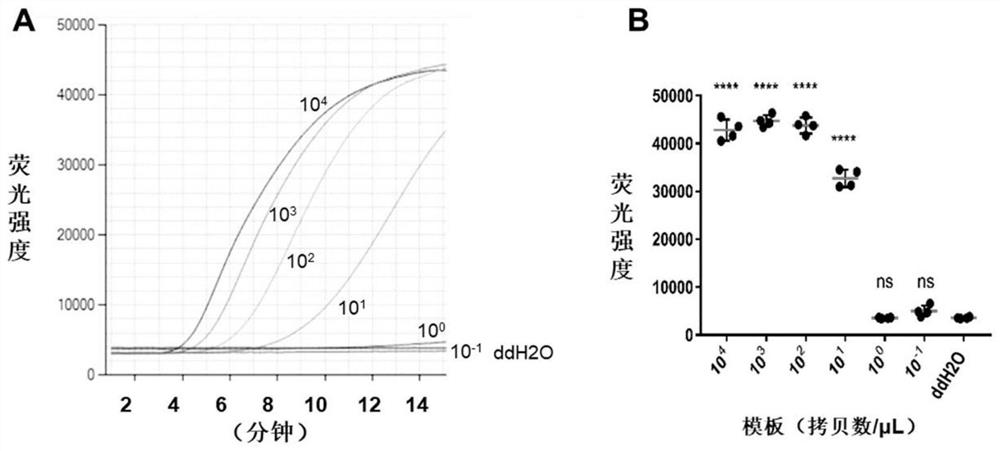
[0052] In order to verify the sensitivity of the real-time fluorescent RPA reaction, the plasmid containing the target fragment (i.e. the positive plasmid prepared in step 3 of Example 1) was diluted by 10 times, so that its concentration was respectively at 10 4 ~10 -1 Between copies / μL, use the diluted plasmid as a template to perform a real-time fluorescent RPA reaction with the screened Yersinia pestis RPA primer (YPS723-F1 / R1) and probe (YPS723-1-P1), and use nucleic acid-free water as a negative Contrast, described in reaction system embodiment 1, reaction result is as follows figure 1 as shown, figure 1 Among them, A is the sensitivity fluorescence diagram, each amplification curve from top to bottom uses a positive plasmid template concentration of 10 4 -10 -1 Copy number / μL; B is the scatter diagram of independent repeatability detection, n=4 independent repeated experiments, t test, ns, not significant; *, p<0.05; **, P<...
Embodiment 3
[0054] Embodiment 3 specificity analysis
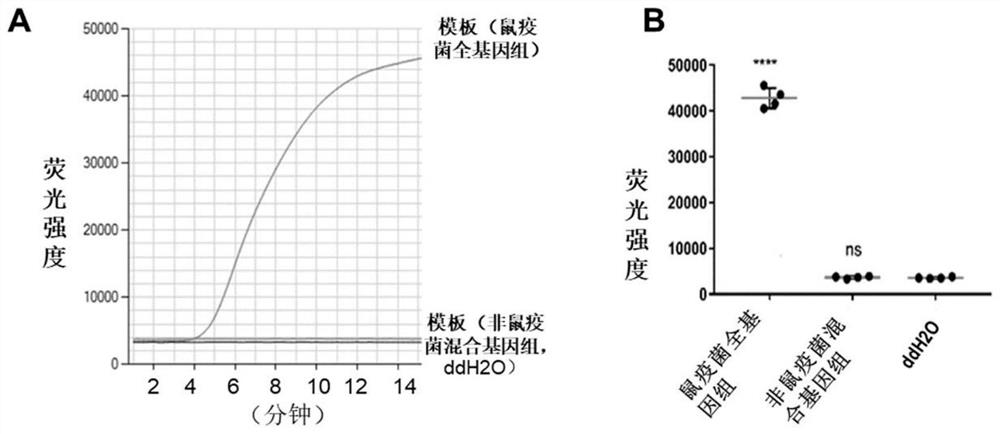
[0055]Bacillus anthraci, Burkholderia pseudomallei, Burkholderia mallei, Brucella bovis, Bacillus cereus, Bacillus thuringiensis, Tularaemia, Salmonella typhimurium, Bacillus subtilis, Brucella melitensis, Escherichia coli, wound arc The mixed genomes of 15 pathogenic bacteria, vibriovulnificus, Staphylococcus aureus, Vibrio parahaemolyticus, and Staphylococcus epidermidis, were analyzed for specificity verification, and Yersinia pestis DNA was positive control.
[0056] The specific experimental steps are: using the mixed genomes of the genomes of 15 pathogenic bacteria in step 1 in Example 1 as templates, and the Yersinia pestis RPA primers (YPS723-F1 / R1) and probes (YPS723-1- P1) Real-time fluorescent RPA reaction is carried out, as described in the reaction system embodiment 1, the genome template of Yersinia pestis is used as a positive control, the reaction conditions are the same, and the reaction results are as follows fig...
PUM
 Login to View More
 Abstract
Description
Claims
Application Information
 Login to View More