

Data feature analysis method and device
A data feature and data analysis technology, applied in the field of data analysis, can solve the problem of ineffective analysis of data features
- Summary
- Abstract
- Description
- Claims
- Application Information
AI Technical Summary
Problems solved by technology
Method used
Image

Examples
Embodiment 1
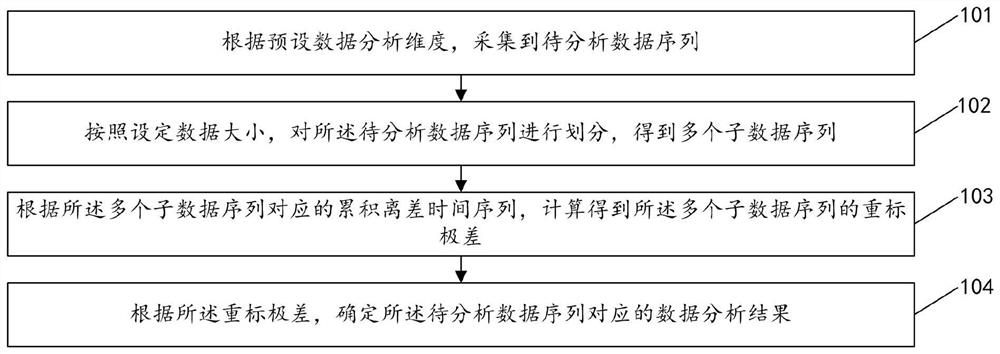
[0054] refer to figure 1 , showing a flow chart of the steps of a method for analyzing data characteristics provided by an embodiment of the present application, as shown in figure 1 As shown, the analysis method of the data feature may specifically include the following steps:
[0055] Step 101: According to the preset data analysis dimension, collect the data sequence to be analyzed.
[0056] The embodiments of the present application may be applied in scenarios where data features are analyzed.
[0057] User data exhibits self-similarity on the time scale, so self-similar estimation of user data using the rescaled range method can extract data features very well. In the practical application of the rescaled range method, especially when performing data self-similarity analysis, the range is calculated based on the cumulative deviation of the sample average value, and the variable-length calculation window is used to extract sub-sample sequences to calculate the average va...
Embodiment 2
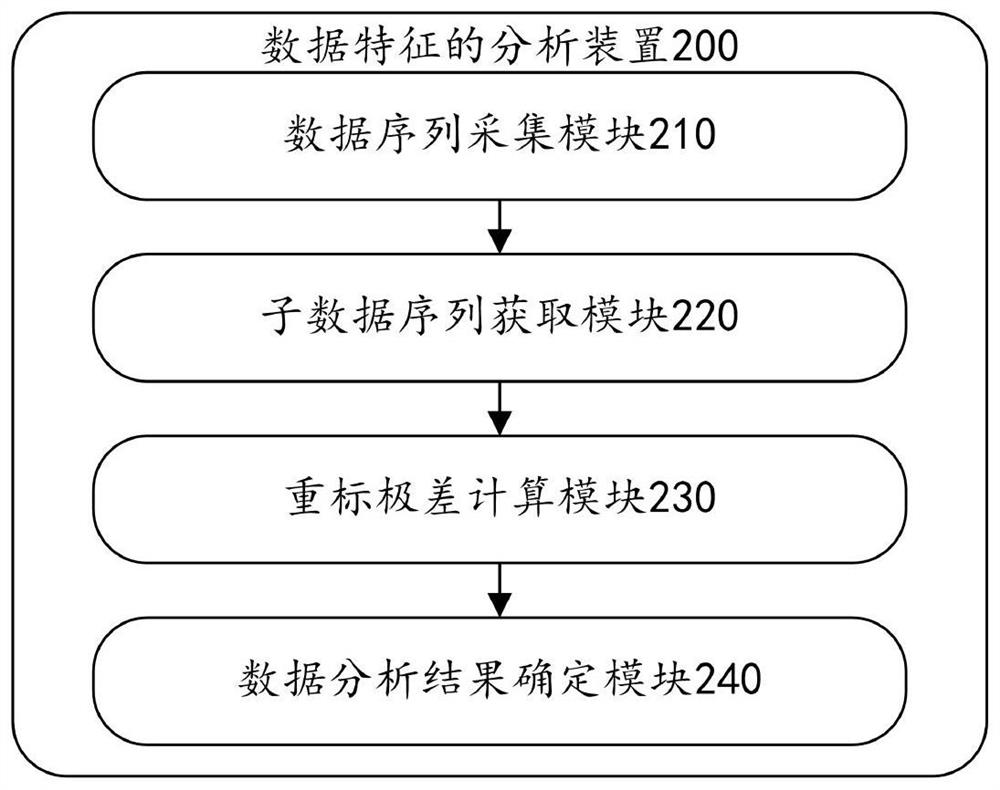
[0115] refer to figure 2 , which shows a schematic structural diagram of a device for analyzing data characteristics provided by an embodiment of the present application, as shown in figure 2 As shown, the analysis device 200 of the data feature may specifically include the following modules:
[0116] The data sequence collection module 210 is used to collect the data sequence to be analyzed according to the preset data analysis dimension;
[0117] The sub-data sequence acquisition module 220 is used to divide the data sequence to be analyzed according to the set data size to obtain multiple sub-data sequences;
[0118] The rescaled range calculation module 230 is used to calculate the rescaled ranges of the multiple sub-data sequences according to the cumulative deviation time series corresponding to the multiple sub-data sequences;
[0119] The data analysis result determination module 240 is configured to determine the data analysis result corresponding to the data sequ...
PUM
 Login to View More
 Abstract
Description
Claims
Application Information
 Login to View More