Unlock instant, AI-driven research and patent intelligence for your innovation.

New abnormal target detection method based on brain-computer fusion cognition and decision

An abnormal target, brain-computer fusion technology, applied in computer parts, instruments, characters and pattern recognition, etc., can solve the problems of improving the difficulty of image feature analysis, reducing the accuracy of computer detection, and large changes in image features. Contradictory decision-making, rich decision-making information, and the effect of improving accuracy

Pending Publication Date: 2021-08-24
NORTHWESTERN POLYTECHNICAL UNIV
View PDF10 Cites 0 Cited by
  • Summary
  • Abstract
  • Description
  • Claims
  • Application Information

AI Technical Summary

Problems solved by technology

[0003] In recent years, researchers at home and abroad have done more research on abnormal target detection. Their research mainly focuses on the improvement of computer abnormal target detection models, feature extraction and classification of EEG signals in the target state, computer and human brain. These studies have made good progress, but there are still many problems: (1) The accuracy of computer detection is very low
The image features of the abnormal target itself change greatly, which increases the difficulty of image feature analysis and reduces the accuracy of computer detection
(2) There are decision-making contradictions in the fusion cognition of human brain and computer
The reasons for the false detection of the computer and the human brain are different, and the detection results of the computer and the human brain are inconsistent, which leads to the contradiction between the decision-making of the computer and the human brain

Method used

the structure of the environmentally friendly knitted fabric provided by the present invention; figure 2 Flow chart of the yarn wrapping machine for environmentally friendly knitted fabrics and storage devices; image 3 Is the parameter map of the yarn covering machine
View more

Image

Smart Image Click on the blue labels to locate them in the text.
Viewing Examples
Smart Image
  • New abnormal target detection method based on brain-computer fusion cognition and decision
  • New abnormal target detection method based on brain-computer fusion cognition and decision
  • New abnormal target detection method based on brain-computer fusion cognition and decision

Examples

Experimental program
Comparison scheme
Effect test

Embodiment Construction

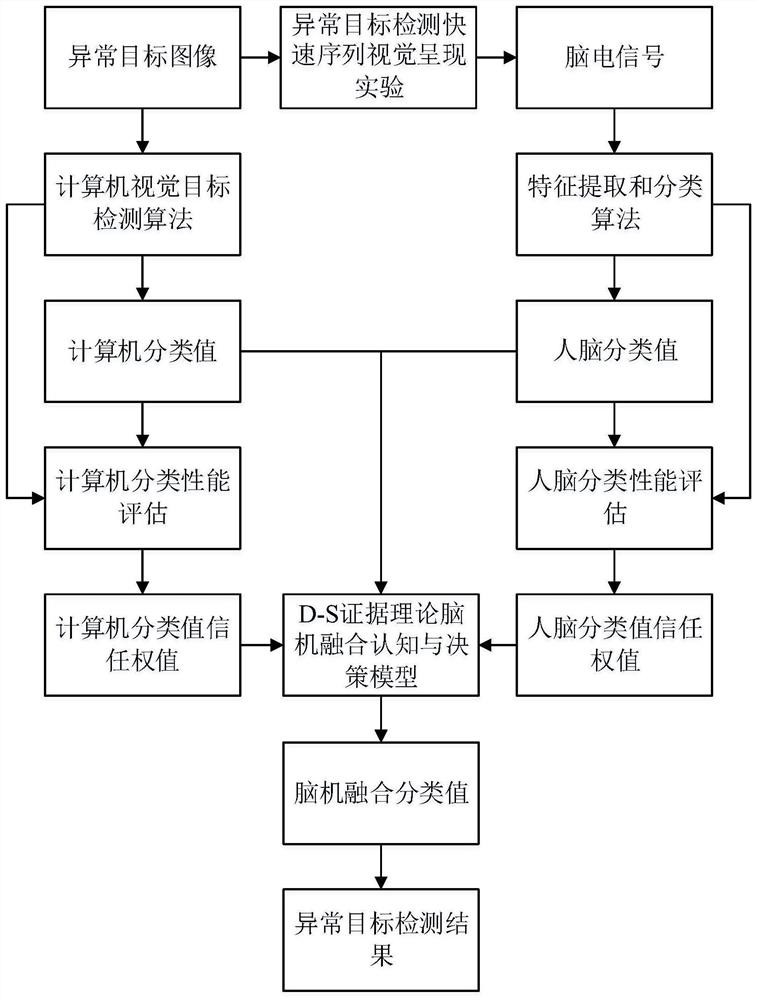
[0016] The method of the present invention will be described in further detail below in conjunction with the accompanying drawings. The method flow is as follows figure 1 As shown, the specific implementation method is:

[0017] (1) Realize the computer vision target detection algorithm through the training set, detect the abnormal target image, and obtain the classification probability of the target detection frame in the image, and the classification probability is the computer classification value of whether there is a target in the image.

[0018] (2) Design an abnormal target detection fast sequence visual presentation experiment to induce task-related EEG signals, the experimental paradigm is as follows figure 2 shown. Image stimuli with abnormal targets accounted for 15% of all image stimuli, image stimuli without targets accounted for 85% of all image stimuli, all image stimuli were presented to the subjects in the form of image streams, and the interval between ima...

the structure of the environmentally friendly knitted fabric provided by the present invention; figure 2 Flow chart of the yarn wrapping machine for environmentally friendly knitted fabrics and storage devices; image 3 Is the parameter map of the yarn covering machine
Login to View More

PUM

No PUM Login to View More

Abstract

The invention discloses a novel abnormal target detection method based on brain-computer fusion cognition and decision. The method comprises the following steps: 1, calculating a classification value of an abnormal target image through a computer vision target detection algorithm; 2, designing a fast sequence visual presentation experiment to induce an electroencephalogram signal corresponding to an abnormal target image, performing feature extraction and classification on the electroencephalogram signal, and calculating a classification value of the abnormal target image; 3, evaluating the classification performance of the computer and the human brain on the abnormal target image, and calculating a trust weight; and 4, establishing a D-S evidence theory brain-computer fusion cognition and decision-making model, and according to classification values of a trust weight fusion computer and a human brain, calculating a brain-computer fusion classification value of whether an abnormal target exists in the image, so as to obtain an abnormal target detection result. The method can fully fuse the decision information of the computer and the human brain, reduces the decision contradiction between the computer and the human brain, improves the brain-computer fusion performance, and effectively solves the problem of low accuracy of abnormal target detection.

Description

technical field [0001] The invention belongs to the interdisciplinary research field of brain-computer interface, computer vision and intelligent information fusion. Background technique [0002] Target detection is to find out the target feature expression in the image to distinguish the target from the non-target. The development of machine learning and deep learning has promoted the development of computer vision object detection, and the accuracy has been greatly improved. However, for abnormal targets in low-visibility scenes such as night and snowy days, the target imaging quality is poor, and the computer lacks sufficient recognition ability to meet the accuracy requirements. Human beings have strong recognition ability, can obtain key visual information in an image at a glance, and can quickly detect objects of interest in an image. Brain-computer interface is a communication and control technology that allows people to communicate directly with the outside world t...

Claims

the structure of the environmentally friendly knitted fabric provided by the present invention; figure 2 Flow chart of the yarn wrapping machine for environmentally friendly knitted fabrics and storage devices; image 3 Is the parameter map of the yarn covering machine
Login to View More

Application Information

Patent Timeline
no application Login to View More
Patent Type & Authority Applications(China)
IPC IPC(8): G06K9/00G06K9/62
CPCG06V2201/07G06F2218/08G06F2218/12G06F18/2135G06F18/253G06F18/214
Inventor 谢松云刘祥惠高川林崔玉洁谢辛舟
Owner NORTHWESTERN POLYTECHNICAL UNIV