
Two-step biological hydrogen preparing process with raised hydrogen generating efficiency of organic waste water
A technology for organic wastewater and biological hydrogen production, which is applied in chemical instruments and methods, biological water/sewage treatment, water/sludge/sewage treatment, etc. The effect of treatment and hydrogen production efficiency improvement
- Summary
- Abstract
- Description
- Claims
- Application Information
AI Technical Summary
Problems solved by technology
Method used
Image

Examples
Embodiment 1
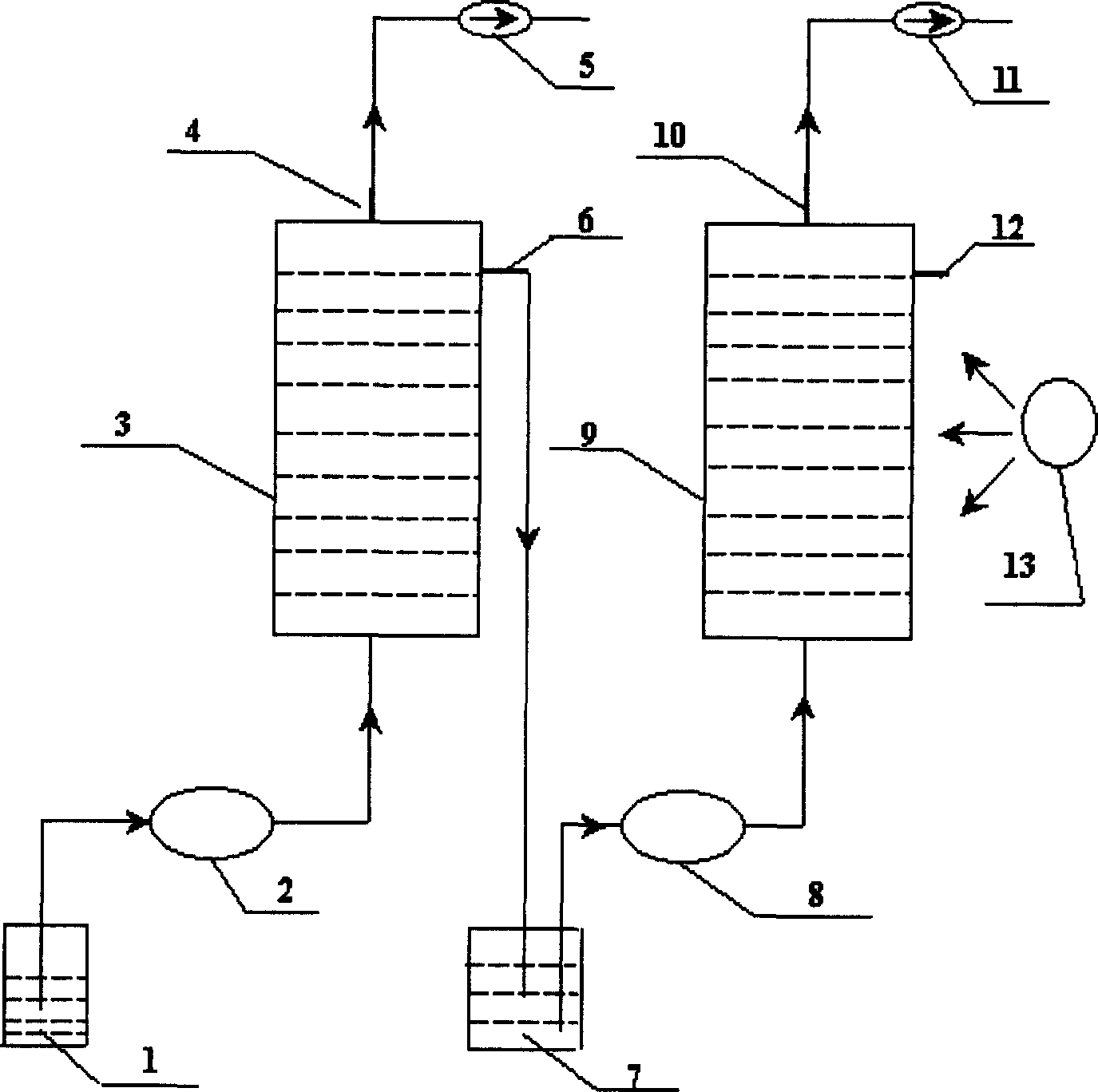
[0009] 1. Prepare simulated organic wastewater (similar in nature to food factory wastewater) and place it in container 1 for use. The preparation process is as follows: add 5 g / l sucrose to tap water, and add 374 mg / l NH at the same time 4 HCO 3 , 97mg / lK 2 HPO 4 .3H 2 O, formulated as organic wastewater. The chemical oxygen demand concentration of this organic waste water is 5.3g / l, uses 2mol / l HCl and 2mol / l NaOH solution to control pH value at 7.0 in organic waste water, puts into refrigerator and makes its temperature be 4 ℃. .
[0010] 2. Add anaerobic methane-producing sludge to the anaerobic fermentation reactor 3 to make its initial concentration 6.3g / l, and simultaneously use HCl to adjust the pH of the solution in the reactor to 4.0-4.5 to obtain anaerobic fermentation hydrogen-producing bacteria The anaerobic methanogenic sludge is the anaerobic methanogenic floc sludge of Anhui Fengyuan Chemical Co., Ltd. for the treatment of citric acid wastewater.
[0011]...
Embodiment 2
[0016] 1.2. Same as Example 1.
[0017] 3. The organic waste water in the container 1 enters the anaerobic fermentation reactor 3 (upflow type anaerobic sludge bed reactor) through the feed pump 2, and its diameter is 100mm, and the total volume is 4.7l, wherein the volume of the reaction zone is 2.1L, The pH value of the solution in the anaerobic fermentation reactor is 5.0, and the temperature is controlled at 36°C; The gas generated in the reactor 3 is collected and separated to obtain hydrogen after passing through the gas outlet 4 and the gas meter 5 . The flow rate of the feed pump 2 is controlled to be 1.94ml / min so that the hydraulic retention time of the organic wastewater in the reactor 3 is 18 hours. After 4 months of acclimation, reactor 3 can produce hydrogen stably, producing 0.10mol hydrogen per day. After conversion, the hydrogen production efficiency is 1.17mol hydrogen / mol glucose.
[0018] 4. the aqueous solution discharged from the outlet 6 of the anaero...
Embodiment 3
[0022] 1. Prepare simulated organic wastewater (similar in nature to flour mill wastewater) and place it in container 1 for use. The preparation process is as follows: add 25g / l starch to tap water, and add 1870mg / l NH at the same time 4 HCO3 , 485 mg / l K 2 HPO 4 .3H 2 O, prepared as organic wastewater, the chemical oxygen demand concentration of the organic wastewater is 29.6g / l, the pH is controlled at 5.5 by 2mol / lHCl and 2mol / lNaOH solution, and it is placed in a room temperature environment (15-20°C).
[0023] 2. Add anaerobic fermentation hydrogen-producing bacteria to reactor 3 to make the initial concentration 4.6g / l; anaerobic fermentation hydrogen-producing bacteria are obtained by heating anaerobic methane-producing sludge to 102°C for one and a half hours, anaerobically The oxygen-methanogenic sludge is the anaerobic methane-producing floc sludge produced by Fengyuan Chemical Co., Ltd. for the treatment of citric acid wastewater.
[0024] 3. the organic waste wa...
PUM
 Login to View More
 Abstract
Description
Claims
Application Information
 Login to View More