Unlock instant, AI-driven research and patent intelligence for your innovation.

Methods and systems for voice-based programming of a voice-controlled device

a voice-based programming and voice-controlled device technology, applied in the field of voice-based programming of voice-controlled devices, can solve the problems of limited customization of voice-activated device applications, the inability of conventional systems to provide for the creation of new programs for execution by voice-activated and voice-response devices, and the inability of end-users and organizational adopters of conventional voice-activated devices to be skilled in conventional programming languages. to achieve the effect of extending and adding functionality to

Active Publication Date: 2019-06-04
4Q CATALYST LLC
View PDF149 Cites 1 Cited by
  • Summary
  • Abstract
  • Description
  • Claims
  • Application Information

AI Technical Summary

Benefits of technology

This patent is related to a method for controlling a voice-controlled device using spoken programming commands. The device receives an audio signal and identifies specific keywords and data associated with an action. The device then modifies its data structure and executes the associated action based on the identified information. This technology allows for easy programming of voice-controlled devices and simplifies the user's experience.

Problems solved by technology

However, such voice-activated device applications can be personalized only to a limited extent by the end user, based on a fixed and pre-defined set of vendor-supported features.
Although many conventional systems provide functionality for improving a level of accuracy in interpreting audio input (e.g., via expanded or customized vocabulary sets), conventional systems do not typically provide for creation of new programs for execution by the voice-activated and voice-response devices, much less via a verbal dialog with the device, in spite of the device's conventional capability to receive and respond to verbal commands.
As a result, end-users and organizational adopters of conventional voice-activated devices who are not skilled in conventional programming languages face significant barriers in extending and adding functionality to the devices.
However, leveraging remote processing over a network raises additional concerns, such as transmission reliability and the utility of the device without a networking connection as well as privacy and security concerns regarding the transmission of non-public, conversational utterances to a remote computing service.
Using different programming languages and different development environments is not only inefficient but creates the problem of keeping all the parts in synchronization.
Thus, using these vendor-supplied application development environments may require knowledge and expertise not typically possessed by end users who are not skilled in computer programming.
As a result of these and other such barriers, non-technical users of voice-controlled devices are effectively prohibited from adapting and extending the functionality of these devices.
Although techniques are known that minimize or eliminate the need to perform word-level natural language processing of audio signals, such techniques are not conventionally used to allow speakers to create new programs executable by voice-controlled devices, modify existing programs executable by voice-controlled devices, modify the data structures stored by voice-controlled devices, or otherwise interact with the voice-controlled device using audio input to generate and execute computer programs.
However, manufacturers of such newer devices have not typically provided the capability to modify or extend the built-in conversational scenarios for the user who may wish to engage in more than canned dialog and does not wish to keep the conversation artificially short, but wishes to develop their own functionality and programs to extend the utility of conversing with the device, including through the development of wholly new applications.

Method used

the structure of the environmentally friendly knitted fabric provided by the present invention; figure 2 Flow chart of the yarn wrapping machine for environmentally friendly knitted fabrics and storage devices; image 3 Is the parameter map of the yarn covering machine
View more

Image

Smart Image Click on the blue labels to locate them in the text.
Viewing Examples
Smart Image
  • Methods and systems for voice-based programming of a voice-controlled device
  • Methods and systems for voice-based programming of a voice-controlled device
  • Methods and systems for voice-based programming of a voice-controlled device

Examples

Experimental program
Comparison scheme
Effect test

Embodiment Construction

[0025]The present disclosure relates to methods and systems for building, extending, and personalizing a program executable by a device that is voice-controlled, wherein the program itself is provided to the device via a sequence of one or more spoken commands. Users of such methods and systems may create and update an application program on a voice-controlled device using conversational speech and without being required to be skilled in computer science or computer programming.

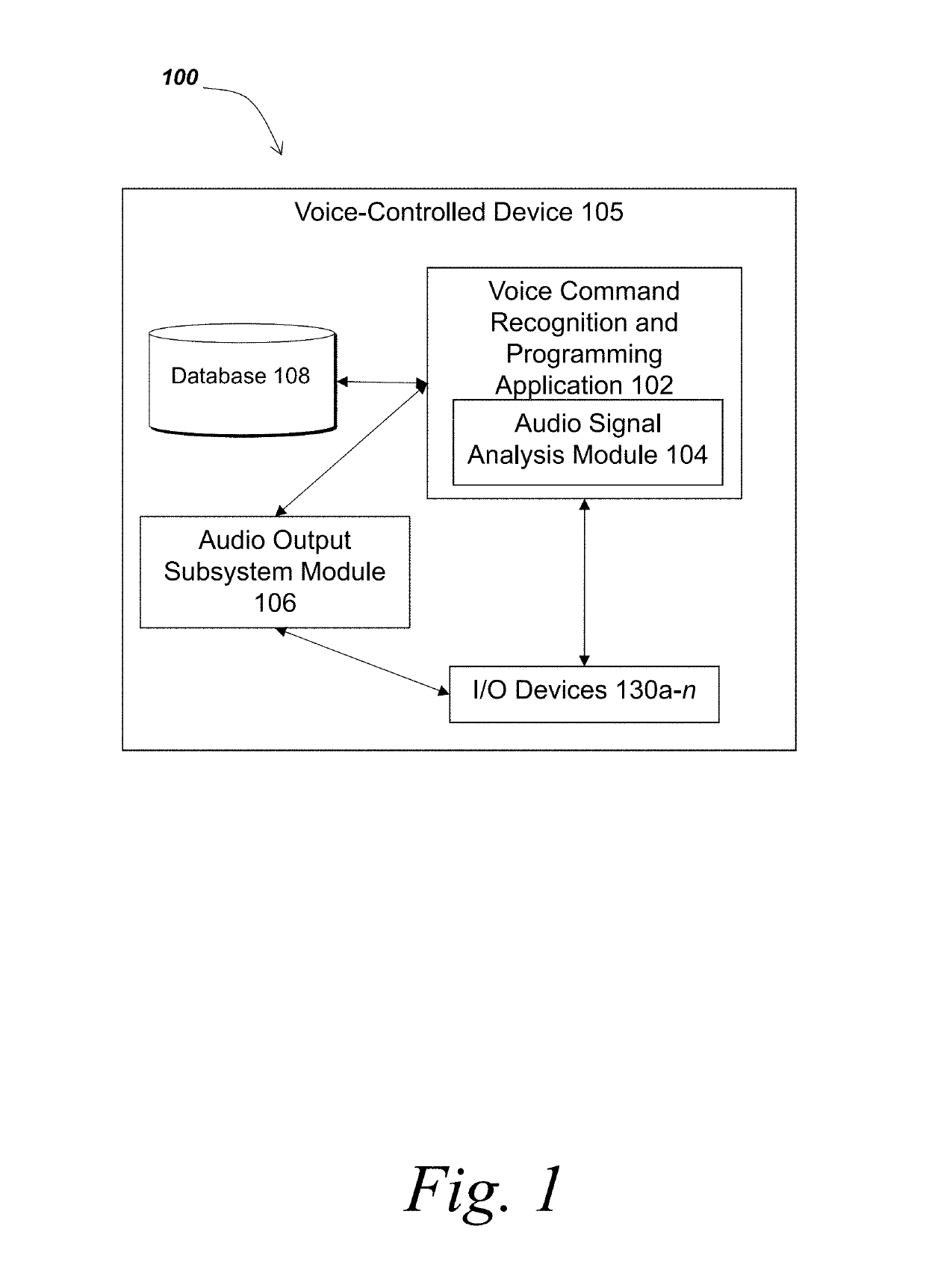
[0026]Referring now to FIG. 1, a block diagram depicts one embodiment of a system 100 for voice-based programming of a voice-controlled device. The system 100 includes a voice-controlled device 105, a voice command recognition and programming application 102, an audio signal analysis module 104, an audio output subsystem module 106, a database 108, and an input / output devices 130a-n.

[0027]The voice-controlled device 105 is a hardware device with functionality for receiving audio input, processing the audio a...

the structure of the environmentally friendly knitted fabric provided by the present invention; figure 2 Flow chart of the yarn wrapping machine for environmentally friendly knitted fabrics and storage devices; image 3 Is the parameter map of the yarn covering machine
Login to View More

PUM

No PUM Login to View More

Abstract

A method for voice-based programming of a voice-controlled device includes executing, by a voice-controlled device, an application for recognizing spoken programming commands, the application including a plurality of keyword phrases each associated with an action. The method includes receiving, by a voice-controlled device, an audio signal representing a user utterance. The method includes identifying, by the voice-controlled device, within the received audio signal, one of the plurality of keyword phrases and data for use in taking the action associated with the one of the plurality of keyword phrases. The method includes modifying, by the voice-controlled device, at least one data structure stored by the voice-controlled device responsive to the identified one of the plurality of keyword phrases and data.

Description

CROSS-REFERENCE TO RELATED APPLICATIONS[0001]This application claims priority from U.S. Provisional Patent Application No. 62 / 553,319, filed on Sep. 1, 2017, entitled “Conversational Programming of Voice-Activated and Voice-Response Devices,” which is hereby incorporated by reference.BACKGROUND[0002]The disclosure relates to voice-controlled devices. More particularly, the methods and systems described herein relate to functionality for voice-based programming of a voice-controlled device.[0003]There has been an increase in the adoption and function set of voice-activated devices in consumer and commercial markets. Devices such as AMAZON ECHO and GOOGLE HOME currently support network-connected applications and interfaces that can be used to control home lighting, entertainment systems, and specially-programmed appliances. Other devices allow for simple question and answer style conversations between the user and the device, with the device programmed to provide voice responses to us...

Claims

the structure of the environmentally friendly knitted fabric provided by the present invention; figure 2 Flow chart of the yarn wrapping machine for environmentally friendly knitted fabrics and storage devices; image 3 Is the parameter map of the yarn covering machine
Login to View More

Application Information

Patent Timeline
no application Login to View More
Patent Type & Authority Patents(United States)
IPC IPC(8): G10L15/00G10L15/22G10L15/02G10L15/28
CPCG10L15/22G10L15/02G10L15/285G10L2015/225G10L2015/223G06F3/167
Inventor GUTHERY, SCOTT B.
Owner 4Q CATALYST LLC