Techniques for representing and processing geometry within a graphics processing pipeline

a graphics processing pipeline and pipeline technology, applied in the field of graphics processing, can solve the problems of limited graphics processing pipeline throughput, limited graphics processing pipeline overall performance, and unit having fixed throughput and limited scalability,

US10600229B2Active Publication Date: 2020-03-24NVIDIA CORP
16 Cites 0 Cited by

Patent Information

Authority / Receiving Office
US · United States
Patent Type
Patents(United States)
Current Assignee / Owner
Publication Date
2020-03-24

Smart Images

  • Figure 1
    Figure 1
  • Figure 2
    Figure 2
  • Figure 3
    Figure 3
Patent Text Reader

Abstract

In various embodiments, a parallel processor implements a graphics processing pipeline that generates rendered images via a shading program. In operation, the parallel processor causes a first set of execution threads to execute the shading program on a first portion of the input mesh to generate first geometry stored in an on-chip memory. The parallel processor also causes a second set of execution threads to execute the mesh shading program on a second portion of the input mesh to generate second geometry stored in the on-chip memory. Subsequently, the parallel processor reads the first geometry and the second geometry from the on-chip memory, and performs operations on the first geometry and the second geometry to generate a rendered image derived from the input mesh. Advantageously, unlike conventional graphics processing pipelines, the performance of the graphics processing pipeline is not limited by a primitive distributor.
Need to check novelty before this filing date? Find Prior Art

Description

BACKGROUND OF THE INVENTIONField of the Invention

[0001] Embodiments of the present invention relate generally to graphics processing and, more specifically, to techniques for representing and processing geometry within a graphics processing pipeline.Description of the Related Art

[0002] A conventional graphics processing pipeline typically includes a single fixed-function hardware unit known as the primitive distributor. The primitive distributor collects vertex data associated with high-order surfaces, graphics primitives, and the like, from a front end unit and constructs corresponding batches of work, where each batch of work includes vertex data that defines multiple primitives. The batches of work are then processed by programmable execution units also included in the graphics processing pipeline. During execution, the batches of work are distributed across a set of streaming multiprocessors that are configured to execute a large number of threads in parallel to perform graphics o...

Examples

Embodiment Construction

[0020]In the following description, numerous specific details are set forth to provide a more thorough understanding of the present invention. However, it will be apparent to one of skilled in the art that the present invention may be practiced without one or more of these specific details.

System Overview

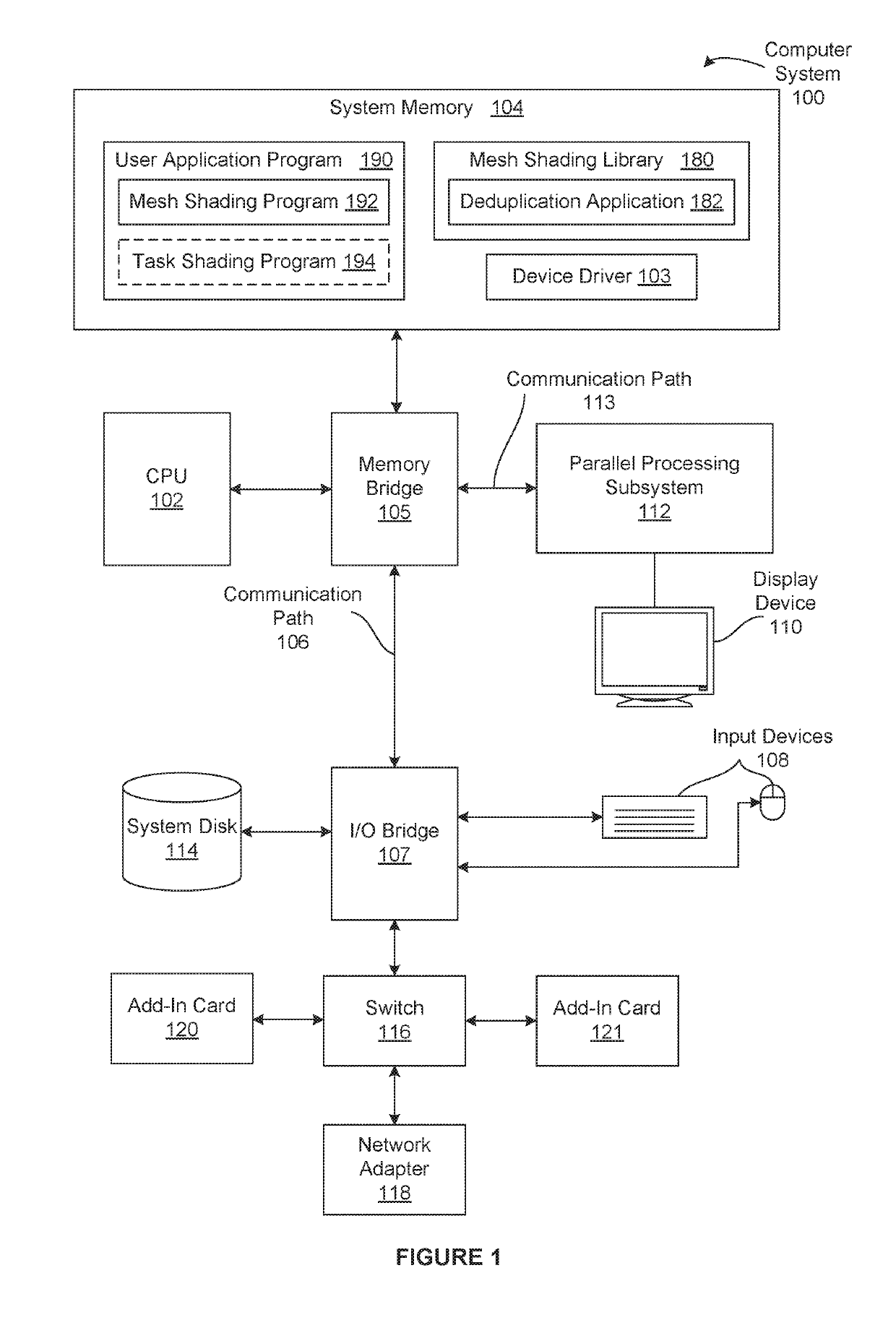
[0021]FIG. 1 is a block diagram illustrating a computer system 100 configured to implement one or more aspects of the present invention. As shown, computer system 100 includes, without limitation, a central processing unit (CPU) 102 and a system memory 104 coupled to a parallel processing subsystem 112 via a memory bridge 105 and a communication path 113. In some embodiments, the computer system 100 is a game console. Memory bridge 105 is further coupled to an I / O (input / output) bridge 107 via a communication path 106, and I / O bridge 107 is, in turn, coupled to a switch 116.

[0022]In operation, I / O bridge 107 is configured to receive user input information from input devices 108, suc...