Supercharge Your Innovation With Domain-Expert AI Agents!

Supression of cross current in a plural converter system

a converter system and cross current technology, applied in the direction of control system, electric motor control, conversion with intermediate conversion to dc, etc., can solve the problem of unbalanced output current of each apparatus

Active Publication Date: 2021-03-16
TOSHIBA MITSUBISHI-ELECTRIC IND SYST CORP
View PDF9 Cites 0 Cited by
  • Summary
  • Abstract
  • Description
  • Claims
  • Application Information

AI Technical Summary

Benefits of technology

This approach effectively suppresses cross currents and prevents unexpected harmonic currents from flowing in the system, ensuring balanced operation and efficient power conversion between parallel power conversion apparatuses.

Problems solved by technology

In such a parallel multiplexed power conversion system, an output current of each apparatus becomes unbalanced due to the difference in output voltages of the two power conversion apparatuses and the difference in impedance of the coupling reactor and wiring cable.

Method used

the structure of the environmentally friendly knitted fabric provided by the present invention; figure 2 Flow chart of the yarn wrapping machine for environmentally friendly knitted fabrics and storage devices; image 3 Is the parameter map of the yarn covering machine
View more

Image

Smart Image Click on the blue labels to locate them in the text.
Viewing Examples
Smart Image
  • Supression of cross current in a plural converter system
  • Supression of cross current in a plural converter system
  • Supression of cross current in a plural converter system

Examples

Experimental program
Comparison scheme
Effect test

embodiment 1

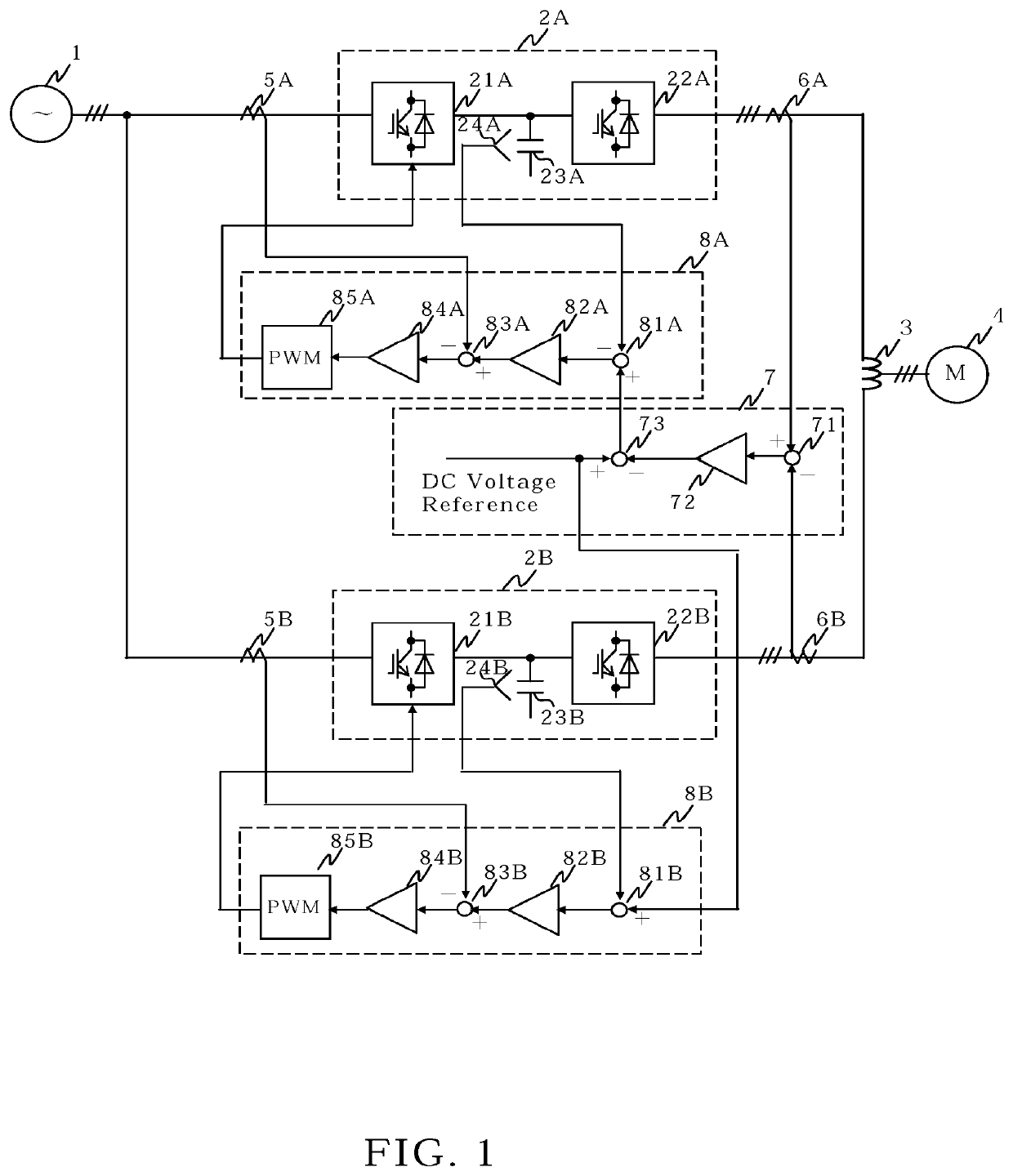
[0015]FIG. 1 is the circuit configuration diagram of the power conversion system according to the first embodiment of the present invention. A commercial three-phase AC power supply 1 is connected to converters 21A and 21B of power conversion apparatuses 2A and 2B via current detectors 5A and 5B, respectively. The power conversion apparatuses 2A and 2B include converters 21A and 21B, DC capacitors 23A and 23B, and inverters 22A and 22B, respectively. DC output voltages of converters 21A and 21B are smoothed by DC capacitors 23A and 23B, and they are inputted to inverters 22A and 22B, respectively. The AC outputs of the inverters 22A and 22B are connected to one and the other terminals of the coupling reactor 3 provided between each phase of the AC output via current detectors 6A and 6B, respectively. The three-phase output at the middle point of the coupling reactor 3 is connected to the AC motor 4. With the above configuration, power conversion apparatuses 2A and 2B drive AC motor ...

embodiment 2

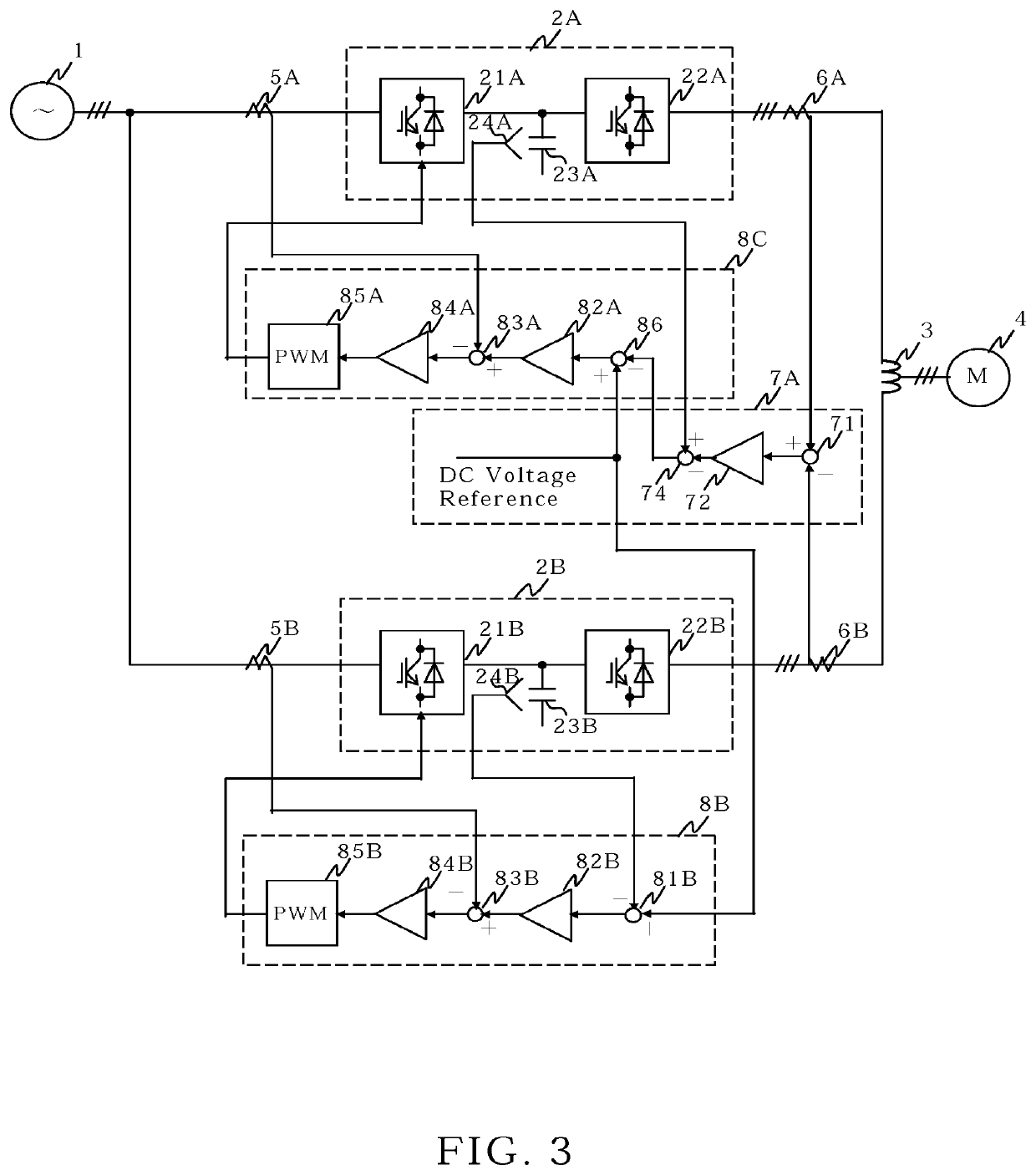
[0024]FIG. 3 is the circuit configuration diagram of the power conversion system according to the second embodiment of the present invention. Regarding each part of the second embodiment, the same parts as those of the power conversion system according to the first embodiment of the present invention in FIG. 1 are denoted by the same reference numerals, and description thereof will be omitted. The difference between the second embodiment and the first embodiment is followings. First, in the difference current control unit 7A, the subtractor 74 calculate the difference between the DC voltage feedback correction amount outputted from the difference current controller 72 and the DC voltage detected by the voltage detector 24A, and gives the output as corrected DC voltage feedback to the subtraction input of a subtractor 86 of the control unit 8C. Second, DC voltage reference is given to the addition input of the subtractor 86, and the difference between the DC voltage reference and the...

embodiment 3

[0026]FIG. 4 is the block diagram of a power conversion system according to Embodiment 3 of the present invention. The AC power supply 1 supplies an AC voltage to the primary winding of an input transformer 1A. The input transformer 1A is a secondary multi-winding transformer, and has six secondary windings in this embodiment. From each of these secondary windings, a three-phase or single-phase secondary voltage is supplied to each converter of the power conversion apparatuses 2C, 2D, 2E, 2F, 2G, and 2H. Each inverter of the power conversion apparatuses 2C, 2D, 2E, 2F, 2G, and 2H is a single-phase inverter. Inverter output of the power conversion apparatuses 2C and 2D, 2E and 2F, and 2G and 2H are connected in parallel via the coupling reactors 3A, 3B and 3C, respectively. The midpoint of each of the coupling reactors 3A, 3B, and 3C is connected to the U-phase, V-phase, and W-phase input terminals of the AC motor 4, respectively.

[0027]Even in the power conversion system having the c...

the structure of the environmentally friendly knitted fabric provided by the present invention; figure 2 Flow chart of the yarn wrapping machine for environmentally friendly knitted fabrics and storage devices; image 3 Is the parameter map of the yarn covering machine
Login to View More

PUM

No PUM Login to View More

Abstract

A power conversion system that has two power conversion apparatuses each including a converter that can control a DC voltage and an inverter and that drives the AC motor by connecting the outputs of the two inverters in parallel is provided. The output voltage of one of the converters is controlled according to the difference between the detection currents detected by the two current detectors for detecting the output currents of the two inverters so that a cross current flowing through the two inverters is suppressed.

Description

CROSS-REFERENCE TO RELATED APPLICATION[0001]This application is based upon and claims the benefit of priority from the prior PCT Patent Application No. PCT / JP2017 / 41104, filed on Nov. 15, 2017, the entire contents of which are incorporated herein by reference.TECHNICAL FIELD[0002]The present invention relates to a power conversion system including at least two power conversion apparatuses whose outputs are connected in parallel.BACKGROUND ART[0003]As a means for increasing the capacity of a power conversion apparatus, a method of connecting outputs of a plurality of power conversion apparatuses in parallel is known. For example, in a power conversion system in which an AC motor is driven by two power conversion apparatuses, AC outputs of the two power conversion apparatuses are connected via a coupling reactor. In such a parallel multiplexed power conversion system, an output current of each apparatus becomes unbalanced due to the difference in output voltages of the two power conve...

Claims

the structure of the environmentally friendly knitted fabric provided by the present invention; figure 2 Flow chart of the yarn wrapping machine for environmentally friendly knitted fabrics and storage devices; image 3 Is the parameter map of the yarn covering machine
Login to View More

Application Information

Patent Timeline
no application Login to View More
Patent Type & Authority Patents(United States)
IPC IPC(8): H02M5/40H02J3/18H02M1/42H02M7/493H02P27/08H02M1/00
CPCH02M5/40H02J3/18H02M1/4208H02M7/493H02P27/08H02M2001/0009H02M2001/0025H02M5/4585H02M1/0009H02M1/007H02M1/12H02P29/50H02M1/0025
Inventor TOBAYASHI, SHUNSUKESUZUKI, HIROMITSU
Owner TOSHIBA MITSUBISHI-ELECTRIC IND SYST CORP
Features
  • R&D
  • Intellectual Property
  • Life Sciences
  • Materials
  • Tech Scout
Why Patsnap Eureka
  • Unparalleled Data Quality
  • Higher Quality Content
  • 60% Fewer Hallucinations
Social media
Patsnap Eureka Blog
Learn More