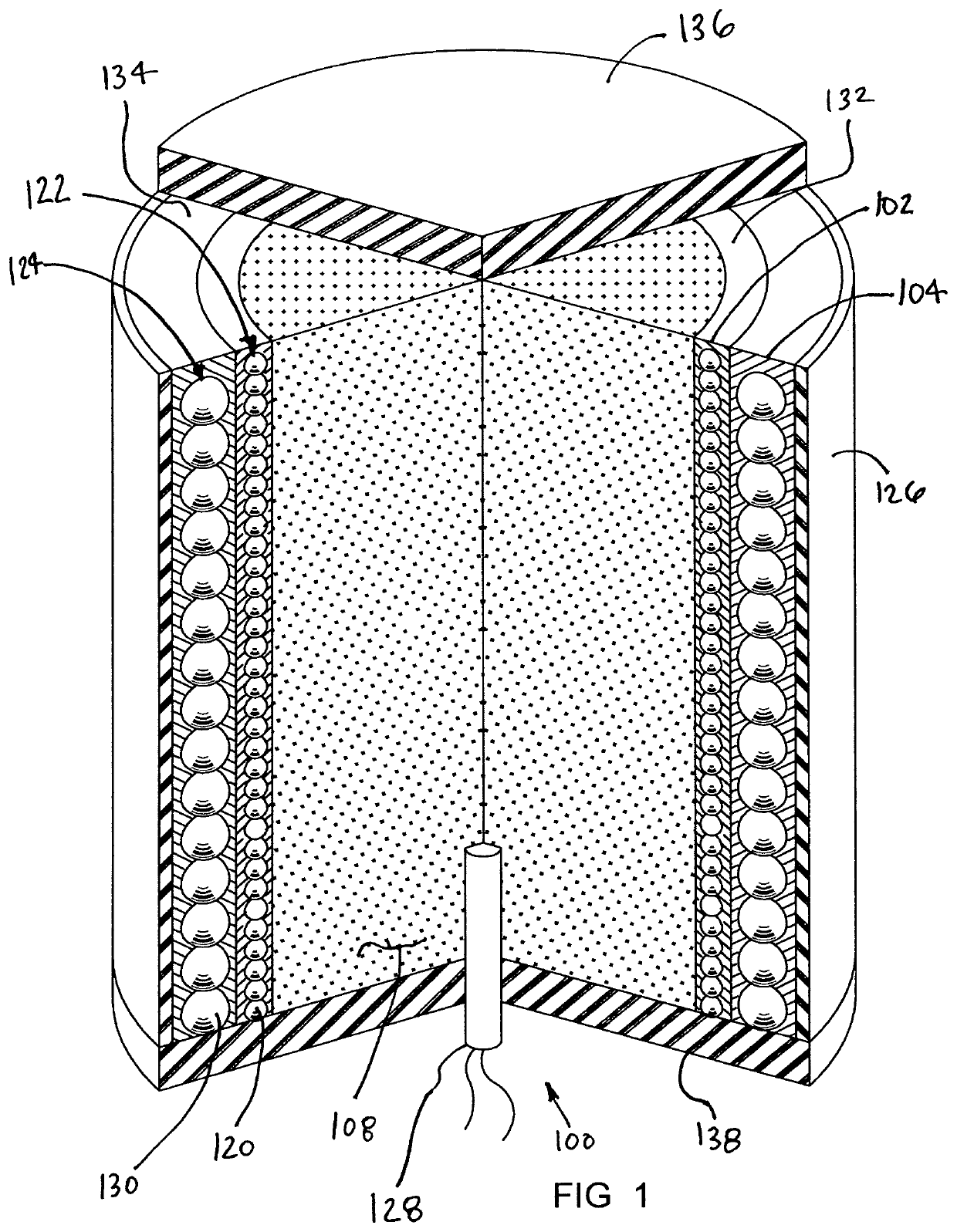
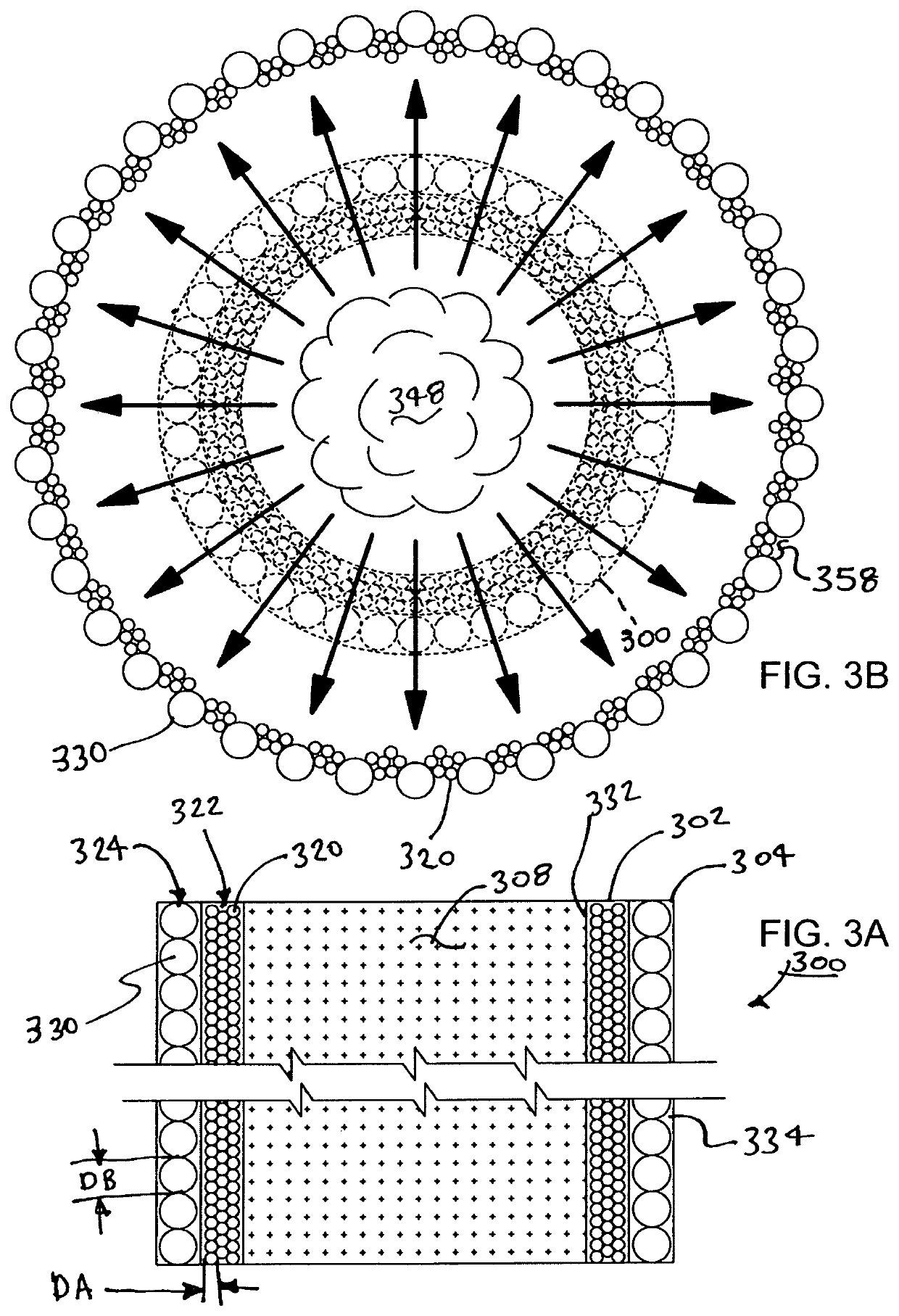
[0010]In some example embodiments, the first sleeve is disposed between the explosive charge and the second sleeve so that expanding gases produced by the explosive charge upon detonation push the small fragments into contact with the large fragments. Also in some example embodiments, the small and large fragments have curved outer surfaces that facilitate migration of the small fragments into interstitial spaces between the large fragments when small fragments are forced into contact with large fragments upon detonation of the explosive charge so that the flow of the expanding gases through the interstitial spaces is restricted by the small fragments. The small fragments and the large fragments may form an expanding fragmentation curtain that provides improved containment of expanding gases compared to other fragmentation arrangements, and increases the total kinetic energy of the fragments.
[0011]The acceleration of the smaller fragments compared to the larger fragments, presuming common densities, varies with the inverse of the radii of the fragments. Thus, under the same explosive pressure, the larger fragments will not accelerate as fast as the smaller fragments, and immediately post detonation, will have less velocity and less kinetic energy. Placing small fragments interior to the large fragments such that the small fragments acceleration is impeded by larger fragments, the small and large fragments coalesce into a curtain immediately after the explosion providing an enhanced dynamic containment of the expanding gases increasing the pressure of the explosion and ultimately the kinetic energy of the fragments. Thus, a feature and advantage of embodiments of the invention is that with the bound uniform small fragments interior to the bound large fragments in an explosive condition, after the small and large fragments are unbound as the binder disintegrates, the small and large fragments provide an improved coalescence, that is, a generally greater density of fragments large and small, providing improved containment of the expanding explosive gases, increasing the explosive pressure providing enhanced acceleration and velocity to the fragments, large and small, and providing a net increase in kinetic energy of the totality of the fragments.
[0014]In some example embodiments, the small fragments and the large fragments have a first infrangibility, the first binding material and the second binding material have a second infrangibility, and the first infrangibility is greater than the second infrangibility. It is contemplated that small fragments and / or large fragments may be deformed after detonation of explosive charge. Whether or not the fragments are deformed, the infrangibility of the fragments may be sufficient to prevent each fragment from breaking into a plurality of pieces.
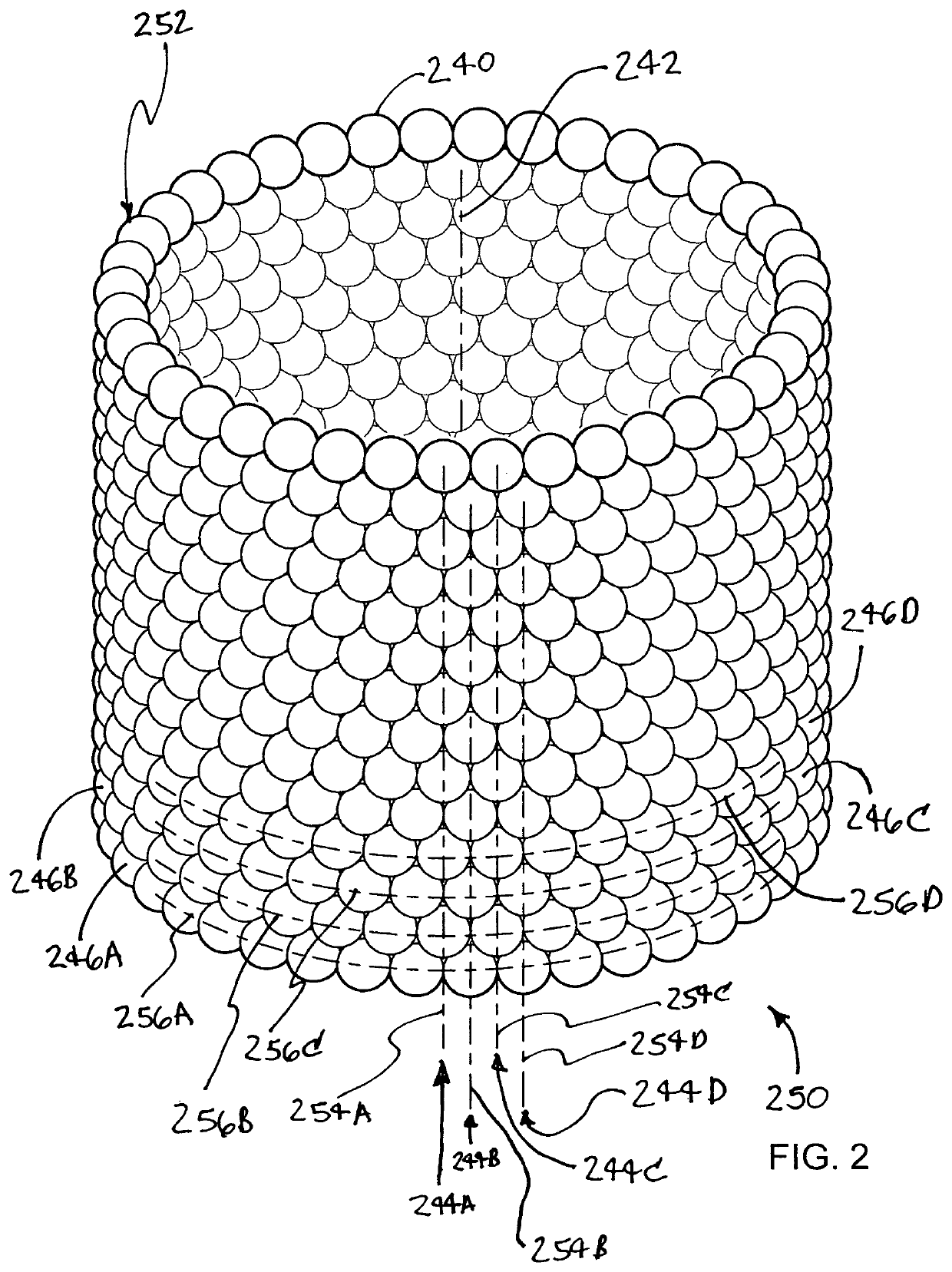
[0021]In embodiments, a method of manufacturing a warhead comprises, loading a first multiplicity of spherical fragments of a uniform first size within a first annular containment in an ordered arrangement; filling the first annular containment with a first annular containment binder for at least substantially covering the first multiplicity of spherical fragments, the first annular containment binder having a flowable condition; allowing the binder to harden wherein the spherical fragments are embedded within the first annular containment binder in a first annular form having the shape of the first annular containment; loading a second multiplicity of spherical fragments of a uniform second size within a second annular containment having an inner wall surface that dimensionally corresponds to an outer wall of the first annular containment, the uniform second size diametrically at least 50 percent larger than the uniform size of the first multiplicity of spherical fragments; filling second annular containment with a second annular containment binder for at least substantially covering the multiplicity of spherical fragments, the first annular containment binder having a flowable condition; allowing the second annular containment binder to harden wherein the spherical fragments are embedded within the second annular containment binder in a second annular form with the shape of the second annular containment; positioning explosive material within a cavity defined by the first annular form; and affixing the first annular form and the second annular form within a housing with the first annular form interior to the second annular form; whereby upon detonation, an enhanced coalescence of small and large fragments post detonation increases the post explosion pressurization providing a net increase in kinetic energy.


 Login to View More