
Method for improving lifespan of lithium secondary battery
a lithium secondary battery and lifetime technology, applied in secondary cell servicing/maintenance, cell components, sustainable manufacturing/processing, etc., can solve the problems of reducing capacity and lifetime, difficult to commercialize lithium-sulfur batteries, and capacity may decrease, so as to achieve the effect of enhancing the lifetime properties of lithium secondary batteries
- Summary
- Abstract
- Description
- Claims
- Application Information
AI Technical Summary
Benefits of technology
Problems solved by technology
Method used
Image

Examples
example 1
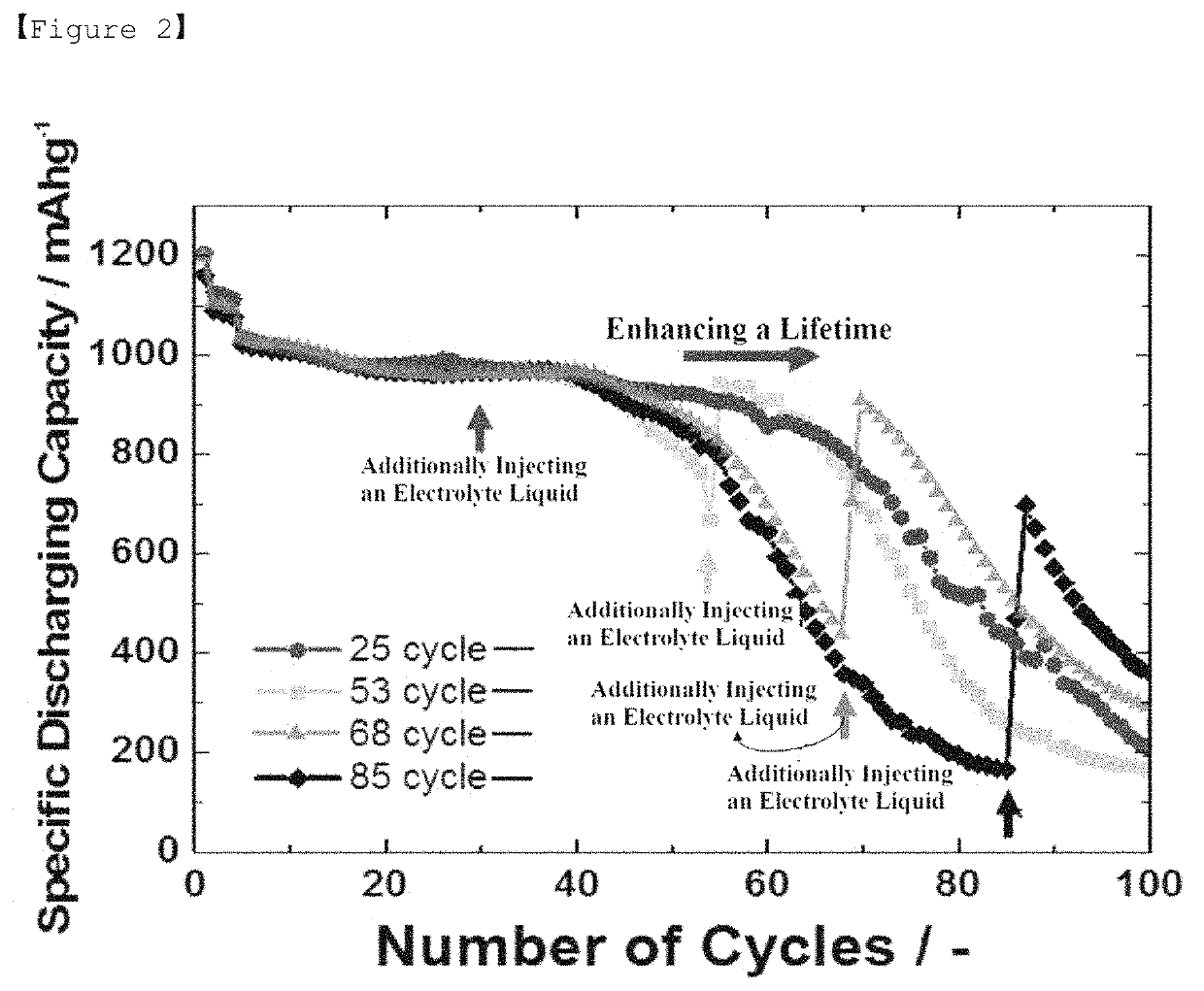
[0083]For the lithium secondary battery manufactured in the same manner as in Comparative Example 1, an electrolyte liquid was additionally injected in the same volume as the initially injected electrolyte liquid at a 25th cycle point corresponding to half the 50th cycle at which cycle capacity started to degenerate.
experimental example
y Properties
[0087]For the additionally-injected batteries of Example 1 and Comparative Examples 2 to 4, a cycle lifetime test was performed in the same manner as in Comparative Example 1, and the results are shown in FIG. 2.
[0088]When examining the cycle lifetime test results of FIG. 2, it was seen that Example 1 additionally injecting an electrolyte liquid at a 25th cycle point had cycle capacity starting to degenerate again at a 75th cycle point and had a cycle lifetime enhanced by approximately 50% (25 cycles) compared to Comparative Example 1.
[0089]In comparison, Comparative Example 2 additionally injecting an electrolyte liquid at a 53rd cycle that is after degeneration started, Comparative Example 3 additionally injecting an electrolyte liquid at a 68th cycle, a point at which cycle capacity was approximately 400 mAh / g after degeneration started, and lastly, Comparative Example 4 additionally injecting an electrolyte liquid near a 85th cycle, a point at which the cell was cons...
PUM
| Property | Measurement | Unit |
|---|---|---|
| thickness | aaaaa | aaaaa |
| thickness | aaaaa | aaaaa |
| thickness | aaaaa | aaaaa |
Abstract
Description
Claims
Application Information
 Login to View More