Multiple-wavelength optical modulation apparatus
- Summary
- Abstract
- Description
- Claims
- Application Information
AI Technical Summary
Benefits of technology
Problems solved by technology
Method used
Image



Examples
example 1
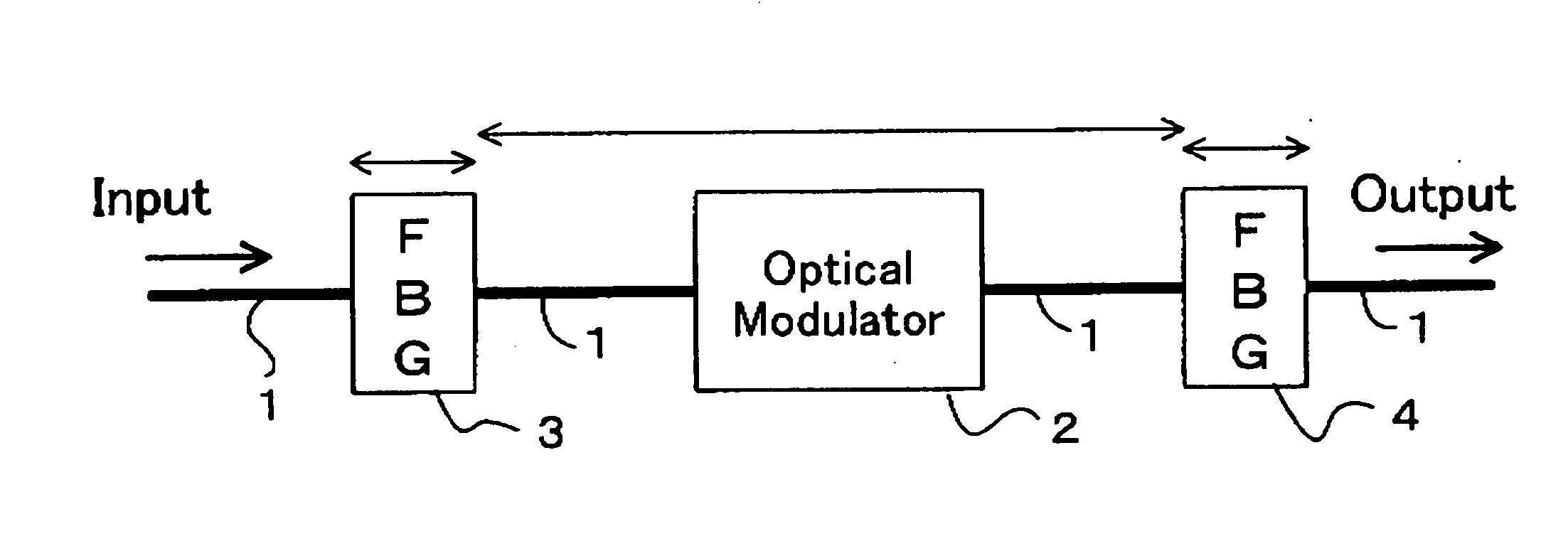
[0047] First, the invention will be explained with reference to the optical modulation apparatus of the invention shown in FIG. 3. FIG. 3 (a) shows a configuration that uses a single modulator to modulate light having a frequency of 200 THz and light having a frequency of 199 THz. Arranged along an optical path 1 are an input end, an input side FBG 5, an input side FBG 3, an optical modulator 2, an output side FBG 4, an output side FBG 6 and an output end. As shown in FIG. 3 (b), FBG 5 has two 13.5 GHz reflection bands and a 1 GHz transmission band between the reflection bands, and FBG 3 has two 22.5 GHz reflection bands and a 1 GHz transmission band between the reflection bands. FBG 6 and FBG 4 have reflection bands corresponding to those of FBG 5 and FBG 3, respectively, without the transmission bands. The upper and lower limits of the reflection bands do not have to be the same in the FBG 6 and FBG 4; the manufacturing error only needs to be in the order of half the modulation fr...
example 2
[0053] The above example relates to the use of input / output filters having uniform reflection characteristics that span the wavelength zone being utilized. However, the same kind of function can be achieved using the reflection characteristics of a comb filter, as described in the following.
[0054]FIG. 4 shows the reflection characteristics of a superlattice type fiber grating. FIG. 4 (a) shows one type of FBG that is 0.4 mm long and set at a pitch of 2 mm, and FIG. 4 (b) shows the reflection characteristics two types of FBG, each 0.4 mm long and set at a pitch of 2 mm. As can be understood from the drawings, there is a high degree of freedom in designing comb-shaped reflection spectral characteristics.
[0055]FIG. 5 shows an embodiment of the invention in which this type of superlattice fiber grating is used in two output filters. As shown in FIG. 5 (a), an optical modulator is provided between input filter FBGa and output filters FBGc and FBGd. In the case of this apparatus, two li...
example 3
[0063] While the above example relates to an apparatus that uses superlattice type fiber gratings to constitute two output filters, in the case of the embodiment shown in FIG. 8, superlattice type fiber gratings are used to constitute two input filters (FBGa and FBGb). In this case, FBGd can be a FBG with a continuous reflection characteristic. With respect to the fringes showing the reflection characteristics of FBGa and FBGb, ones satisfying the same conditions as in the case of the FBGc and FBGd of Example 2 may be used.
[0064] However, in the case of this example too, various lightwaves are included in the modulation apparatus, such as sidebands of the λa lightwave modulated by an 8 GHz signal and sidebands of the λb lightwave modulated by a 5 GHz signal. Therefore, for practical application, it is desirable to provide a filter at location B in FIG. 7 to output a lightwave with a specific frequency selected from among such lightwaves. As in the preceding example, when a filter t...
PUM
 Login to View More
 Abstract
Description
Claims
Application Information
 Login to View More
 - R&D
- Intellectual Property
- Life Sciences
- Materials
- Tech Scout
- Unparalleled Data Quality
- Higher Quality Content
- 60% Fewer Hallucinations
Browse by: Latest US Patents, China's latest patents, Technical Efficacy Thesaurus, Application Domain, Technology Topic, Popular Technical Reports.
© 2025 PatSnap. All rights reserved.Legal|Privacy policy|Modern Slavery Act Transparency Statement|Sitemap|About US| Contact US: help@patsnap.com