[0005] An object of the invention is to provide for a complete and functional disc replacement that simultaneously restores sufficient disc space height and mobility to provide for functional normalcy, while allowing for a variety of surgical approaches and the use of minimally invasive surgical techniques.
[0006] To achieve this objective, the component parts of the replacement disc are bonded to the surface of sacks or chambers which are distensible or inflatable. In this manner, the replacement discs can be inserted through a small opening and then inflated within a disc space thereby assuming its final functional configuration. The sacks are nonporous and allow no escape of their contents. The sacks, or chambers, are initially inflated with a radio opaque liquid contrast material under fluoroscopic guidance to check for functional positioning and anatomic alignment, as well as functional integrity of the chambers themselves. Once ideal placement is confirmed, the radio opaque contrast material is removed and replaced with a hardenable material or resin which forms a solid construct once suitably mature. In this fashion, infinite anatomic variation of disc heights and configurations can be accommodated, and insertion of the replacement disc can be facilitated through a small annulotomy favoring minimally invasive surgical techniques.
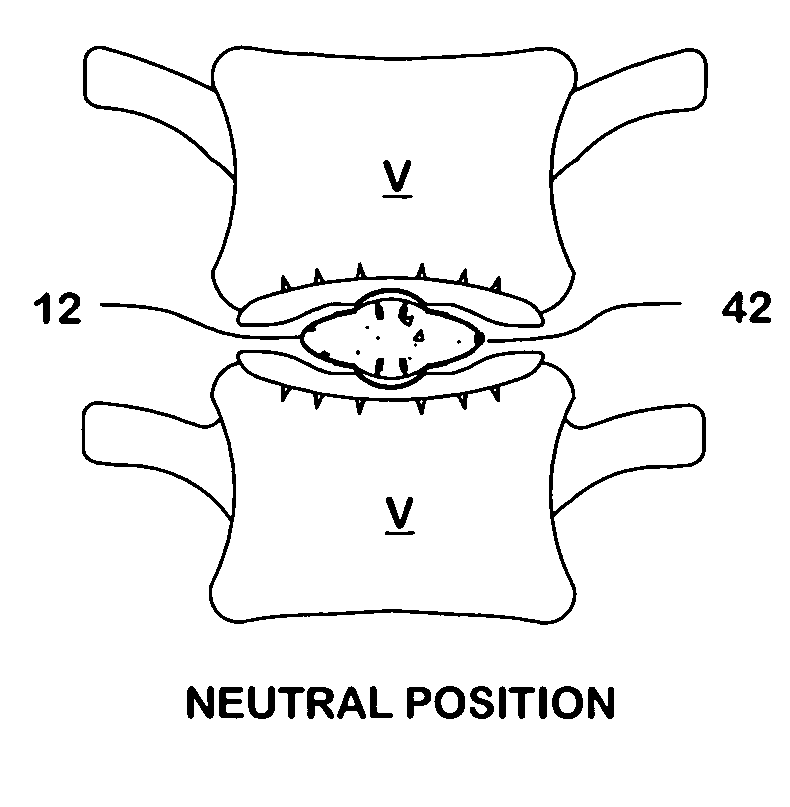
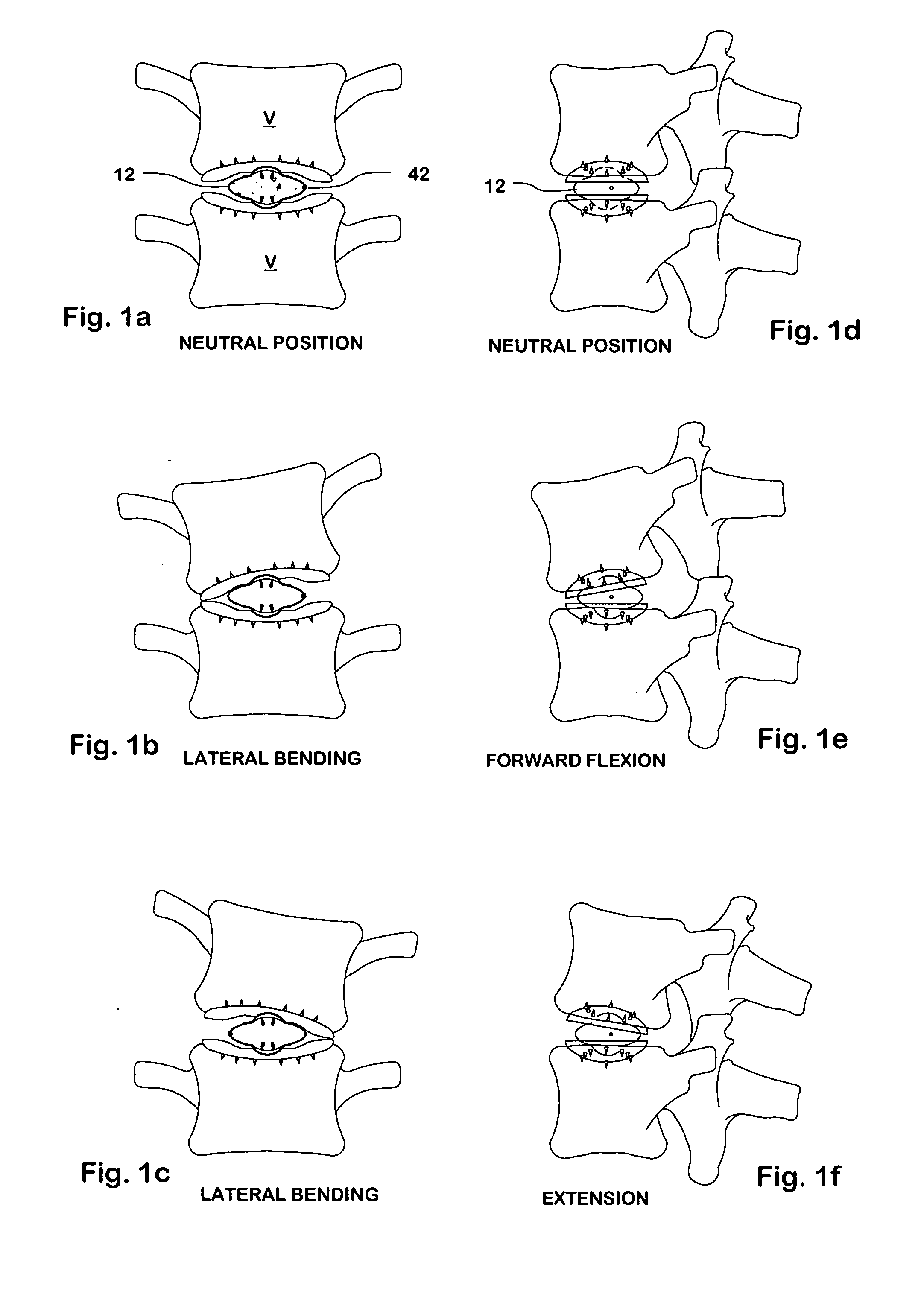
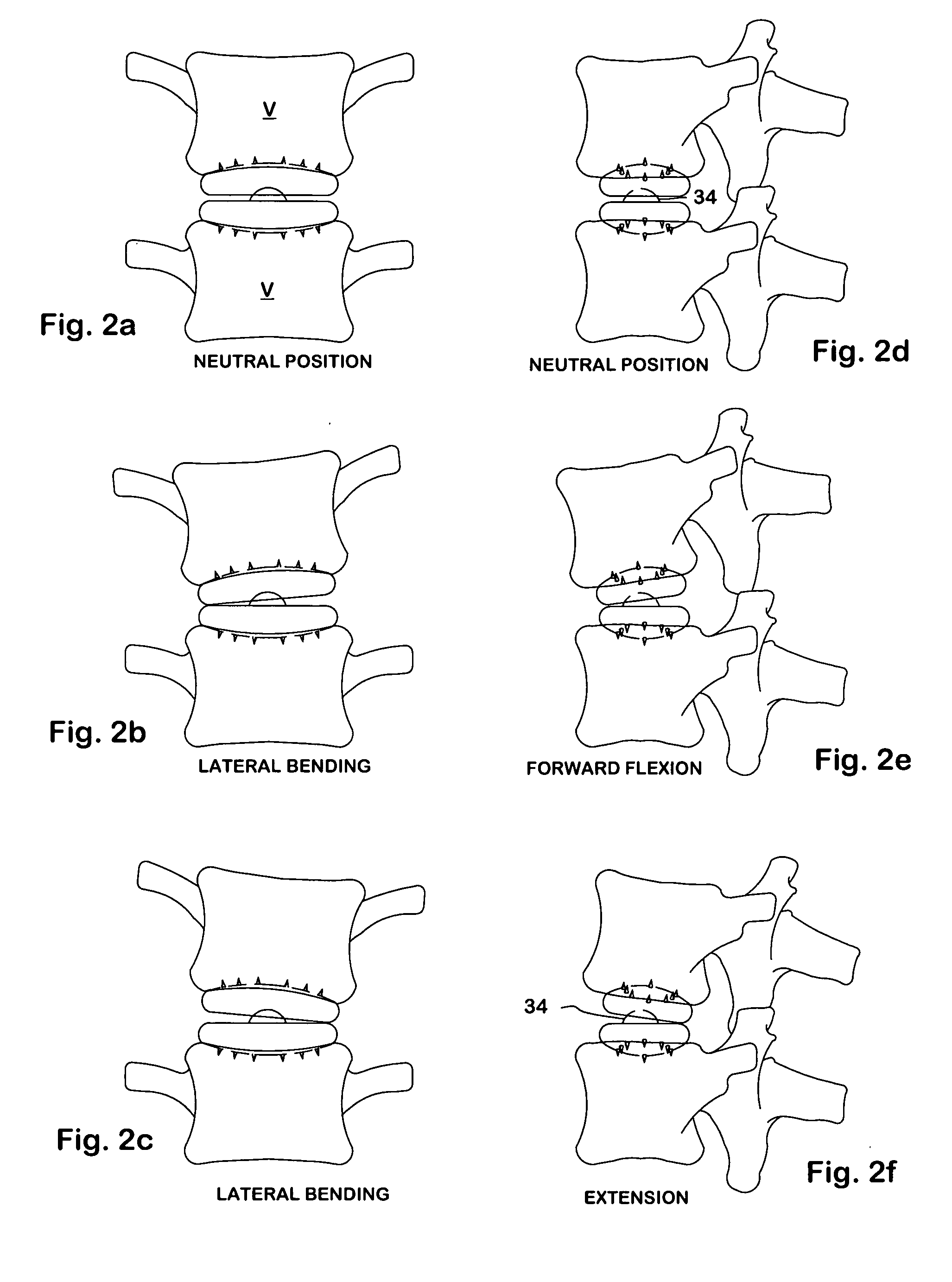
[0008] For example, in the two component version, one chamber sits atop the other with the disc space between the vertebral end plates. On the cranial or superior surface of the cranial chamber, teeth, digits, or corrugations are found which impress themselves into the end plate when the sack or chamber is inflated. A similar set of components is found on the caudal or inferior surface of the caudal or inferior chamber. These teeth or digits transgress the end plate surface and fixate the replacement disc in situ when the chambers are inflated. The juxtaposing surface between the cranial and caudal chambers contain mating surfaces that allow for functional motion between the cranial and caudal chambers when they are inflated to their final size. The mating surfaces are formed of male and female components that interdigitate, largely in a ball and socket fashion, but other similar functional relationships may be considered, provided that the adjacent surface interaction provides for the cardinal movements of a functioning intervertebral disc. These cardinal movements will allow for approximately 15 degrees of flexion, 5 degrees of extension, 5 degrees of lateral bending, 2 degrees of axial rotation and 1-5 mm of translation. When fully expanded, the fulcrum of movement on flexion and extension is located near the junction of the posterior one third and anterior two thirds of the vertebral body. The relationship between the components is such that it allows for varying degrees of rotation, flexion, extension and translational movements while simultaneously retarding the extremes of these motions to prevent disengagement of the cranial and caudal components at the extremes of functional movement. The mating surfaces are lined with polyethylene or similar materials suited for long term frictional wear. These linings may include plastics, ceramics, metals, carbon composites or combinations thereof.
[0010] As the chambers are inflated, teeth or digits on the superior or cranial and inferior or caudal surface of the chambers dig into the adjacent end plate and lock the prosthesis in position. The mating surface between the two inflated chambers in turn contains a ball and socket or male and female interacting component that permits functional movement between the cranial and caudal chambers when they are suitably inflated. By inflating them with a hardenable material, a solid, functional disc prosthesis can be formed with a final size that is much larger than its component parts. This allows not only for varying disc sizes and shapes, but also provides for use of the prosthesis in minimally invasive surgical techniques.
[0012] Suitable materials for the walls of the inflatable chamber include Kevlar, polypropylene or any of a variety of plastics or fabrics having either elastic or non-elastic properties, but sufficiently pliable and having sufficient tensile strength to allow for deflated and inflated attitudes. The material should be sufficiently non-porous so as to prevent leakage of injected contents.


 Login to View More