Unlock instant, AI-driven research and patent intelligence for your innovation.

Method of detecting memory leaks in software applications

a software application and memory leak detection technology, applied in the field of data processing systems, can solve the problems of large number of mostly garbage-filled pages in real memory and page space, memory leakage, application slowing down over time,

Inactive Publication Date: 2006-11-02
CISCO TECH INC
View PDF35 Cites 20 Cited by
  • Summary
  • Abstract
  • Description
  • Claims
  • Application Information

AI Technical Summary

Problems solved by technology

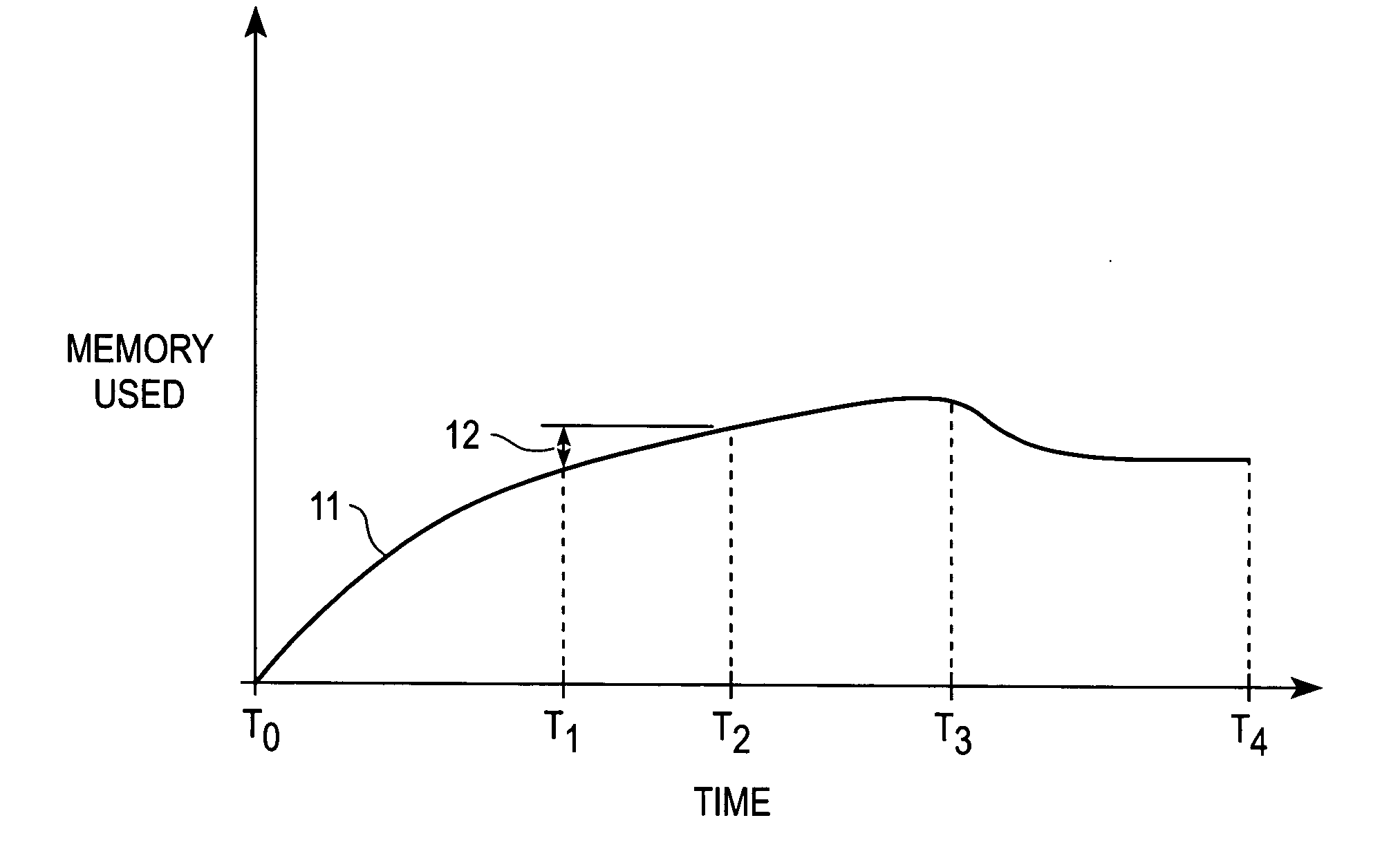
A “memory leak” occurs when a process such as an application or a service allocates memory (heap memory) and either neglects to free it to the operating system.
This can occur when an application or service loses track of memory or keeps spawning new operations that allocate memory but never free the memory by completing their task.
Memory leaks are a common problem in software applications that can cause the application to slow down over time.
Memory leaks in a long-running program, such as a server application that is designed to run for weeks or months at a time, are a particularly serious problem, because it can result in memory fragmentation and the accumulation of large numbers of mostly garbage-filled pages in real memory and page space.
Although many of these prior art approaches have been successfully used to track down memory leaks in an application, each is not without its drawbacks.
Often times, however, the tracking paths can be larger than the memory allocations itself, which can be a significant burden to the application running, causing the application to slow down or even fail.
False positive results are also a common occurrence with many prior art techniques for detecting memory leaks.

Method used

the structure of the environmentally friendly knitted fabric provided by the present invention; figure 2 Flow chart of the yarn wrapping machine for environmentally friendly knitted fabrics and storage devices; image 3 Is the parameter map of the yarn covering machine
View more

Image

Smart Image Click on the blue labels to locate them in the text.
Viewing Examples
Smart Image
  • Method of detecting memory leaks in software applications
  • Method of detecting memory leaks in software applications
  • Method of detecting memory leaks in software applications

Examples

Experimental program
Comparison scheme
Effect test

Embodiment Construction

[0012] A novel method of tracking down memory leaks in a process running on a computer is described. In the following description specific details are set forth, such as bit field sizes, data structures, binary settings, etc., in order to provide a thorough understanding of the present invention. However, persons having ordinary skill in the networking arts will appreciate that these specific details may not be needed to practice the present invention.

[0013] According to one embodiment of the present invention, memory leaks are detected as stale memory or memory that has not been accessed in a given time period through the use of a large bitmap. The size of the bitmap is determined by the number of possible addresses that can be allocated. For example, in the standard 32-bit addressing scheme of the Intel family of processors and Windows Operating System (OS), there are approximately 17 million different addresses that may returned when an application allocates a chunk of memory. T...

the structure of the environmentally friendly knitted fabric provided by the present invention; figure 2 Flow chart of the yarn wrapping machine for environmentally friendly knitted fabrics and storage devices; image 3 Is the parameter map of the yarn covering machine
Login to View More

PUM

No PUM Login to View More

Abstract

A method for detecting memory leaks includes initializing memory for a process under a load. Bits in a bitmap are then set / reset during a time interval after initialization of the memory. Each bit is set / reset at a location in the bitmap that uniquely corresponds to an address of a memory allocation / deallocation of the process stopping the load. Memory allocations corresponding to remaining bits in the bitmap are listed to identify the leaked memory. It is emphasized that this abstract is provided to comply with the rules requiring an abstract that will allow a searcher or other reader to quickly ascertain the subject matter of the technical disclosure. It is submitted with the understanding that it will not be used to interpret or limit the scope or meaning of the claims. 37 CFR 1.72(b).

Description

FIELD OF THE INVENTION [0001] The present invention relates generally to data processing systems; more specifically, to software applications and software tools for optimizing the performance of applications and processes designed to run on a data processing system. BACKGROUND OF THE INVENTION [0002] Most modern computer operating systems include a subsystem which provides high-level memory management functions that make it easy for applications to build dynamic data structures, provide compatibility with previous versions of the operating system, and create buffers and temporary placeholders for system functions. These memory management functions typically return handles and pointers to blocks of memory that are allocated at run time and managed by an entity called a heap. As is well-known, the primary function of a heap is to efficiently manage the memory and address space of a process for an application. [0003] In order to optimize the performance of software applications that ru...

Claims

the structure of the environmentally friendly knitted fabric provided by the present invention; figure 2 Flow chart of the yarn wrapping machine for environmentally friendly knitted fabrics and storage devices; image 3 Is the parameter map of the yarn covering machine
Login to View More

Application Information

Patent Timeline
no application Login to View More
Patent Type & Authority Applications(United States)
IPC IPC(8): G06F7/00
CPCG06F11/366
Inventor BELCHER, AARON J.
Owner CISCO TECH INC