
Invisible antimicrobial glove and hand antiseptic
an antimicrobial glove and hand technology, applied in the direction of detergent compounding agents, cleaning using liquids, ampholytes/electroloneutral surface active compounds, etc., can solve the problems of unpopularity of alcohol-based surgical scrubs in the united states, dry skin, chapped and cracked skin, etc., to improve the anti-microbial characteristics of formulations, prevent alcohol-based scrubs from being popular, and eliminate dry skin. chapped feeling
- Summary
- Abstract
- Description
- Claims
- Application Information
AI Technical Summary
Benefits of technology
Problems solved by technology
Method used
Image

Examples
examples
[0031] The following examples are not intended to limit the scope of the invention, but are only intended to be exemplary in nature.
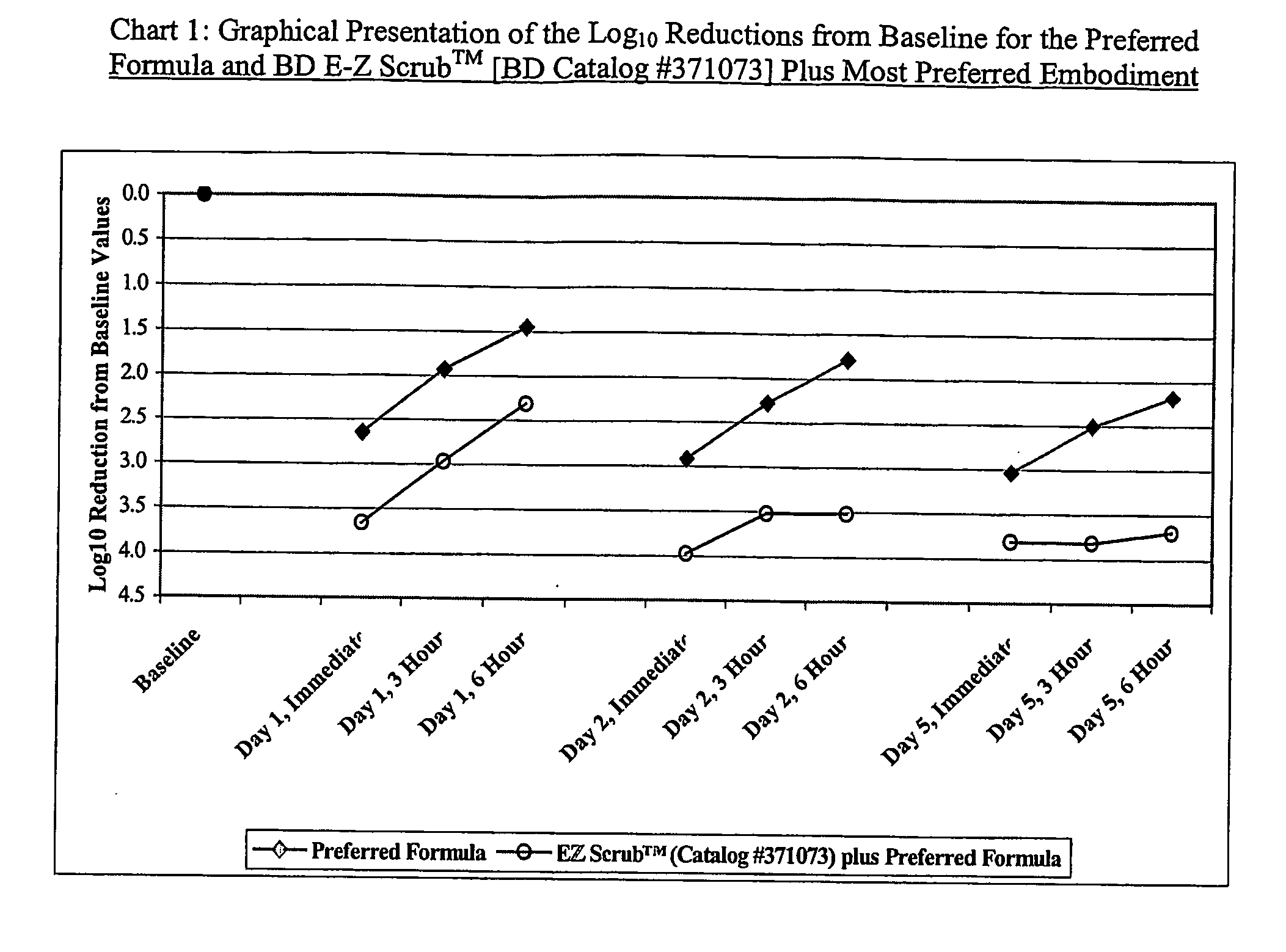
[0032] Standard testing of the most preferred embodiment demonstrates its effectiveness as an antiseptic to provide an immediate reduction of microbes and then to prevent microbial growth back to baseline within a 6-hour period. The immediate log reduction was 2.65 on day 1, 2.92 on day 2 and 3.04 on day 3. The residual effect was a log reduction six hours after hand cleaning of 1.45 on day 1, 1.79 on day 2 and 2.18 on day 3. The residual anti-microbial activity is facilitated by the containment of the anti-microbial agent in the polymer film that is formed. The film forms an invisible “glove” containing an anti-microbial agent. The anti-microbial agent remains on the skin in the film and continues to be bactericidal over extended periods of time. The invisible glove prevents microbes that may be present on the hands of the healthcare worker from infec...
PUM
| Property | Measurement | Unit |
|---|---|---|
| weight percent | aaaaa | aaaaa |
| weight percent | aaaaa | aaaaa |
| weight percent | aaaaa | aaaaa |
Abstract
Description
Claims
Application Information
 Login to View More