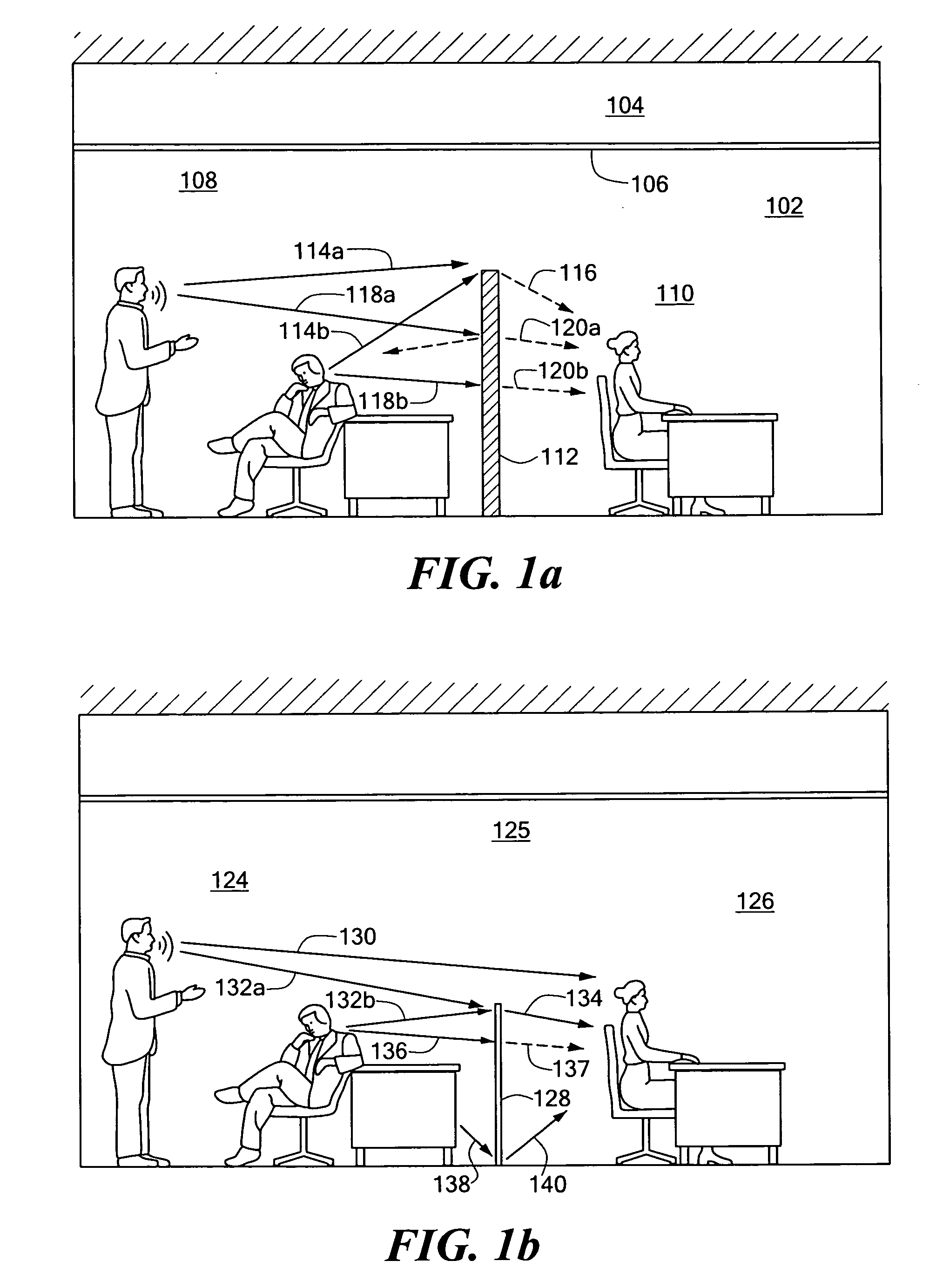
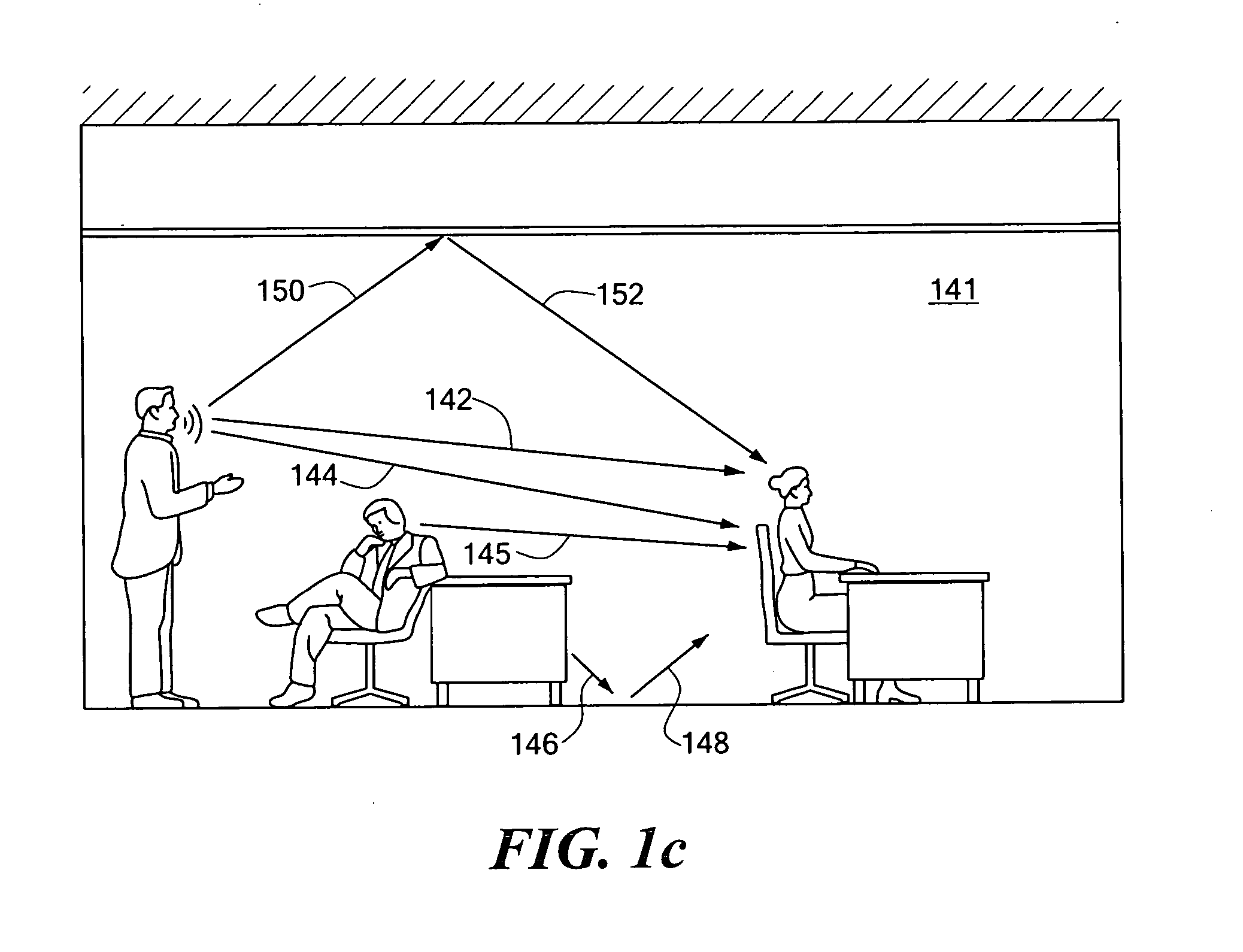
However, despite the advantages of the open plan type office, unwanted speech from a talker in a nearby
workstation is readily transmitted to unintended listeners in nearby
workstation areas.
By contrast, if it has any readily identifiable or unnatural characteristics such as “rumble,”“hiss,” or tones, or if it exhibits obvious temporal variations of any type, it readily becomes a source of annoyance itself.
However, the volume of the masking sound must be a relatively
high intensity if the construction NR is reduced by partial-height intervening partitions, an acoustically poor design or
layout, or materials that have a high acoustic
reflectivity.
Even in an acoustically well designed open office, the level of masking
noise necessary to meet privacy goals may be judged uncomfortable by some individuals, especially those with certain hearing impairments.
Naturally generated air
noise from an
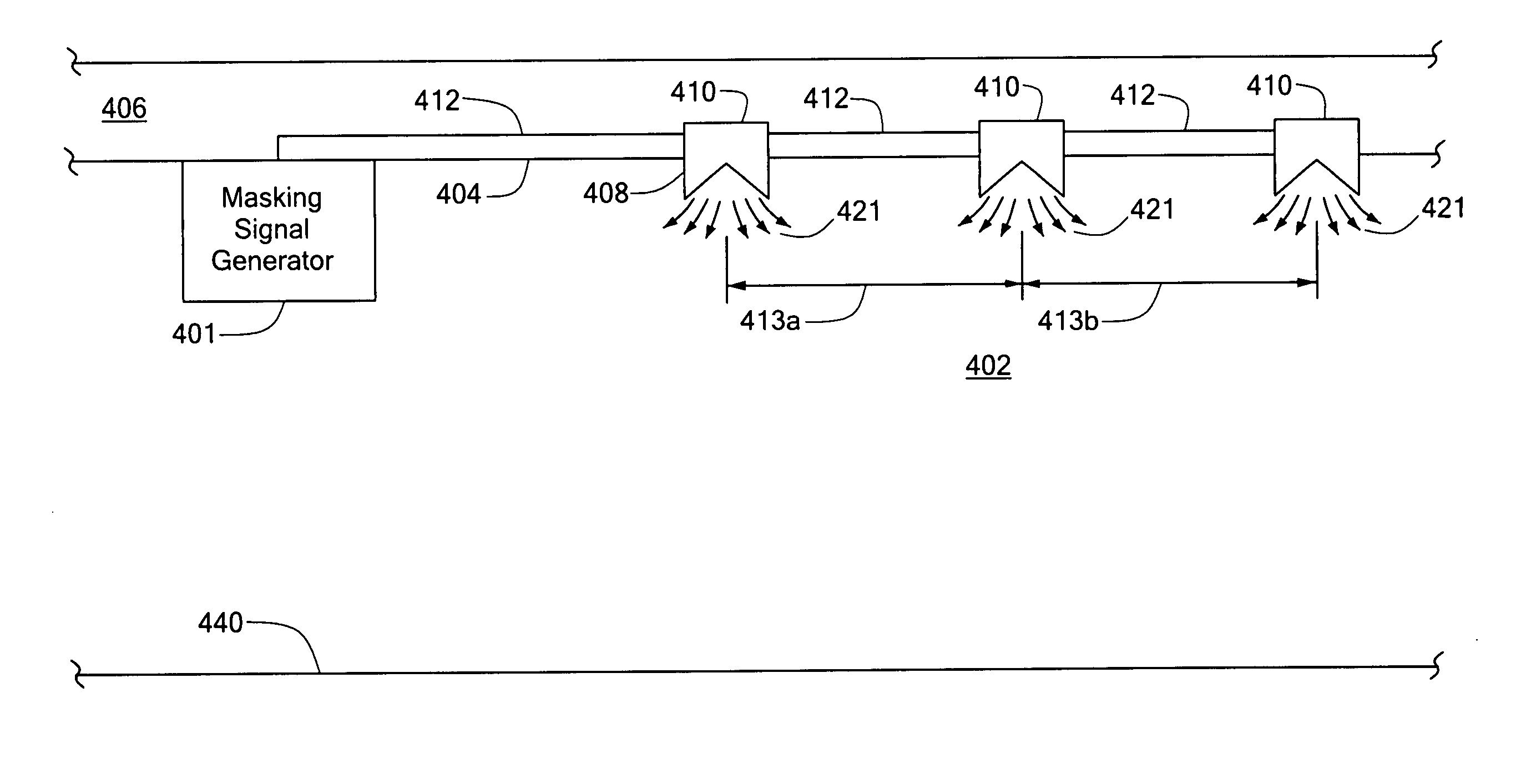
HVAC system typically is radiated by many spatially separated turbulent eddies generated at the system terminal devices or diffusers.
In contrast, even if a masking system provides an ideal spectrum shape and sound level, its quality will be unpleasantly “canned” or
colored subjectively if it is radiated from a single loudspeaker or location.
In addition, the sound attenuation characteristics of the ceiling
assembly are normally not knowable until after installation and testing.
Thus, additional time and cost are incurred due to the testing and frequency adjustment that must be performed post installation.
Also, because the acoustic sound masking signal must pass through the acoustical ceiling and be attenuated thereby, a large part of the acoustical power radiated by the loudspeakers is wasted in the form of heat as the acoustic masking signal is attenuated.
Accordingly, despite the requirement for only very small amounts of acoustical sound masking power within the listening space itself, relatively high power electrical signals driving large and costly loudspeakers are needed to provide the necessary masking
signal strength.
Due to the power required, the loudspeaker assemblies are normally large and heavy.
This additional support structure increases the installation cost, and the placement of the large loudspeakers in the plenum area inhibits access to the above ceiling space, which also complicates the design and installation of the loudspeakers.
However, their use has been restricted to installation in facilities with atypically high ceiling heights due to appearance, masking sound uniformity, an overly small or crowded plenum area, and cost considerations.
When a conventional loudspeaker is attempted below a ceiling in a more typical office environment with ceiling heights of 9′-12′, or within the ceiling, the uniformity of masking sound is found to be unacceptable.
In particular, conventional loudspeakers exhibit a narrow
beamwidth at higher frequencies, causing “hot-spotting” on their axes.
Unlike music or other time varying signals, masking sound has essentially constant bandwidth temporally, and any significant narrowing of
beamwidth within the acoustic band is immediately obvious and unpleasant to most individuals.
Moreover, unless loudspeakers are mounted within several feet of one another, overall level uniformity is unacceptable due to square law or distance spreading, that is, the sound level attenuates unacceptably with distance from the loudspeaker, drawing attention to its location.
This close loudspeaker proximity is unsightly and uneconomic.
Thus, in these systems an unacceptable number of these conventional loudspeakers are required to avoid hot-spotting and signal non-uniformity within a masking zone.
As masking levels are increased above 48 dBA, complaints of excessive masking sound increase.
Unfortunately, it can be shown that this level of sound with the typically used spectrum is largely ineffective for sound masking in an office setting without significant acoustical barriers to reduce high frequencies of intruding
speech sound.



 Login to View More
  Login to View More