Check patentability & draft patents in minutes with Patsnap Eureka AI!

Multi-bit nonvolatile memory device and related programming method

a nonvolatile memory, multi-bit technology, applied in static storage, digital storage, instruments, etc., can solve the problems of affecting the performance of memory cells, and requiring a large amount of memory,

Inactive Publication Date: 2007-11-01
SAMSUNG ELECTRONICS CO LTD
View PDF5 Cites 211 Cited by
  • Summary
  • Abstract
  • Description
  • Claims
  • Application Information

AI Technical Summary

Benefits of technology

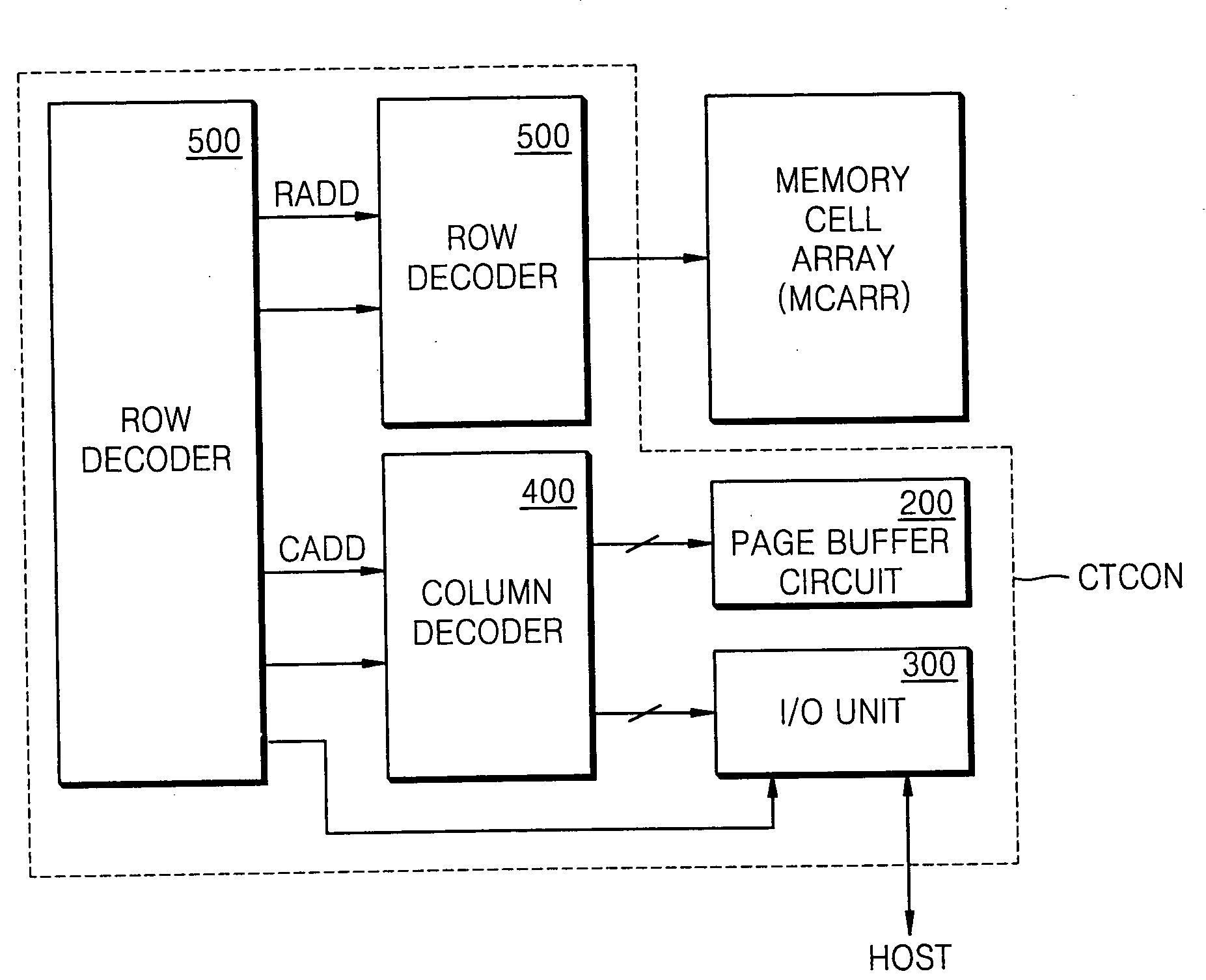
[0075]One embodiment of the invention provides a method of programming a nonvolatile memory device comprising a plurality of n-valued nonvolatile memory cells arranged in a matrix, wherein n is a natural number greater than or equal to two (2). The method comprises programming i-valued data to three or more memory cells contiguously arranged along a first direction of the matrix before programming (i+1)-valued data to any of the three or more memory cells, wherein i is less than n, and wherein the three or more memory cells are programmed during three or more respectively distinct program periods, and after programming the i-valued data to the three or more memory cells, programming (i+1)-valued data to a particular memory cell among the three or more memory cells.
[0076]Another embodiment of the invention provides a method of programming a nonvolatile memory device comprising a plurality of n-valued nonvolatile memory cells arranged in a matrix and further arranged in a plurality of strings, wherein n is a natural number greater than or equal to two (2). The method comprises defining odd and even strings among the plurality of strings and identifying a particular odd string and a corresponding particular even string

Problems solved by technology

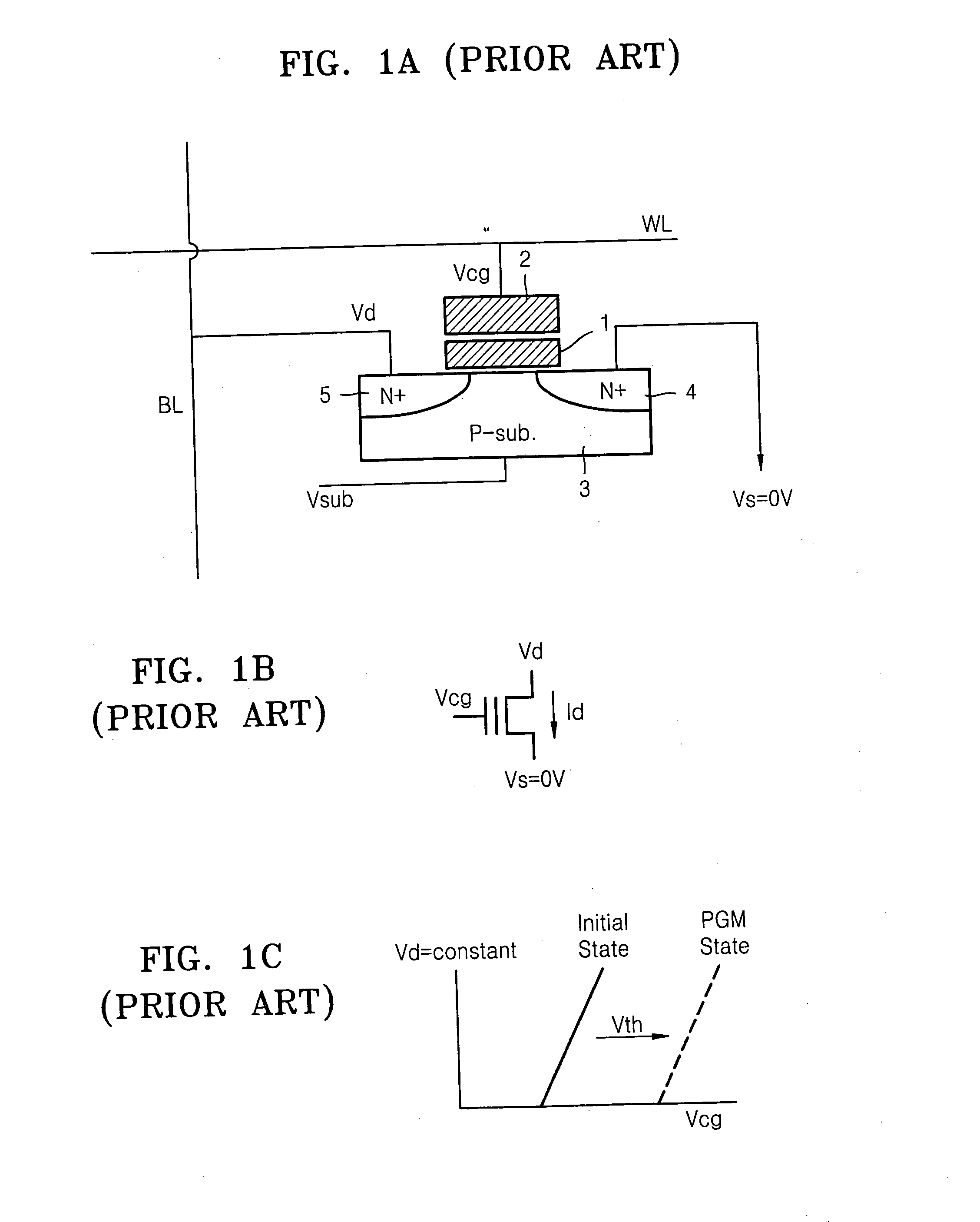
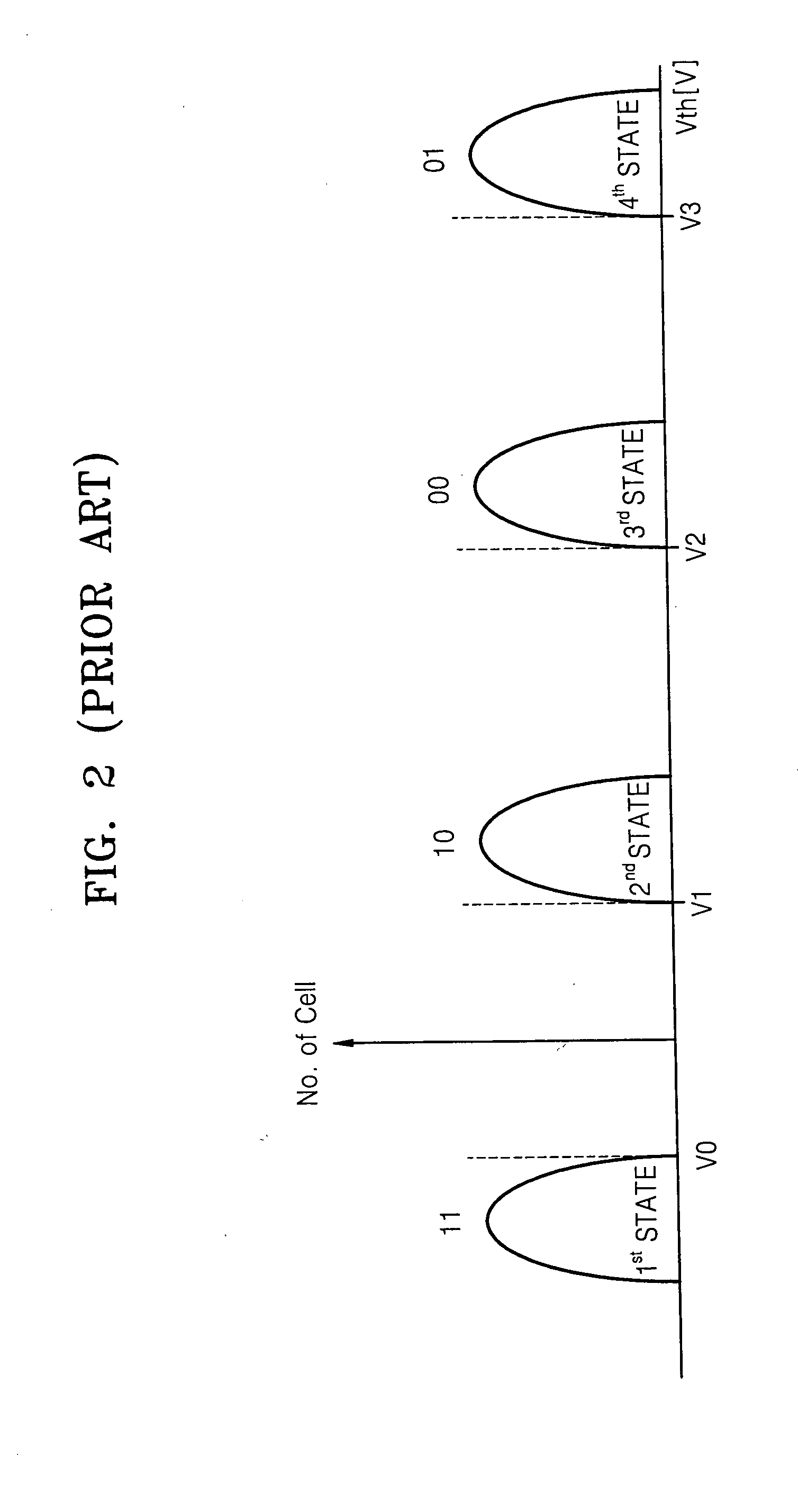
Typically, adequate sensing margins are more difficult to attain as the number of programmed states represented by a nonvolatile memory device increases.
Unfortunately, as the density of memory cells in a nonvolatile semiconductor memory device increases, electrical interactions between adjacent memory cells can begin to have a significant impact on the memory cells' performance.
For example, noise on the common select line (CSL) can affect the detected threshold voltage of memory cells during read verify operations, causing the threshold voltage to be higher or lower than desired.
However, as demonstrated by FIG. 14, floating gate coupling tends to have a relatively large effect on the threshold voltage of a memory cell compared with CSL noise and BPD.
As a result, floating gate coupling tends to make memory cells more error prone—especially memory cells with relatively densely packed threshold voltage distributions, such as multi-bit memory cells.

Method used

the structure of the environmentally friendly knitted fabric provided by the present invention; figure 2 Flow chart of the yarn wrapping machine for environmentally friendly knitted fabrics and storage devices; image 3 Is the parameter map of the yarn covering machine
View more

Image

Smart Image Click on the blue labels to locate them in the text.
Viewing Examples
Smart Image
  • Multi-bit nonvolatile memory device and related programming method
  • Multi-bit nonvolatile memory device and related programming method
  • Multi-bit nonvolatile memory device and related programming method

Examples

Experimental program
Comparison scheme
Effect test

Embodiment Construction

[0106]Exemplary embodiments of the invention are described below with reference to the corresponding drawings. These embodiments are presented as teaching examples. The actual scope of the invention is defined by the claims that follow.

[0107]FIGS. 23 through 27 illustrate various methods of programming the memory cells of a multi-bit nonvolatile memory device according to selected embodiments of the invention. In these methods, the respective least significant bits (LSBs) of several memory cells are programmed before the MSB of any of the memory cells is programmed in order to minimize the effects of floating gate coupling on the final states of the memory cells.

[0108]The methods of FIGS. 23 through 27 are illustrated in the context of two-bit NAND flash memories. However, those skilled in the art will recognize that these methods can be alternatively implemented in a variety of different types of nonvolatile memories, including nonvolatile memories storing more than two bits per ce...

the structure of the environmentally friendly knitted fabric provided by the present invention; figure 2 Flow chart of the yarn wrapping machine for environmentally friendly knitted fabrics and storage devices; image 3 Is the parameter map of the yarn covering machine
Login to View More

PUM

No PUM Login to View More

Abstract

In a method of programming a nonvolatile memory device comprising a plurality of n-valued nonvolatile memory cells arranged in a matrix, wherein n is a natural number greater than or equal to two (2), the method comprises; programming i-valued data to three or more memory cells contiguously arranged along a first direction of the matrix before programming (i+1)-valued data to any of the three or more memory cells, wherein i is less than n, and wherein the three or more memory cells are programmed during three or more respectively distinct program periods, and after programming the i-valued data to the three or more memory cells, programming (i+1)-valued data to a particular memory cell among the three or more memory cells.

Description

BACKGROUND OF THE INVENTION[0001]1. Field of the Invention[0002]Embodiments of the invention relate generally to nonvolatile memory devices and related programming methods. More particularly, embodiments of the invention relate to programming methods adapted to reduce the negative effects of floating gate coupling in multi-bit nonvolatile semiconductor memory cells.[0003]A claim of priority is made to Korean Patent Application No. 10-2006-0037429 filed Apr. 26, 2006, the disclosure of which is hereby incorporated by reference in its entirety.[0004]2. Description of Related Art[0005]The demand for electrically programmable and electrically erasable nonvolatile memory devices has increased dramatically in recent years. Such devices are at least partially characterized by the ability to maintain stored data even in the absence of supplied power. The use of so-called “flash memory” has become especially popular, particularly, but not exclusively, in the context of portable devices such ...

Claims

the structure of the environmentally friendly knitted fabric provided by the present invention; figure 2 Flow chart of the yarn wrapping machine for environmentally friendly knitted fabrics and storage devices; image 3 Is the parameter map of the yarn covering machine
Login to View More

Application Information

Patent Timeline
no application Login to View More
IPC IPC(8): G11C16/04
CPCG11C11/5628G11C16/3418G11C16/0483
Inventor KANG, SANG-GULIM, YOUNG-HO
Owner SAMSUNG ELECTRONICS CO LTD
Features
  • R&D
  • Intellectual Property
  • Life Sciences
  • Materials
  • Tech Scout
Why Patsnap Eureka
  • Unparalleled Data Quality
  • Higher Quality Content
  • 60% Fewer Hallucinations
Social media
Patsnap Eureka Blog
Learn More