Eletrofluid collisional accelerator and fusion reactor

a technology of electrofluid and collision accelerator, which is applied in the field of electrofluid fusion systems, can solve the problems of operator receiving a severe electrostatic shock

US20090065714A1Inactive Publication Date: 2009-03-12KEADY JOHN P
6 Cites 37 Cited by

Patent Information

Authority / Receiving Office
US · United States
Patent Type
Applications(United States)
Current Assignee / Owner
Publication Date
2009-03-12
Estimated Expiration
Not applicable · inactive patent

Smart Images

  • Figure 1
    Figure 1
  • Figure 2
    Figure 2
  • Figure 3
    Figure 3
Patent Text Reader

Abstract

At least one exemplary embodiment is directed toward accelerating charged hydrogenated fluid into collisions of sufficient energy to initiate at least partial fusion of the collisional hydrogenated fluid, where one of the products of the collision is a product including an element higher in the periodic tables than at least one of the colliding fluids, and where, optionally, the at least partial fusion heats a coolant loop which in turn generates electricity.
Need to check novelty before this filing date? Find Prior Art

Description

CROSS-REFERENCE TO RELATED APPLICATIONS

[0001] This application claims a priority benefit of U.S. provisional patent application 60 / 868,074 filed on 30 Nov. 2006, incorporated herein by reference in it's entirety.FIELD OF THE INVENTION

[0002] The invention relates in general to devices and methods of electrofluid technology, and particularly though not exclusively, is related to electrofluid fusion systems.BACKGROUND OF THE INVENTION

[0003] In 1988 Dr. Keady developed one of the first co-axial electrofluid devices, which charged droplets of water and kerosene, and deflected the droplets in an electric field. Electrified fluid can impact many future industries, propulsion, detector designs, manufacturing, optics, power generation and transfer, shielding, nanotechnology, and semiconductor structure formation, to mention just a few. The system was described at a NASA Langley conference in 1988 as a student paper and presentation.Charged Fluid Technology

[0004] Plasma physicist sometimes refer ...

Examples

first exemplary embodiment

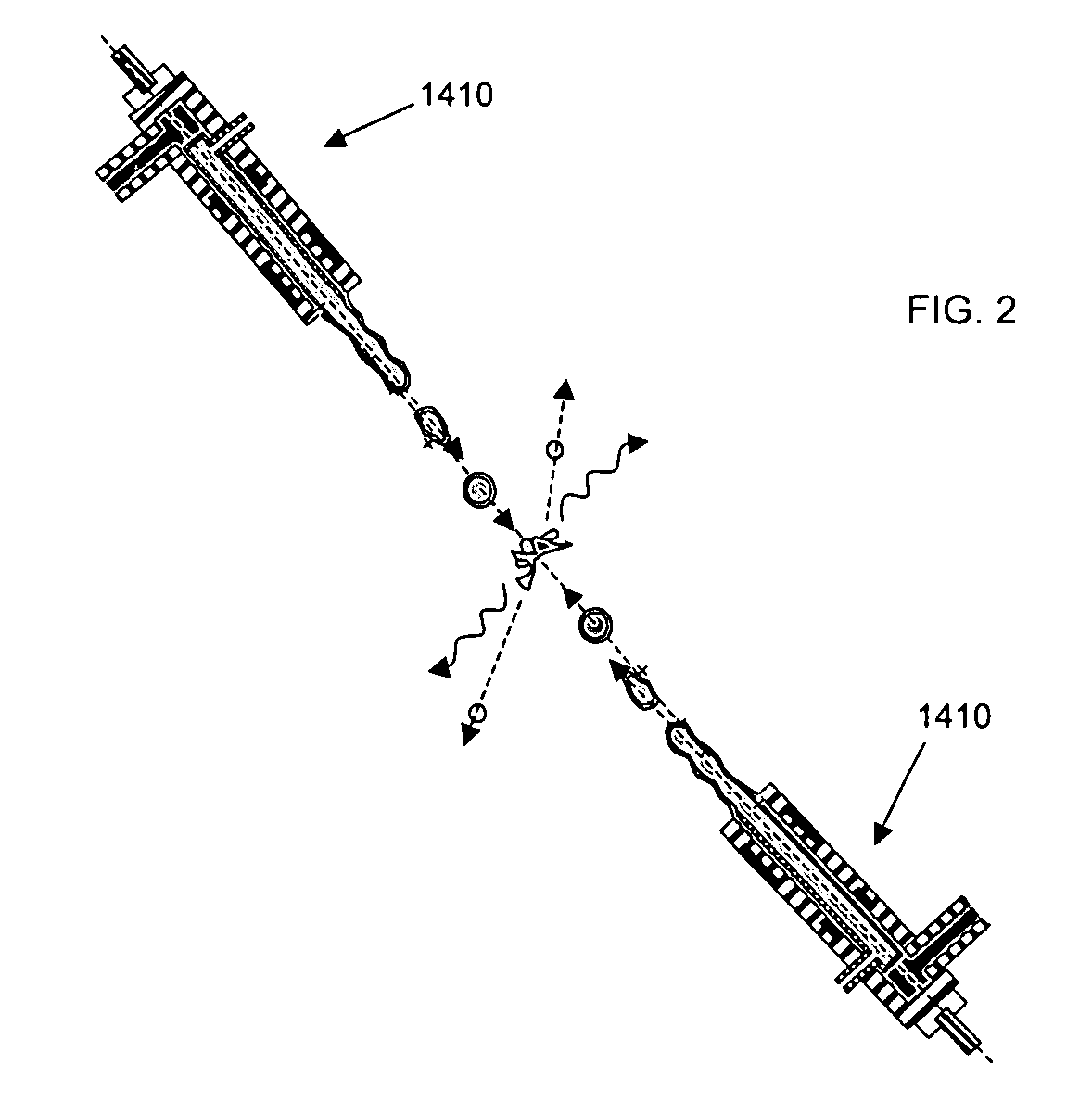
[0127]The first exemplary embodiment is directed toward accelerating charged hydrogenated fluid into collisions of sufficient energy to initiate at least partial fusion of the collisional hydrogenated fluid, where one of the products of the collision is a product including an element higher in the periodic tables than at least one of the collided fluids, and where, optionally, the at least partial fusion heats a coolant loop which in turn generates electricity.

second exemplary embodiment

[0128]The second exemplary embodiment is directed to the collisional fusion of at least two oppositely charged hydrogenated fluid streams, droplets, and / or mists.

third exemplary embodiment

[0129]The third exemplary embodiment is directed to the collisional fusion of at least two neutralized charged fluid streams, droplets, and / or mists.