Unlock instant, AI-driven research and patent intelligence for your innovation.

Video coding and decoding

a video and signal technology, applied in the field of video coding and decoding, can solve the problems of loss of synchronization, loss of whole packet, and considerable disruption

Inactive Publication Date: 2009-09-17
BRITISH TELECOMM PLC
View PDF6 Cites 14 Cited by
  • Summary
  • Abstract
  • Description
  • Claims
  • Application Information

AI Technical Summary

Benefits of technology

[0031]the criterion for identification of the said forward predictor portion and backward predictor portion being that the sum of the future motion vector and the backward motion vector shall be equal to the forward motion vector, and that a combined similarity measure representing a combination of (A) the similarity of the forward predictor portion of the past reference frame to the region to be coded and (B) the similarity of the backward predictor portion of the past reference frame to the region to be coded shall be substantially maximized.

Problems solved by technology

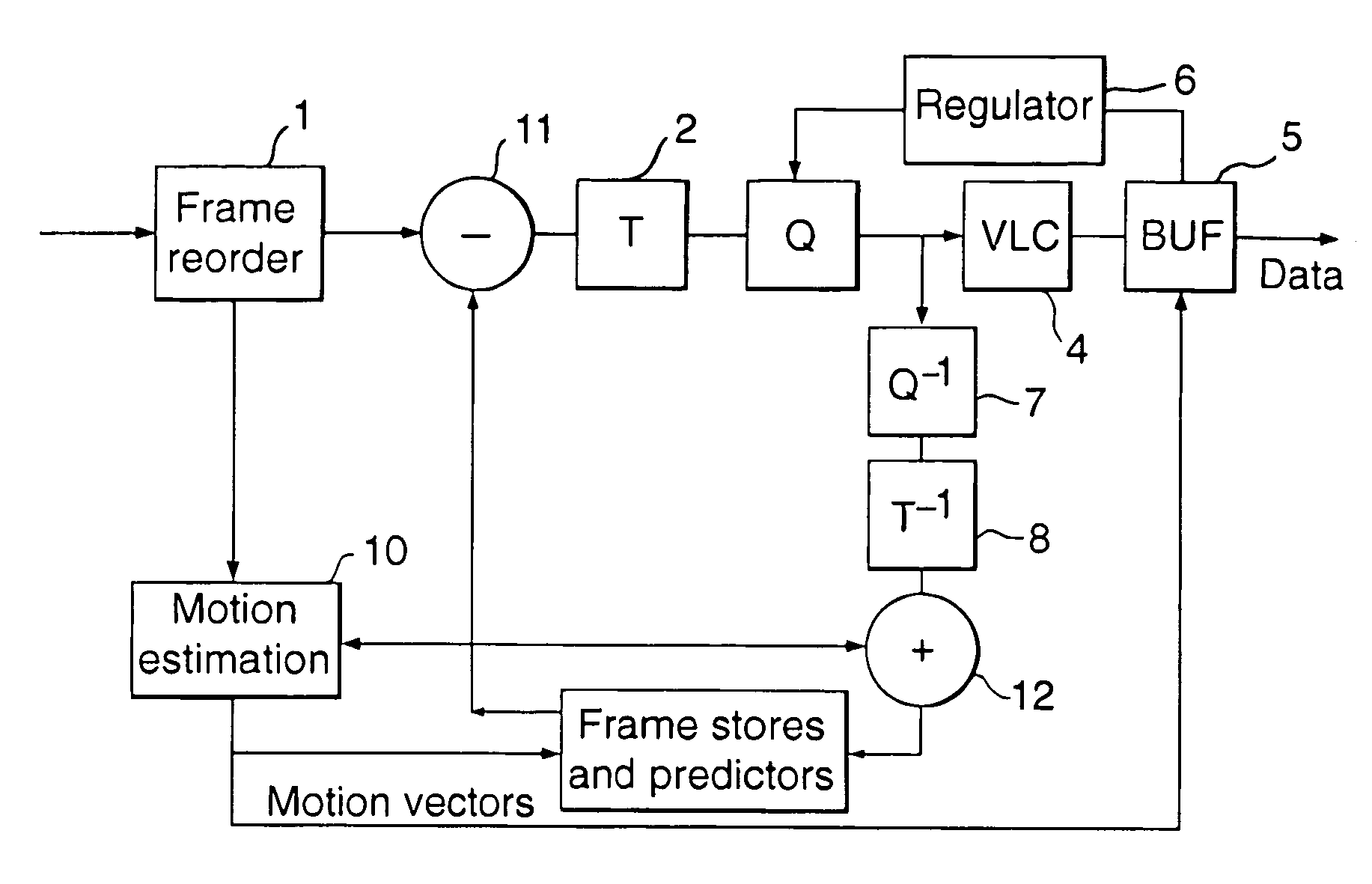
However, because of movement in the scene, this may not be optimum and, therefore, the MPEG standard uses motion-compensated predictive coding whereby one takes as one's prediction an area of the reference frame the same size and shape as the macroblock, but offset from it by an amount referred to as a motion vector.
These may be of brief duration, or may persist for some time: for example, in packet-switched networks, network congestion may cause delays exceeding the maximum delay that a decoder can accommodate, so that a whole packet is effectively lost.
Even brief errors can cause considerable disruption if they cause loss of synchronization of information coded using variable-length codes.
Inherently, the use of inter-frame coding means that corruption of an anchor frame propagates into subsequent frames.
However, in the event of the loss of a significant portion, or all, of a frame, this concealment fails, because the concealment vectors are also lost.

Method used

the structure of the environmentally friendly knitted fabric provided by the present invention; figure 2 Flow chart of the yarn wrapping machine for environmentally friendly knitted fabrics and storage devices; image 3 Is the parameter map of the yarn covering machine
View more

Image

Smart Image Click on the blue labels to locate them in the text.
Viewing Examples
Smart Image
  • Video coding and decoding
  • Video coding and decoding
  • Video coding and decoding

Examples

Experimental program
Comparison scheme
Effect test

Embodiment Construction

[0041]Before describing a decoder constructed according to the invention, the operation of a conventional MPEG decoder will be outlined, with reference to FIG. 3. Signals to be decoded are received at an input buffer 100. A demultiplexer 101 separates control information (including, for example, signals which indicate whether a macroblock uses intra- or inter-frame coding), DCT coefficients and motion vectors. When an I-frame is being received, the DCT coefficients are processed by a variable-length decoder 102, inverse quantizer 103, and inverse DCT unit 104. The resulting decoded frame is entered, via an adder 108 which, in this case, receives no other input and, therefore, performs no addition into a “future frame” frame store 109.

[0042]Prior to decoding of the P-frame which follows, the I-frame (or more generally, the preceding anchor frame) stored in the “future frame” frame store 109 is entered into a display buffer 105 and also copied into a “previous frame” frame store 106. ...

the structure of the environmentally friendly knitted fabric provided by the present invention; figure 2 Flow chart of the yarn wrapping machine for environmentally friendly knitted fabrics and storage devices; image 3 Is the parameter map of the yarn covering machine
Login to View More

PUM

No PUM Login to View More

Abstract

A decoder for video signals, such as MPEG, which uses motion-compensated bidirectional predictive coding, performs concealment of lost or corrupted portions of a picture. For this purpose, it estimates missing motion vectors by combining the two vectors which accompany a bidirectionally coded frame to create a substitute vector. An encoder can be modified to enhance this decoder operation, including forcing at least one frame per group of frames to be coded using bidirectional prediction, and constraining the two vectors so that the substitute vector is closer to the wanted value.

Description

CROSS-REFERENCE TO RELATED APPLICATIONS[0001]This application is a division of Ser. No. 10 / 111,660 filed Apr. 26, 2002, which was the U.S. National Phase of International Patent Application No. PCT / GB2002 / 04504 filed Nov. 27, 2000, which claims priority under 35 U.S.C. §119 based on United Kingdom Patent Application No. GB 9928022.4 filed Nov. 26, 1999, the contents of all of which are hereby incorporated by reference.BACKGROUND[0002]1. Technical Field[0003]The present invention concerns the coding and decoding of video signals using inter-frame motion-compensated predictive coding, and more especially to techniques directed towards the concealment, in the decoded pictures, of degradation caused by transmission errors.[0004]Details of the invention will be described in the context of video signals encoded and decoded in accordance with the so-called MPEG-1 system, as defined in the standard ISO-11172. However, the invention can also be used with other coding schemes in which some pi...

Claims

the structure of the environmentally friendly knitted fabric provided by the present invention; figure 2 Flow chart of the yarn wrapping machine for environmentally friendly knitted fabrics and storage devices; image 3 Is the parameter map of the yarn covering machine
Login to View More

Application Information

Patent Timeline
no application Login to View More
IPC IPC(8): H04N7/26G06T9/00H04N19/895
CPCH04N19/577H04N19/895
Inventor GHANBARI, MOHAMMED
Owner BRITISH TELECOMM PLC