
Methods, systems, and computer-program products for estimating scattered radiation in radiographic projections
a radiographic projection and radiation estimation technology, applied in material analysis using wave/particle radiation, instruments, nuclear engineering, etc., can solve the problems of non-ideal effects, spatial errors in the pixel data generated by the two-dimensional imager, and slight non-uniform radiation distribution
- Summary
- Abstract
- Description
- Claims
- Application Information
AI Technical Summary
Problems solved by technology
Method used
Image

Examples
Embodiment Construction
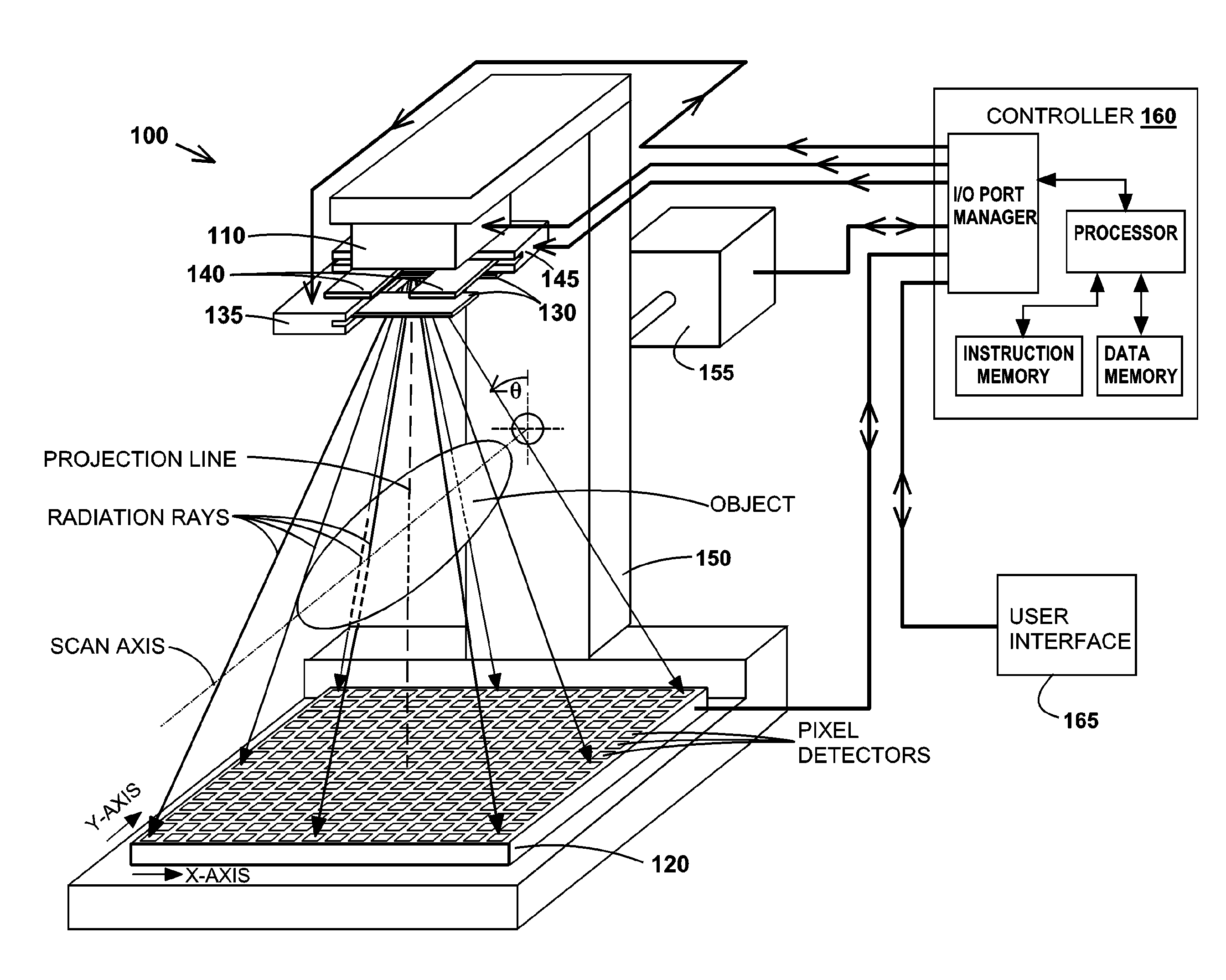
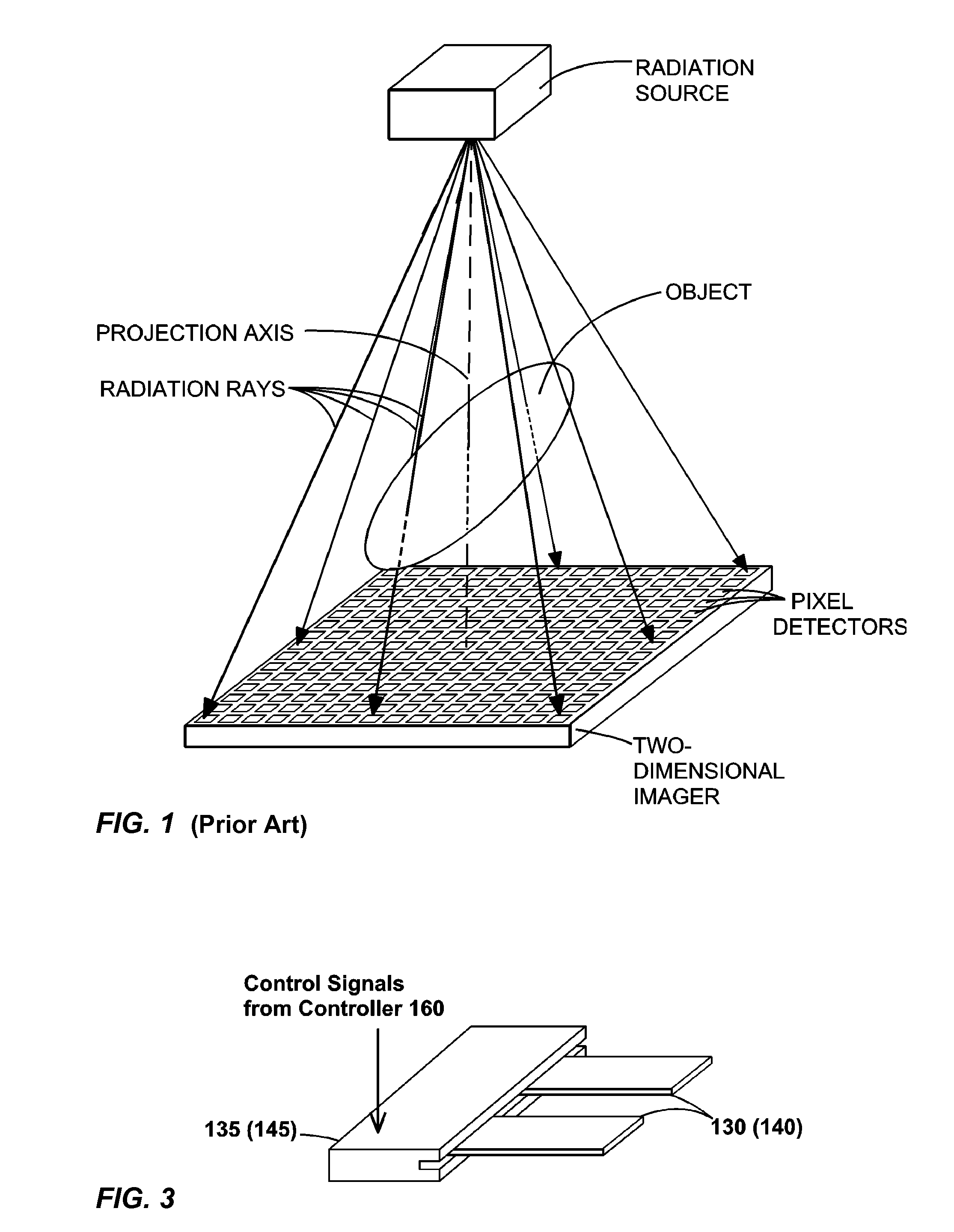
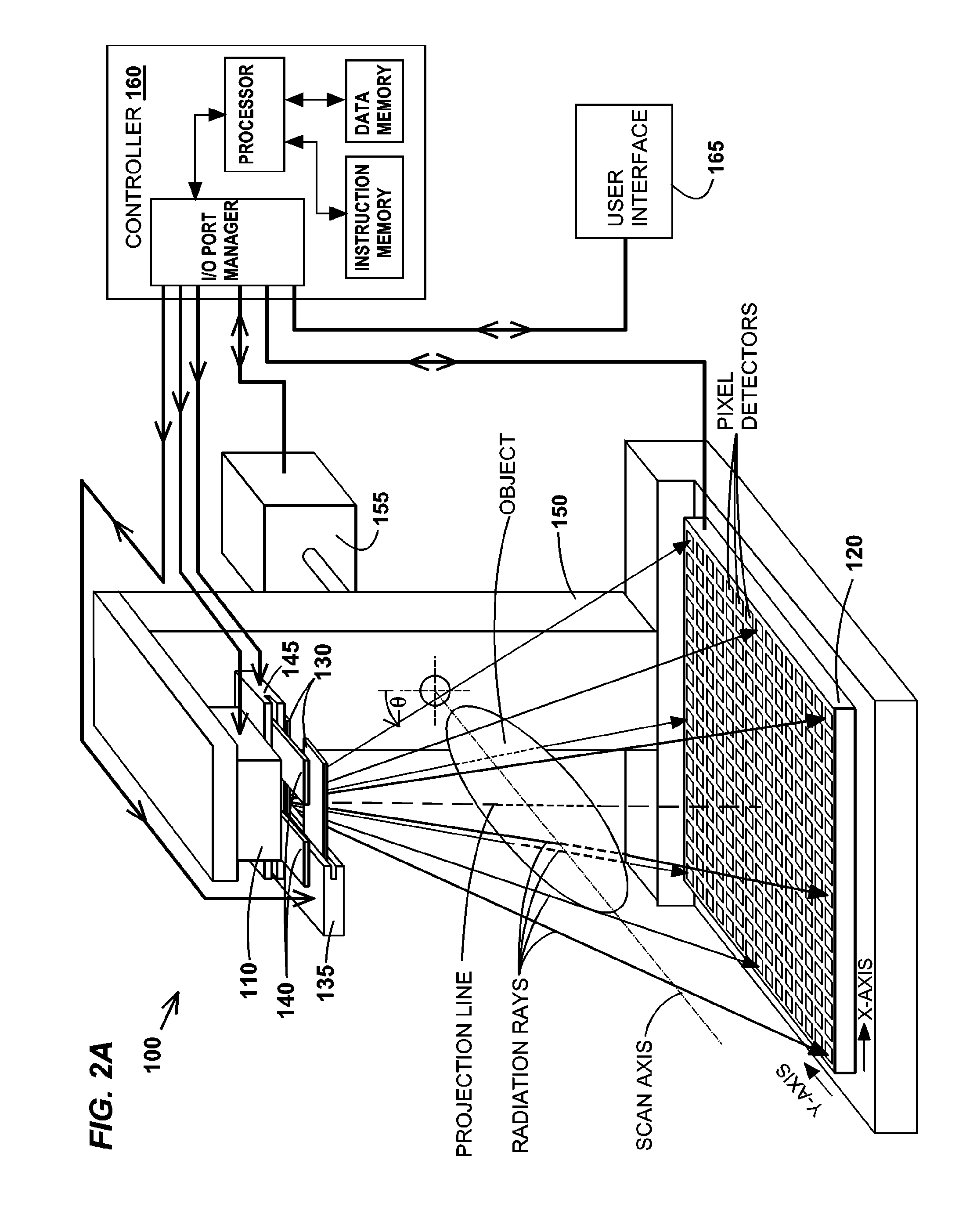
[0046]System Overview. FIG. 2A is a schematic diagram of a first exemplary imaging system 100 according to the system inventions of the present application. System 100 comprises a radiation source 110, a two-dimensional imaging device 120 disposed opposite to radiation source 110 along a projection line, a first set of fan blades 130 disposed between the radiation source and the two-dimensional imaging device, a first fan-blade drive 135 that holds fan blades 130 and sets their positions. The edges of fan blades 130 are oriented substantially perpendicular to the scan axis (defined below), and are substantially parallel with the trans-axial dimension (defined below) of imaging device 120. As an option, system 100 may further comprise a second set of fan blades 140 disposed between the radiation source and the two-dimensional imaging device, and a second fan-blade drive 145 that holds fan blades 140 and sets their positions. The edges of fan blades 140 are oriented substantially para...
PUM
| Property | Measurement | Unit |
|---|---|---|
| size | aaaaa | aaaaa |
| size | aaaaa | aaaaa |
| distance | aaaaa | aaaaa |
Abstract
Description
Claims
Application Information
 Login to View More