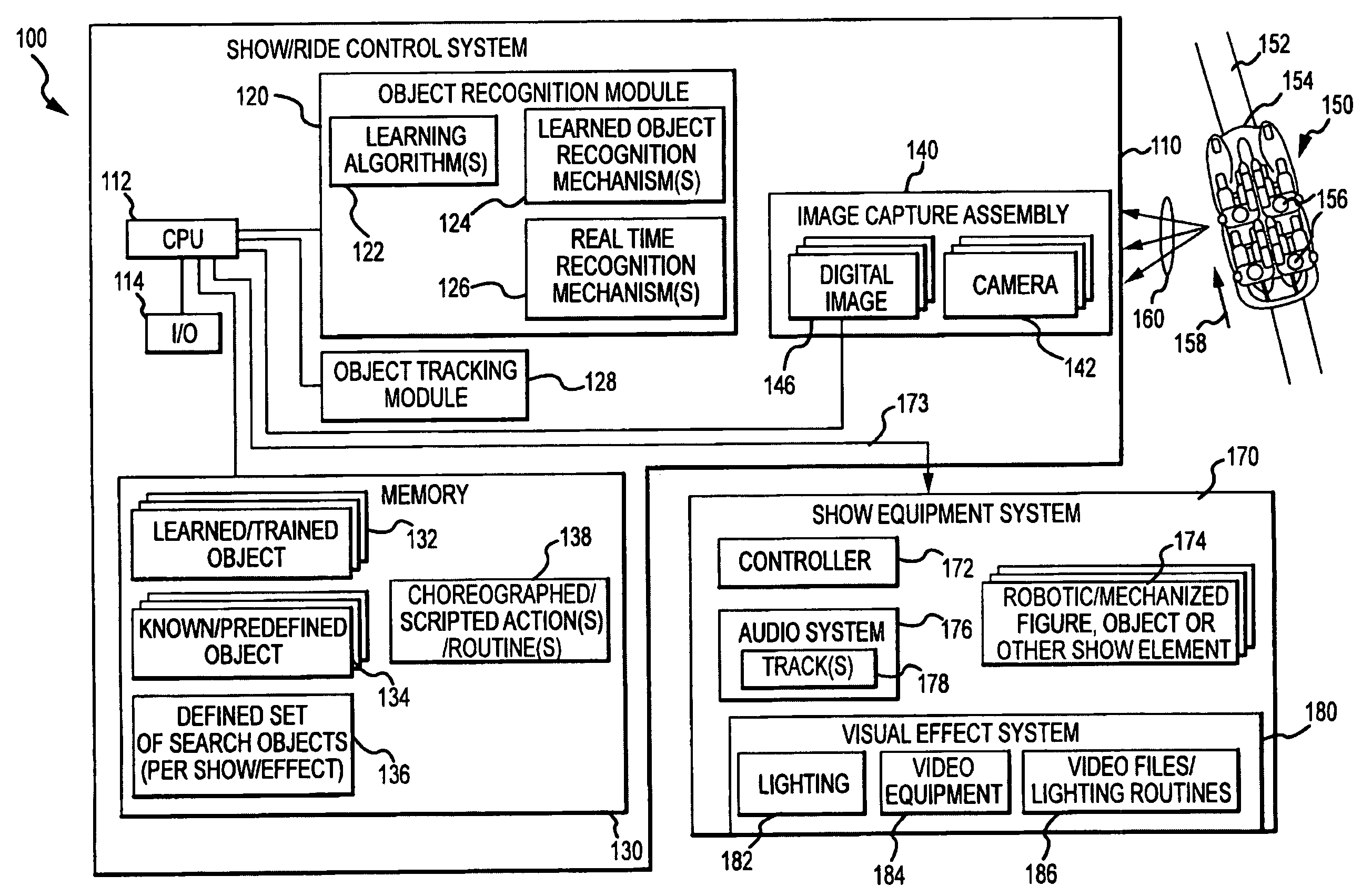
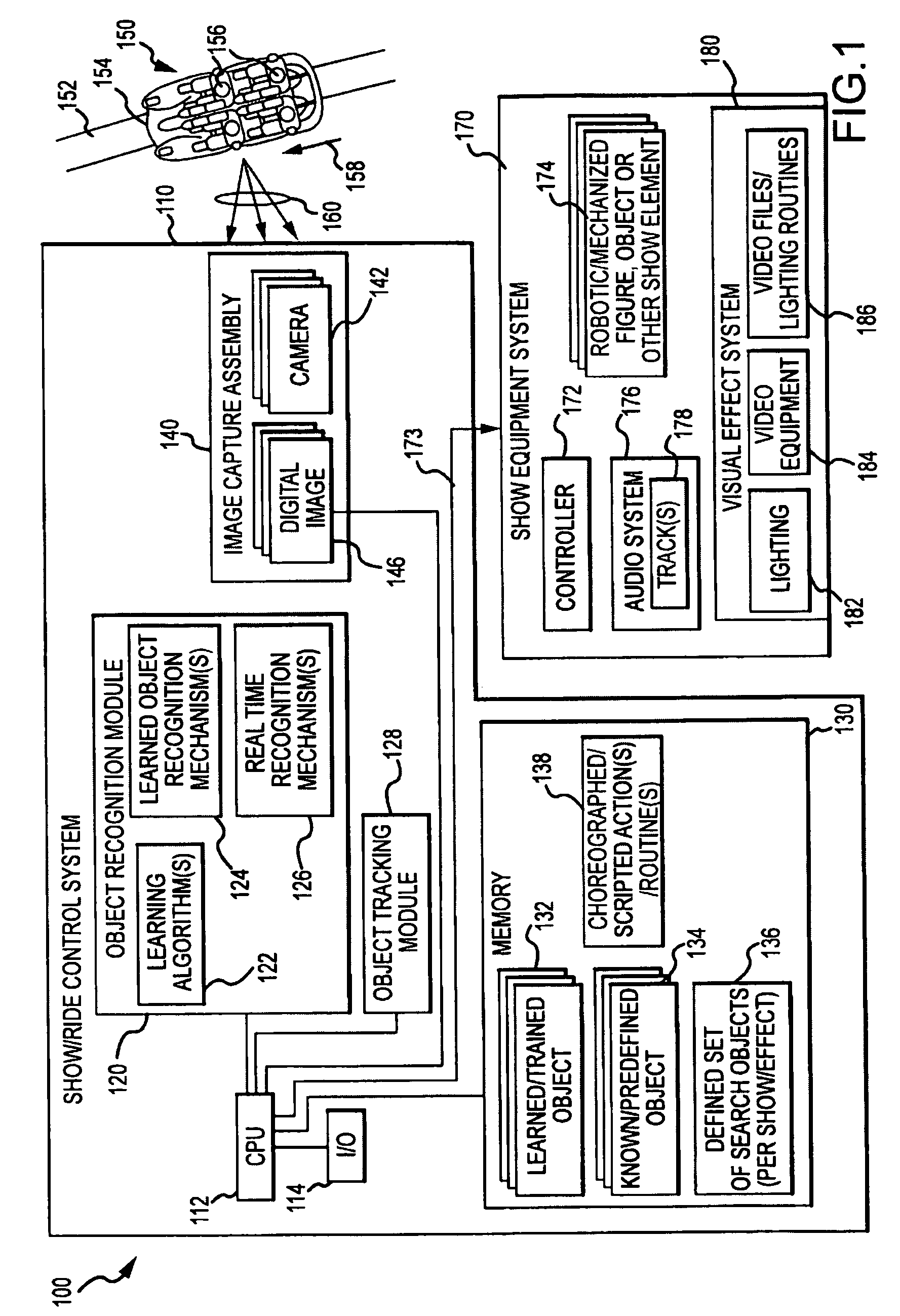
[0008]Embodiments of the present invention are directed toward use of visual recognition technology to provide rides and shows that are more interactive with guests or participants. For example, an embodiment may provide an apparatus for use in operating a ride or show element, such as robotic figure or character, to interact in a more realistic manner with people in a guest traffic area (e.g., in a vehicle traveling along a track through such an area or visitors of a park walking on a path or in a line or queue area). The apparatus may include a mechanized or robotic object / element with one or more movable components that is positioned near the guest traffic area, e.g., a robot or robotic statue positioned near a vehicle track or near a high traffic area of a park or entertainment facility. The apparatus may further include an image capture assembly using a camera and / or other devices to capture images of the traffic area and to output digital image data A controller or control system is included in the apparatus and uses a processor to run an object recognition module to process the image data so as to recognize or determine whether an object is positioned in the traffic area. In response to the object recognition, the control system operates the mechanized object or element, e.g., the mechanized object may be a robotic figure and the responsive operating may include causing the robotic figure to speak, sing, or point in the direction of the recognized object or guest wearing or holding such an object.
[0009]The control system may also include (or have access to) memory that stored data related to a set of search objects such as buttons or badges, clothes of a particular color and / or style, hats, or other worn items and / or maps, keys, balloons, or other carried / held items. These items may be objects learned by the object recognition module and / or be predefined or items known by the object recognition module. During operation, the control system acts to determine whether any of the search objects are present in the guest traffic area by processing the output image data (or the control system may be programmed to only react when 2 or more search objects are present or to look for objects in a subset of the larger set of search objects). Sets of scripted actions may also be stored in memory and one or more of such scripted actions may be associated with each of the search objects. Then, when the object recognition module identifies or recognizes one of the search objects, the control system may act to retrieve the associated script and cause the mechanized object or show element to perform the actions defined in the script (e.g., sing a song, speak a recorded message, wave arms at a guest, or the like). The object recognition module may include or utilize existing or to be developed robotic vision systems that support object recognition, e.g., ViPR™ visual pattern recognition technology or enabled-devices distributed by Evolution Robotics, Inc.; Selectin™ suite of tools for machine vision or devices enabled with Selectin™ distributed by Energid Technologies Corporation, or the like.
[0010]The control system may also include an object tracking module that is run or used by the processor to track a physical location or position of the determined object within the guest traffic area, and the control system then would in some cases operate the mechanized object or element at least partially responsive to the tracked physical position of the recognized object (e.g., turn a head or body to follow a person in a moving vehicle or have eyes of a robotic creature follow a guest walking by the creature). In some cases, the recognized object may be a human face, and the control system may operate the mechanized object or element only when a human face is detected in the guest traffic area such as to only operate a robotic figure when a passing ride vehicle is carrying passengers and not to an empty vehicle. The object tracking module may include or utilize existing or to be developed robotic vision systems that support object recognition, e.g., Selectin™ suite of tools for machine vision or devices enabled with Selectin™ distributed by Energid Technologies Corporation, object tracking software and tools developed / available from Mitsubishi Electric Research Laboratories (MERL), or the like.



 Login to View More
  Login to View More