
Sample-based robust inference for decision support system
- Summary
- Abstract
- Description
- Claims
- Application Information
AI Technical Summary
Benefits of technology
Problems solved by technology
Method used
Image

Examples
Embodiment Construction
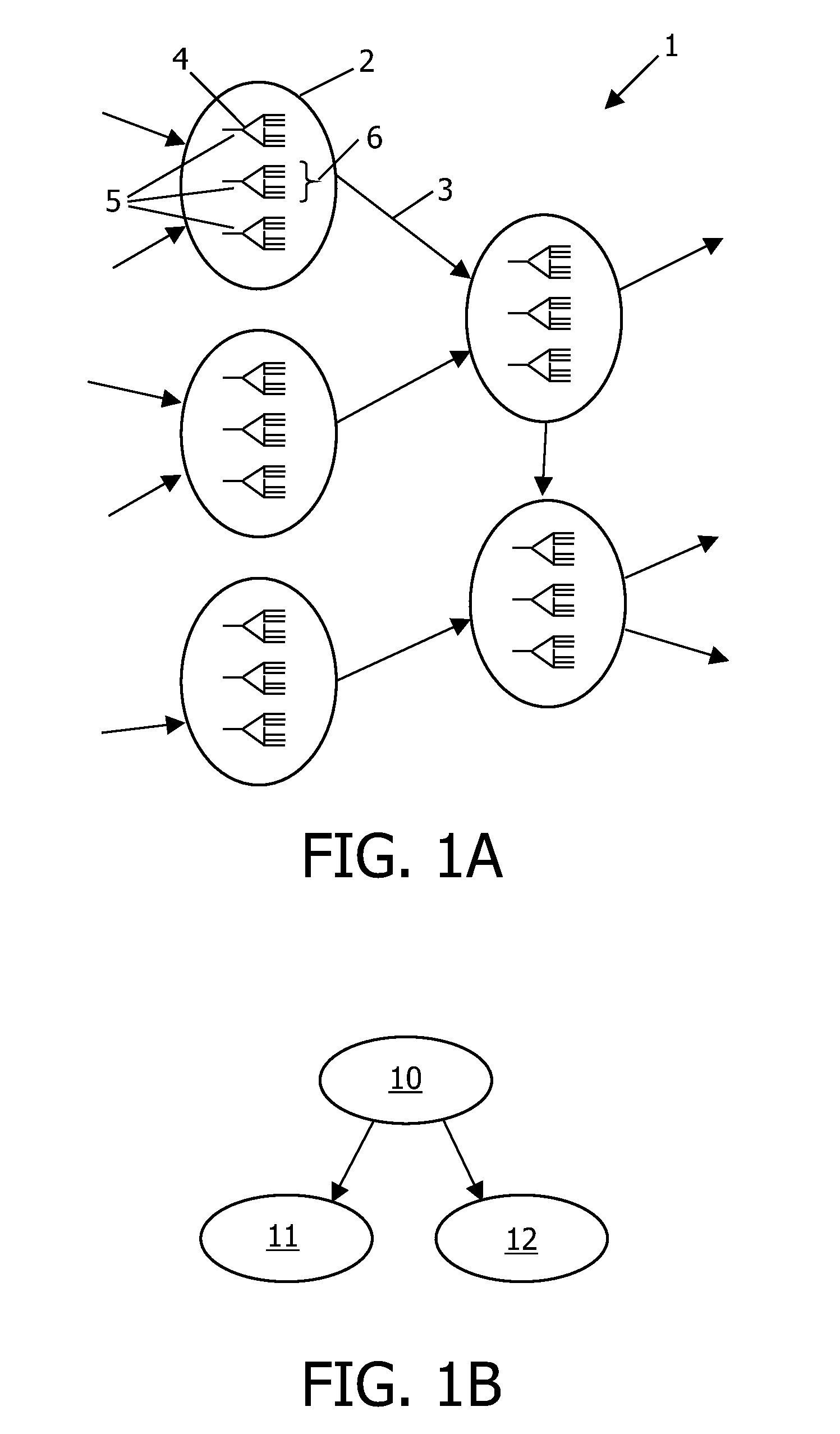
[0034]FIG. 1A illustrates a Bayesian network 1 in accordance with embodiments of the present invention. The Bayesian network 1 comprises a plurality of nodes 2 with associated probability parameters 4, the nodes being interconnected by directed arcs 3. An arc from one node to another may denote that an event represented by the former node can cause an event represented by the latter node with an associated conditional probability (CP), which is stored as a parameter of the latter node. The absence of arcs between two nodes indicates statistical independence of these nodes. Each node can have zero or more parent nodes and / or zero or more child nodes.
[0035]In the illustrated embodiment, all the nodes store three parameters 5, each parameter being stored as a value range 6. It is to be understood, that only at least a subset of the parameters may store value ranges. Thus a part of the nodes may store some, none or all of parameters as value ranges.
[0036]FIG. 1B illustrates another embo...
PUM
 Login to View More
 Abstract
Description
Claims
Application Information
 Login to View More