Unlock instant, AI-driven research and patent intelligence for your innovation.

Management of persistent memory in a multi-node computer system

Inactive Publication Date: 2009-12-17
IBM CORP
View PDF10 Cites 1 Cited by
  • Summary
  • Abstract
  • Description
  • Claims
  • Application Information

AI Technical Summary

Benefits of technology

[0009]The PM Manager works in conjunction with an operating system kernel on the nodes to provide persistent memory for application data and system metadata. The PM Manager uses the persistent memory to load applications in such a way as to preserve data from one application to the next. This operation includes re-establishing the TLB pointers to the persistent memory after the node is re-initialized for a new application. The data created by a first application is then available for use by the second application. Alternatively, the data preserved in persistent memory may be system metadata such as file system data that will be available to subsequent applications such that the system metadata will not need to be reloaded for each new application running on the node.

Problems solved by technology

Without a way to effectively create and manage persistent memory, parallel computer systems will continue to suffer from reduced efficiency of computer system.

Method used

the structure of the environmentally friendly knitted fabric provided by the present invention; figure 2 Flow chart of the yarn wrapping machine for environmentally friendly knitted fabrics and storage devices; image 3 Is the parameter map of the yarn covering machine
View more

Image

Smart Image Click on the blue labels to locate them in the text.
Viewing Examples
Smart Image
  • Management of persistent memory in a multi-node computer system
  • Management of persistent memory in a multi-node computer system
  • Management of persistent memory in a multi-node computer system

Examples

Experimental program
Comparison scheme
Effect test

Embodiment Construction

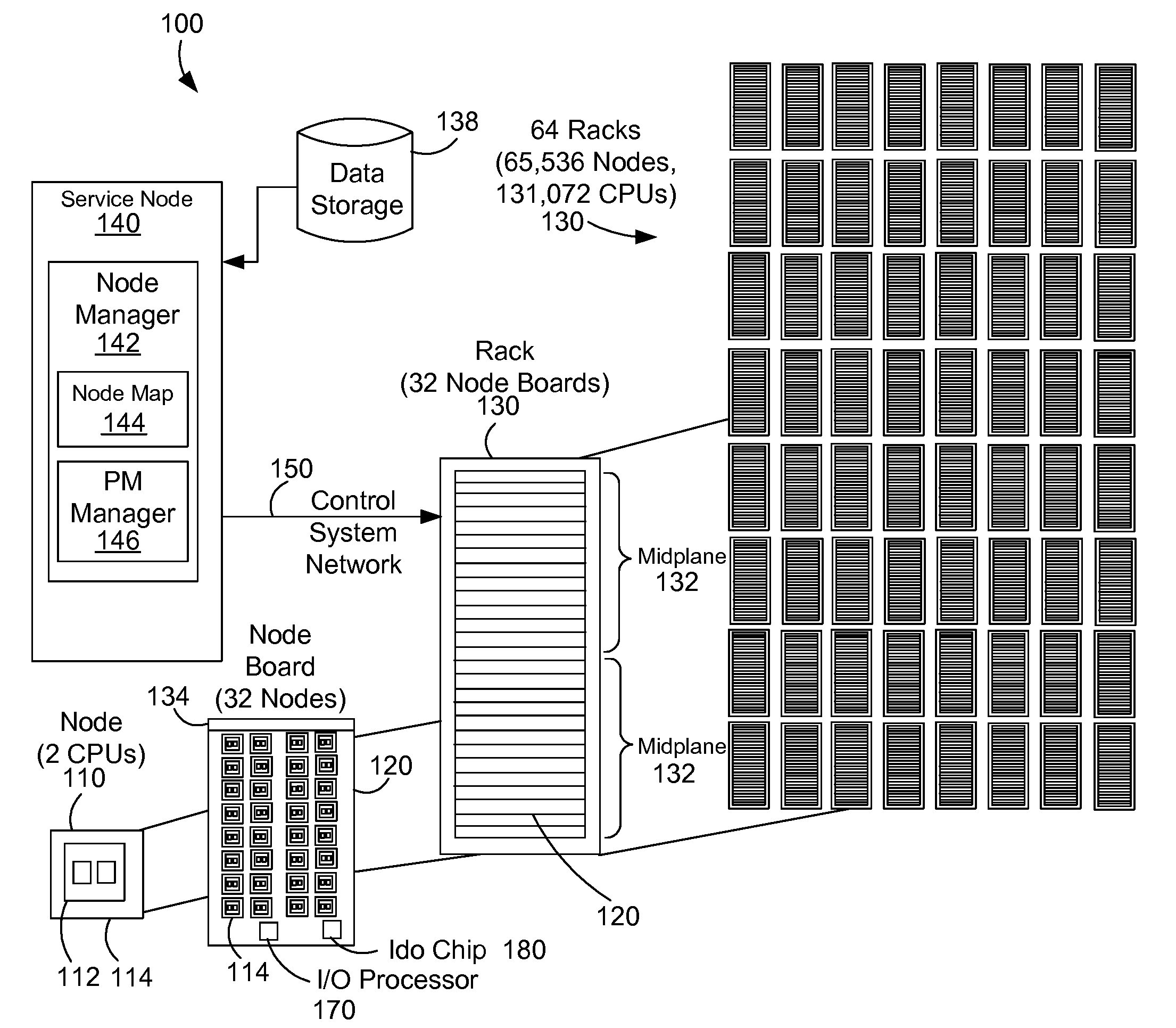
[0020]The description and claims herein are directed to a method and apparatus for creating and managing persistent memory (PM) in a multi-node computing system. The examples herein will be described with respect to the Blue Gene / L massively parallel computer developed by International Business Machines Corporation (IBM). A PM Manager in the service node creates and manages pools of nodes with various sizes of PM. A node manager uses the pools of nodes to load applications to the nodes according to the size of the available PM. The PM Manager works in conjunction with an operating system kernel on the nodes to provide persistent memory for application data and system metadata. The PM Manager uses the persistent memory to load applications in such a way as to preserve data from one application to the next. Also, the data preserved in persistent memory may be system metadata such as file system data that will be available to subsequent applications.

[0021]FIG. 1 shows a block diagram t...

the structure of the environmentally friendly knitted fabric provided by the present invention; figure 2 Flow chart of the yarn wrapping machine for environmentally friendly knitted fabrics and storage devices; image 3 Is the parameter map of the yarn covering machine
Login to View More

PUM

No PUM Login to View More

Abstract

A method and apparatus creates and manages persistent memory (PM) in a multi-node computing system. A PM Manager in the service node creates and manages pools of nodes with various sizes of PM. A node manager uses the pools of nodes to load applications to the nodes according to the size of the available PM. The PM Manager can dynamically adjust the size of the PM according to the needs of the applications based on historical use or as determined by a system administrator. The PM Manager works with an operating system kernel on the nodes to provide persistent memory for application data and system metadata. The PM Manager uses the persistent memory to load applications to preserve data from one application to the next. Also, the data preserved in persistent memory may be system metadata such as file system data that will be available to subsequent applications.

Description

BACKGROUND[0001]1. Technical Field[0002]The disclosure and claims herein generally relate to multi-node computer systems, and more specifically relate to managing persistent memory in a multi-node computer system such as in the memory of a massively parallel super computer.[0003]2. Background Art[0004]Supercomputers and other multi-node computer systems continue to be developed to tackle sophisticated computing jobs. One type of multi-node computer system is a massively parallel computer system. A family of such massively parallel computers is being developed by International Business Machines Corporation (IBM) under the name Blue Gene. The Blue Gene / L system is a high density, scalable system in which the current maximum number of compute nodes is 65,536. The Blue Gene / L node consists of a single ASIC (application specific integrated circuit) with 2 CPUs and memory. The full computer is housed in 64 racks or cabinets with 32 node boards in each rack.[0005]Computer systems such as B...

Claims

the structure of the environmentally friendly knitted fabric provided by the present invention; figure 2 Flow chart of the yarn wrapping machine for environmentally friendly knitted fabrics and storage devices; image 3 Is the parameter map of the yarn covering machine
Login to View More

Application Information

Patent Timeline
no application Login to View More
IPC IPC(8): G06F12/10
CPCG06F12/1072G06F12/1027
Inventor BARSNESS, ERIC LAWRENCEDARRINGTON, DAVID L.MCCARTHY, PATRICK JOSEPHPETERS, AMANDASANTOSUOSSO, JOHN MATTHEW
Owner IBM CORP
Features
  • R&D
  • Intellectual Property
  • Life Sciences
  • Materials
  • Tech Scout
Why Patsnap Eureka
  • Unparalleled Data Quality
  • Higher Quality Content
  • 60% Fewer Hallucinations
Social media
Patsnap Eureka Blog
Learn More