
High Voltage Power Supply
a high-voltage power supply and power supply technology, applied in the direction of power conversion systems, dc-dc conversion, instruments, etc., can solve the problems of inefficiency and waste of output voltage, performance decline, etc., and achieve the effect of effective regulation of the voltage of the power source applied
- Summary
- Abstract
- Description
- Claims
- Application Information
AI Technical Summary
Benefits of technology
Problems solved by technology
Method used
Image

Examples
examples
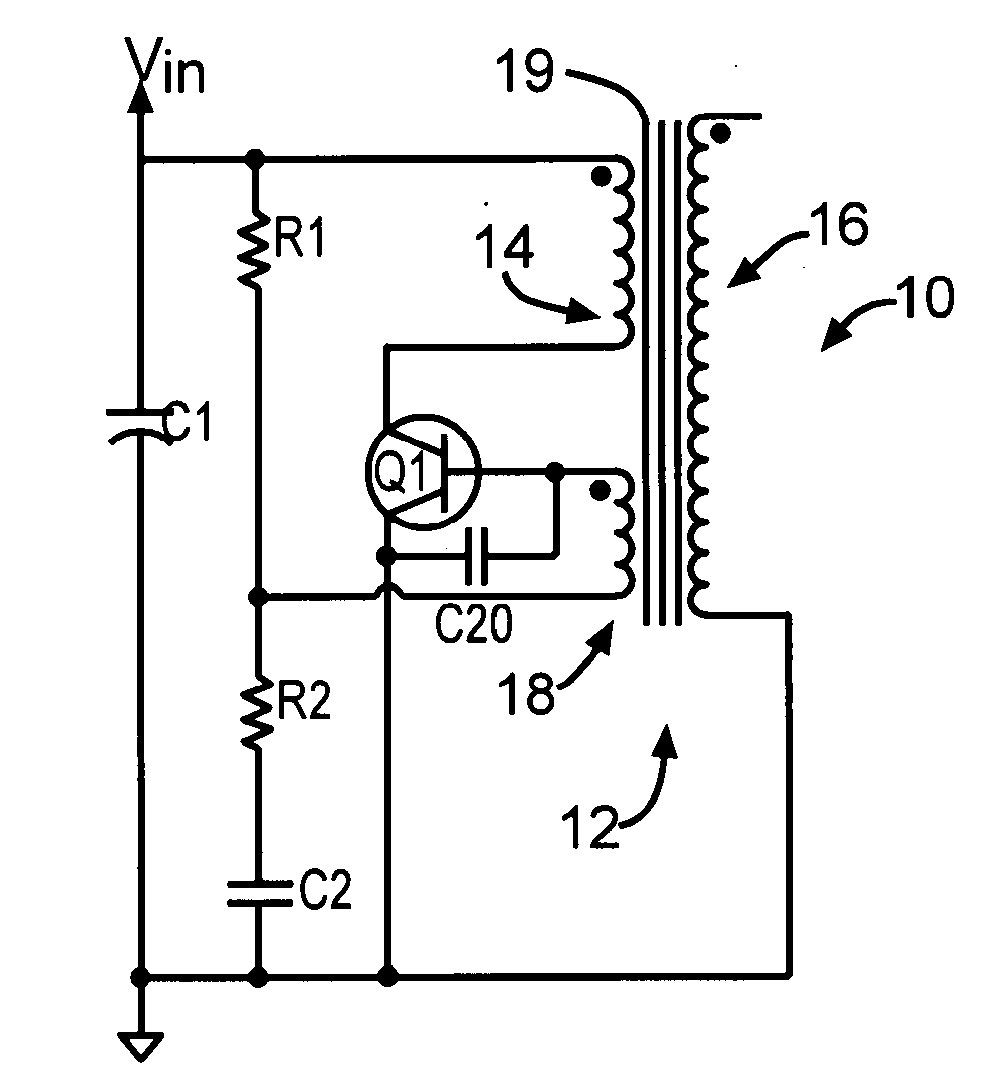
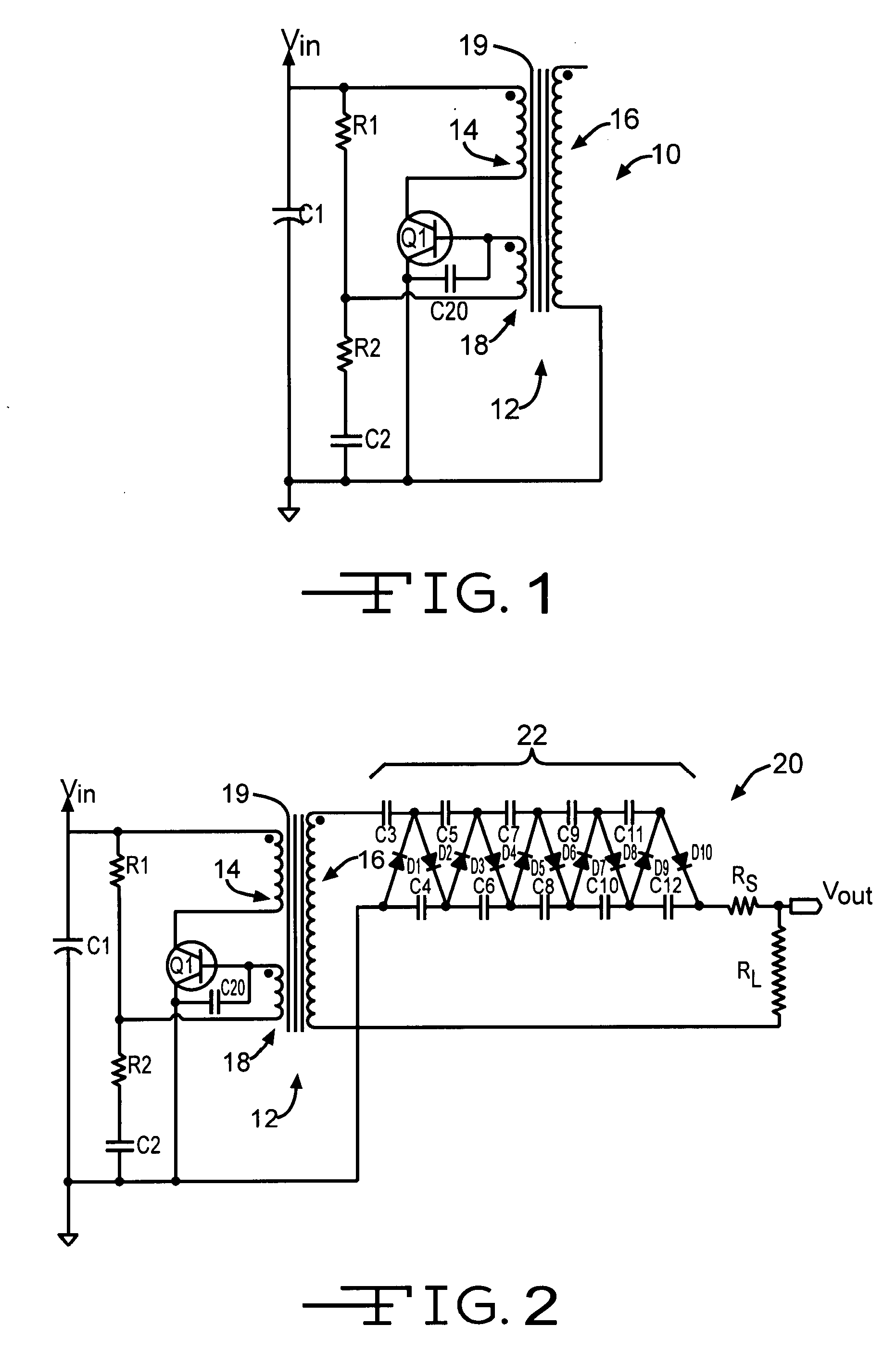
[0041]Referring now to the circuit HVPS 20 of FIG. 2, the inventors tested the circuit with a compensating capacitor C20 having a value of 0.033 uF. An oscilloscope screen of the transistor Q1 voltages is shown in FIG. 9, where the top trace is the collector signal monitored at point (a) and the bottom trace is the base signal at point (b). The compensating capacitor C20 was then removed and the test repeated, with the results shown in FIG. 10. It is clear that with the inclusion of the compensating capacitor C20, the amount of ripple was significantly reduced in the base signal (b) as well as in collector signal (a). More importantly, input current to the converter, which was at a fixed 4-volt input voltage, was reduced from 116 milliamperes (mA) to 99 mA, or by 14.66%, while the output voltage into a fixed impedance decreased from 24.4 kilovolts (kV) to 22.7 kV, or by 6.97%. Since the input voltage VIN was the same for both cases, the decrease in input current indicates a reduced ...
PUM
 Login to View More
 Abstract
Description
Claims
Application Information
 Login to View More