
Technique for compensating undesired effects in optical links of an optical communication network
- Summary
- Abstract
- Description
- Claims
- Application Information
AI Technical Summary
Benefits of technology
Problems solved by technology
Method used
Image

Examples
Example
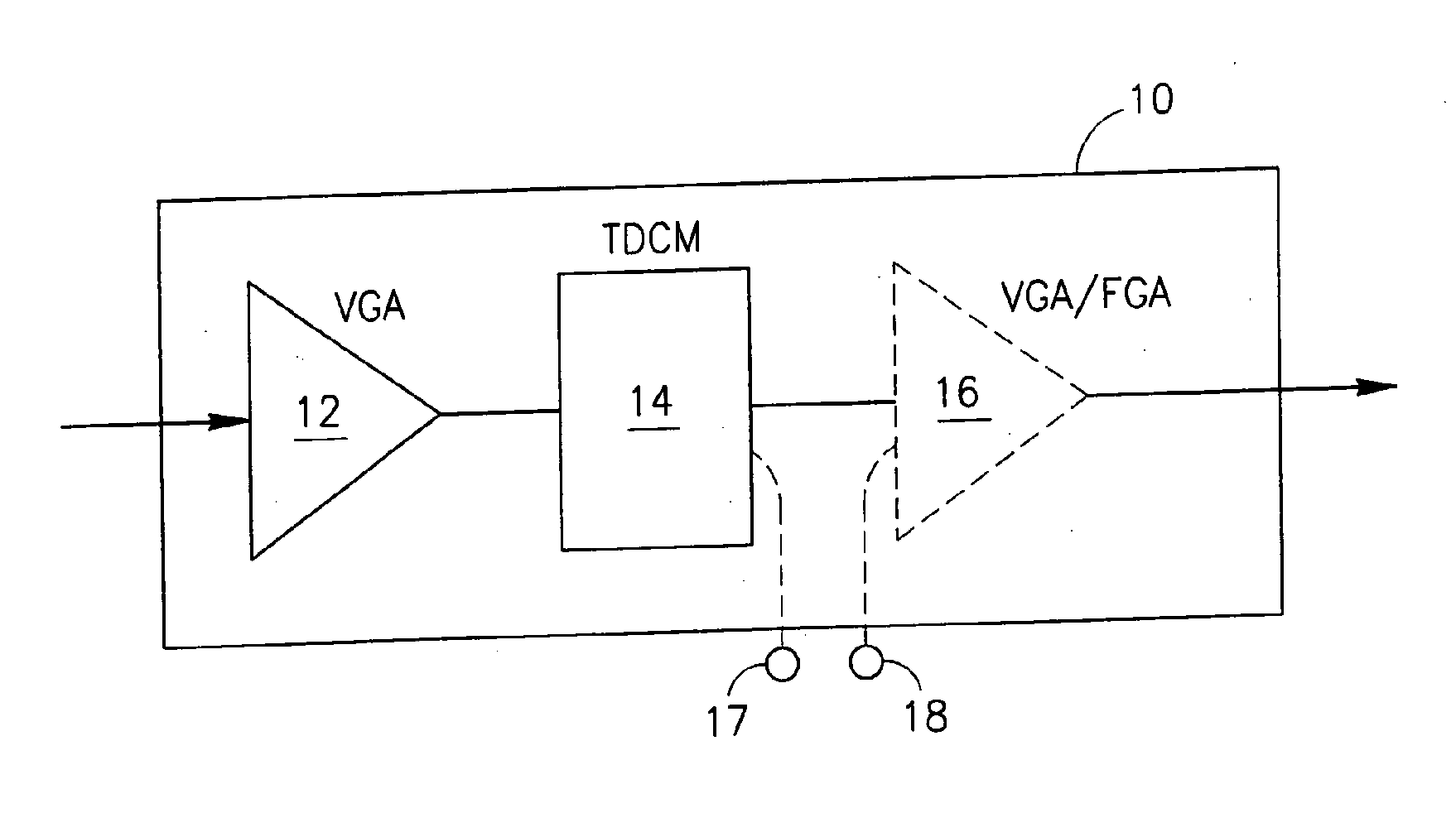
[0054]FIG. 1 shows a basic embodiment of the proposed ready-made adjustment module 10 for optical communication links, comprising a variable gain amplifier VGA 12 and a tunable dispersion compensation module TDCM 14 connected in a chain. Optionally and preferably, the adjustment module 10 comprises a second, additional amplifier 16 in the chain, which may be either a variable gain amplifier VDA or a fixed gain amplifier FGA. The figure further shows that, in case module 10 comprises the two amplifiers 12 and 16, the module may further be provided with two external contacts 17 and 18 to enable the insertion of a functional element into the chain between the amplifiers 12 and 16. These amplifiers may be two separate erbium doped fiber amplifiers—EDFAs. Alternatively, amplifiers 12 and 16 may constitute two stages of a double-stage optical amplifier, provided with contacts 17 and 18 in the mid-stage (see FIG. 3).
[0055]It should be noted that, within the adjustment module 10, the tunabl...
PUM
 Login to View More
 Abstract
Description
Claims
Application Information
 Login to View More