

Oxidized cationic polysaccharide-based polymer tissue adhesive for medical use
a tissue adhesive and cationic polysaccharide technology, applied in the field of medical adhesives, can solve the problems of limited internal application use of fibrin-based adhesives, slow curing of fibrin-based adhesives, and general inapplicability of conventional tissue adhesives to a wide range of adhesive applications
- Summary
- Abstract
- Description
- Claims
- Application Information
AI Technical Summary
Problems solved by technology
Method used
Image

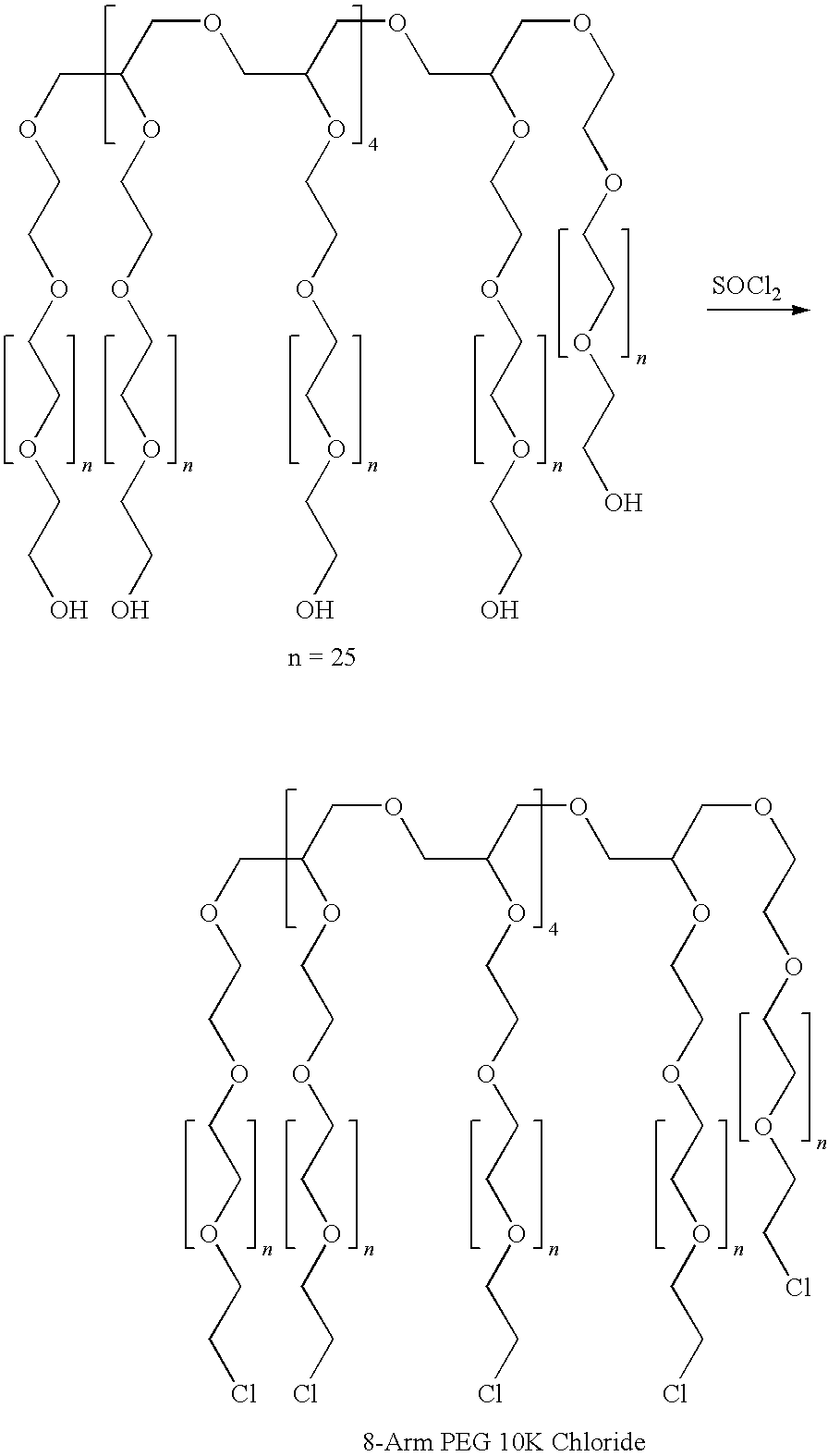
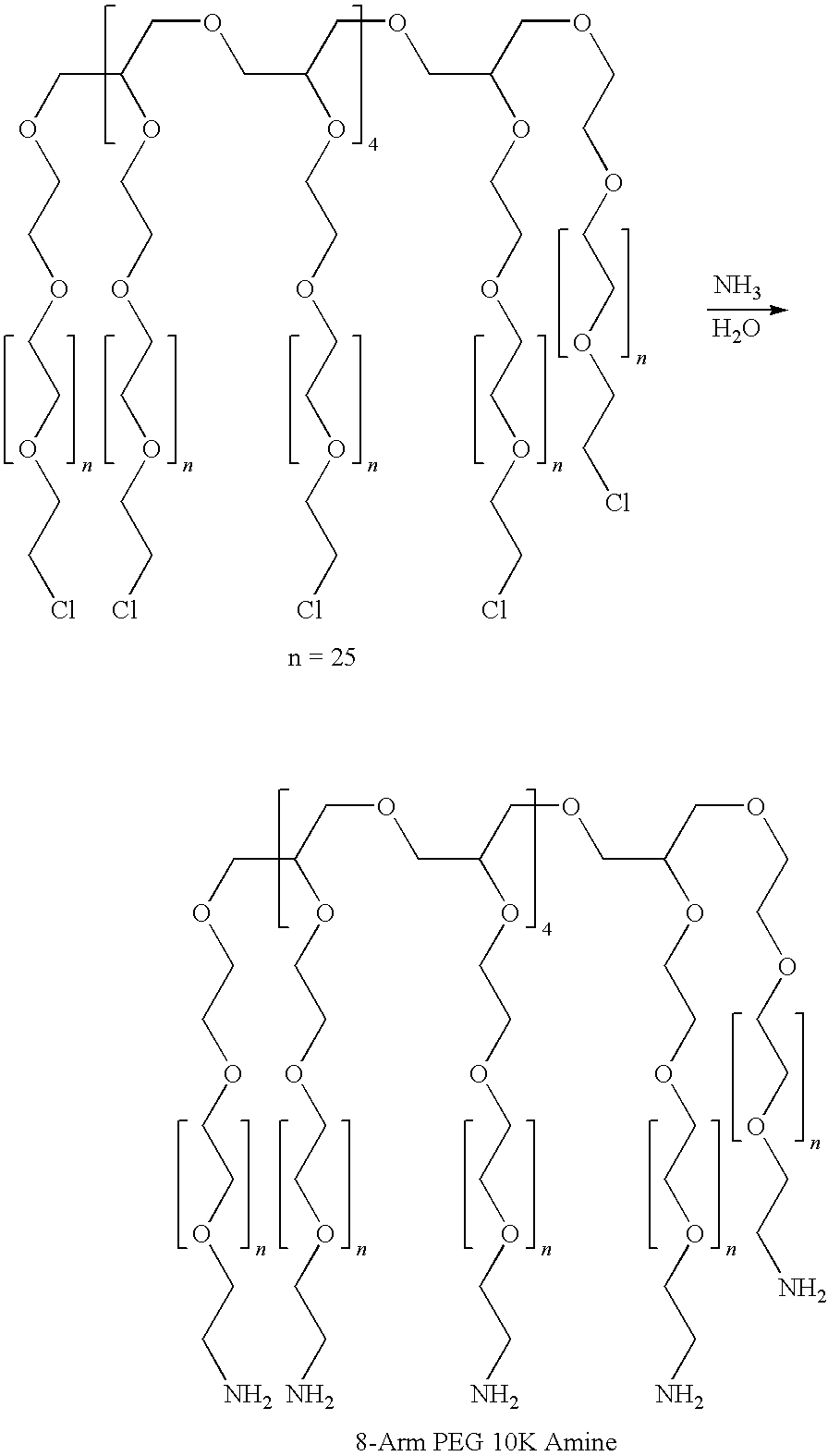

Examples
examples
[0133]The present invention is further defined in the following Examples. It should be understood that these Examples, while indicating preferred embodiments of the invention, are given by way of illustration only. From the above discussion and these Examples, one skilled in the art can ascertain the essential characteristics of this invention, and without departing from the spirit and scope thereof, can make various changes and modifications of the invention to adapt it to various uses and conditions.
[0134]All water used in these Examples was distilled-deionized water unless otherwise stated.
General Methods
Preparation of Oxidized Dextrans Containing Aldehyde Groups and Amine Groups: Preparation of Oxidized DEAE Dextran Having a Dialdehyde Content of 41% and an Amine Substitution Level of 33%
[0135]In a round-bottom flask, 20 g of DEAE-dextran hydrochloride (diethylaminoethyl-dextran hydrochloride, having an amine substitution of about 1 in 3 glucose units, i.e., about 33% substituti...
examples 1-3
Preparation of Hydrogels from Reaction of Oxidized Deae-Dextrans Containing Aldehyde Groups and Amine Groups with a Multi-Arm PEG Amine
[0172]The following Examples demonstrate the preparation of hydrogels from reaction of a multi-arm PEG amine with oxidized DEAE-dextran containing aldehyde groups and amine groups. The gel time to form the hydrogels was measured.
[0173]Into a small vial, 100 μL of an aqueous DEAE dextran aldehyde stock solution (20 wt %), as disclosed in Table 1, was added. The DEAE dextran aldehydes having various degrees of dialdehyde content were prepared as described in General Methods. The vial was tilted and 100 μL of a 50 wt % aqueous multi-arm PEG amine solution (P8-10-1), prepared as described in General Methods, was added with care taken not to mix the two solutions. A timer was started and the two solutions were stirred together with the wooden end of a cotton swab. The initial gel time was defined as the observation of increased viscosity, such that a stri...
examples 4 and 5
In Vitro Biocompatibility Testing
[0175]The following Examples demonstrate the safety of hydrogels resulting from the reaction of a multi-arm PEG amine with a DEAE dextran aldehyde in an in vitro test.
[0176]The testing was done using NIH3T3 human fibroblast cell cultures according to IS010993-5:1999. The NIH3T3 human fibroblast cells were obtained from the American Type Culture Collection (ATCC; Manassas, Va.) and were grown in Dulbecco's modified essential medium (DMEM), supplemented with 10% fetal calf serum.
[0177]NIH3T3 human fibroblast cell cultures were challenged with hydrogels made by combining equal volumes of an aqueous solution of a DEAE-dextran aldehyde and an aqueous solution of a multi-arm PEG amine, as shown in Table 2. Each hydrogel was placed in a well in a polystyrene culture plate such that about ¼ of the well bottoms were covered. The wells were then sterilized under UV light and seeded with 50,000-100,000 NIH3T3 cells.
[0178]The cells grew normally conf...
PUM
| Property | Measurement | Unit |
|---|---|---|
| equivalent weight | aaaaa | aaaaa |
| weight-average molecular weight | aaaaa | aaaaa |
| number-average molecular weight | aaaaa | aaaaa |
Abstract
Description
Claims
Application Information
 Login to View More