[0060]The present disclosure is directed to a
system and method for testing wireless transceivers in the laboratory where the advantages of
laboratory testing are maintained plus many unique attributes of comprehensive field testing are made possible.
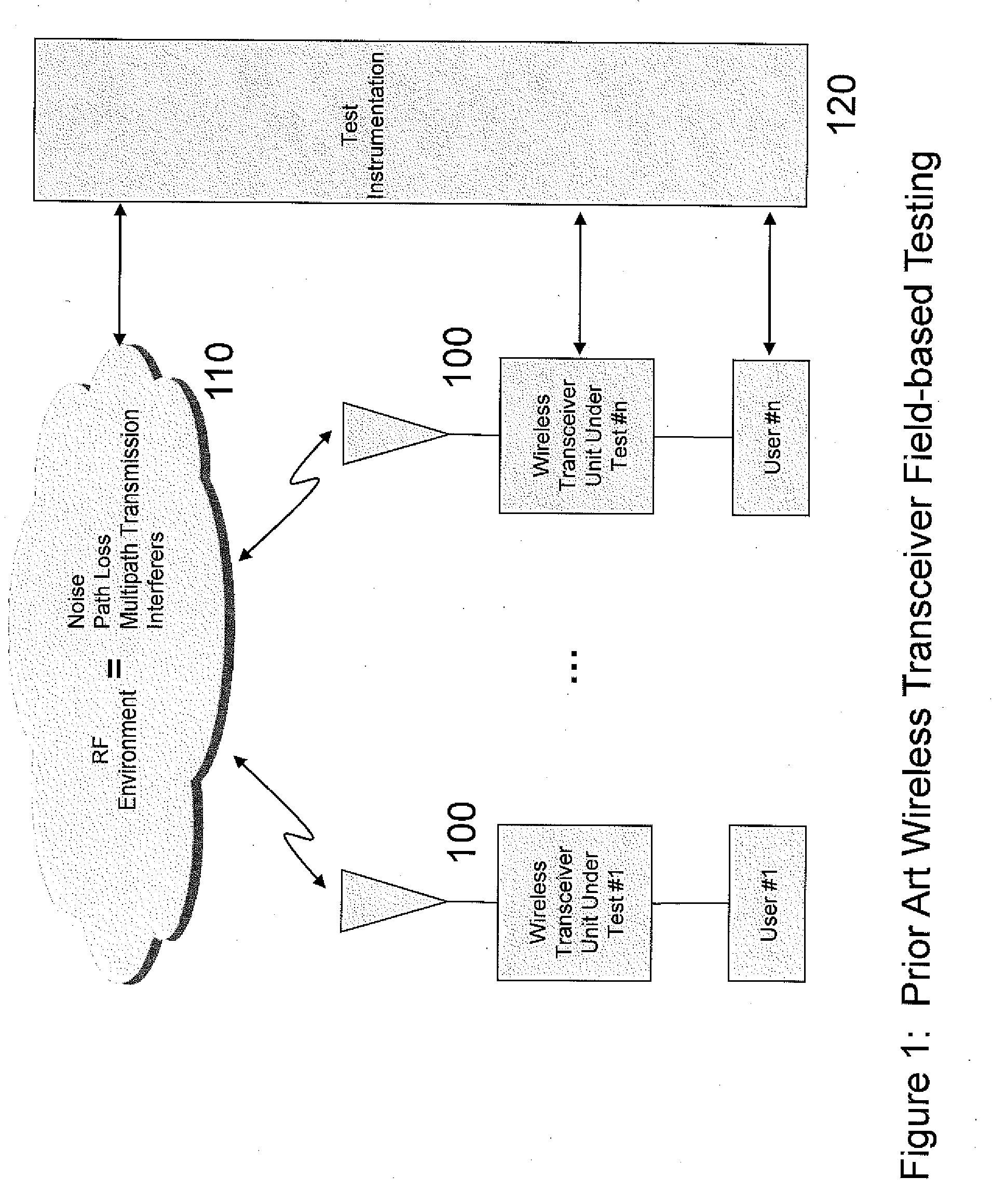
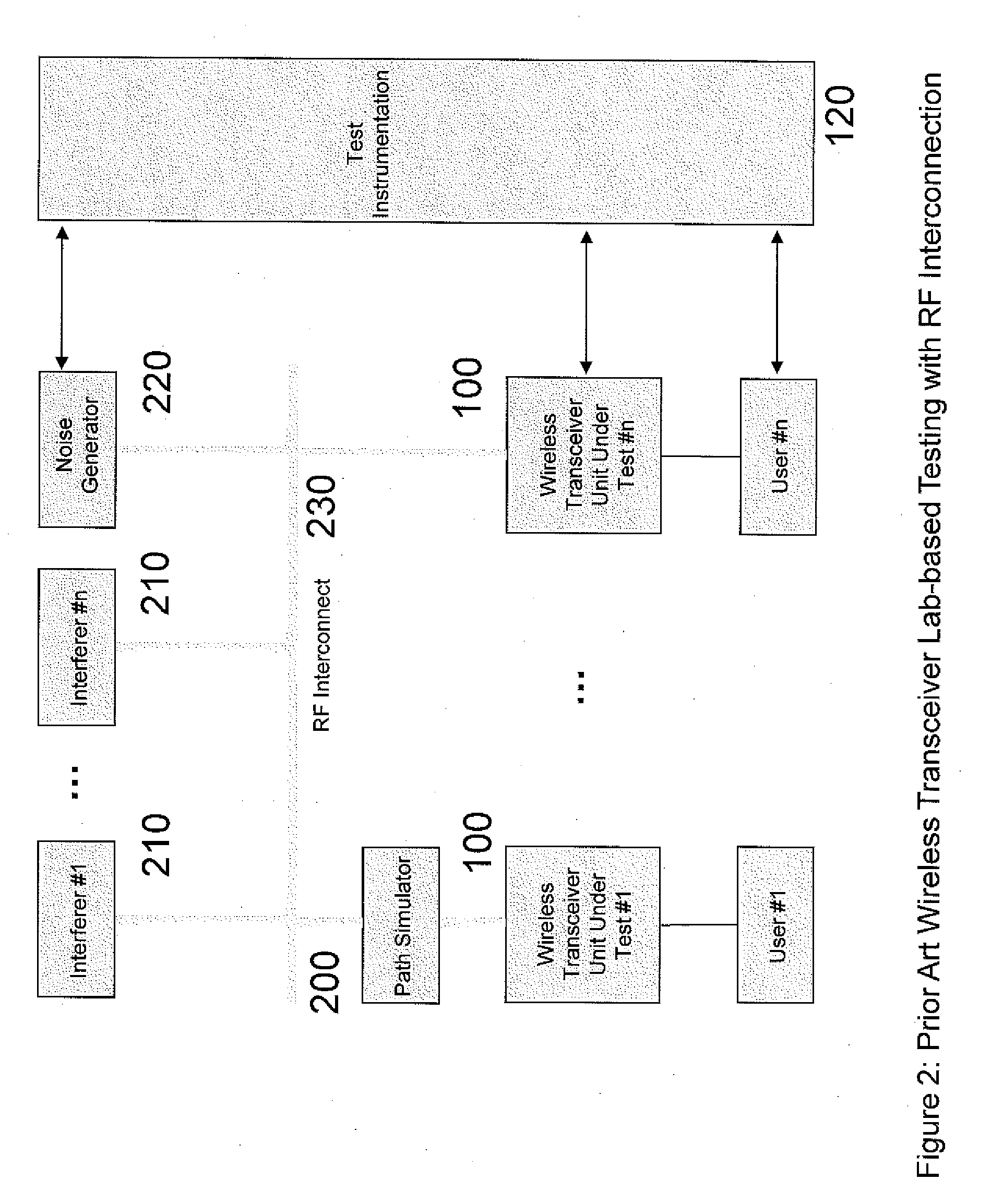
Laboratory testing approaches fall into two general categories: those that use RF cable-interconnected UUT and
test equipment, and those that perform computer simulations and rely on
software-based UUT and RF environment models.
Laboratory testing advantages include simplicity,
cost effectiveness, flexibility in number and type of UUT,
scalability with respect to
computer resources, and ease of
collaboration as networked computers may distribute and share
processing and results. Shortcoming include realism and flexibility of the wireless channel, the potential inability to model any real time effects (such as if the
simulation software cannot run in real time), inability to move UUT to field environment, and inability to model
wideband RF effects.
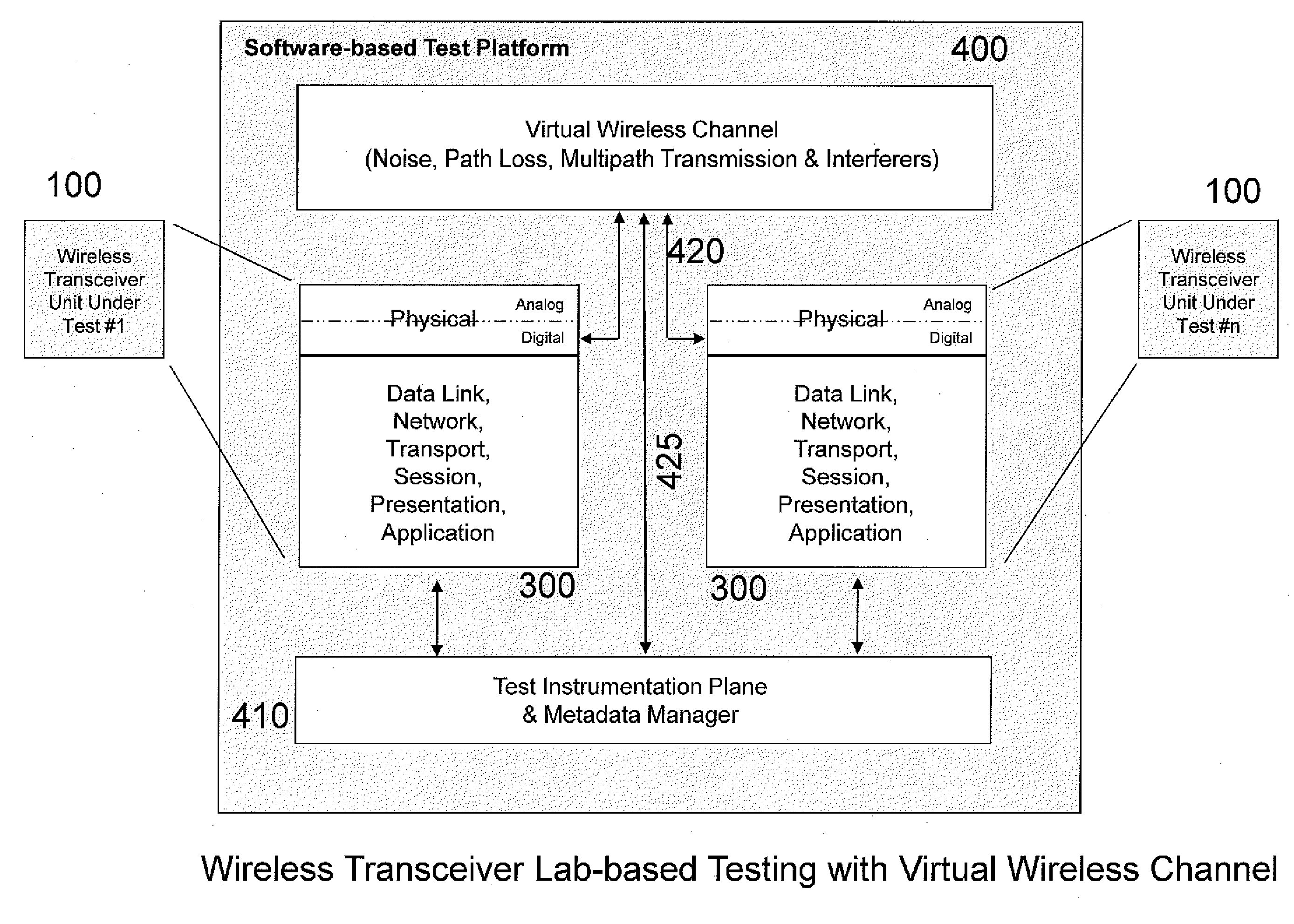
[0061]The present disclosure describes a novel system and new methods to allow laboratory-based testing to overcome these shortcomings. These innovations apply to both the RF cable-interconnected laboratory approach, and the software model-based approach. In both cases, a Virtual
Wireless Channel (VWC) function is introduced that flexibly and accurately allows the wireless channel to be modeled and exercised. The UUT is interfaced to the VWC using down / up converted digital RF samples to allow all significant RF channel effects to be modeled including multipath and real time
radio wave propagation. The modeling of the real time effects is facilitated by the introduction of executing the test in piecewise real time or real time capable hardware, and using
metadata which is communicated between the UUT and VWC. The
metadata contains the information needed by the test architecture components to reference the down / up converted digital RF to the true RF spectrum as well as the geographic lay down of the RF emitters in the defined for the test
scenario. This is enabled by time tags for samples being included in the
metadata, and controlling
delay through the VWC using the sample time tags. The metadata allows the UUT and VWC to operate in a
wideband RF sense. The metadata may include time stamp information, location information, or frequency information including
center frequency, bandwidth, power and modulation. Primary Users, Secondary Users and other interference (Virtual Spectrum Users (VSU)) can be created and accurately emulated in the VWC to create the realistic RF environment. The VSU may have selectable transmission parameters and selectable physical characteristics. For example, transmission parameters may include frequency, bandwidth, power, modulation. Physical characteristics may include location, speed, direction of motion, and antenna parameters including type, elevation
gain,
azimuth gain, phase, polarization and orientation. The VSU can be selected to be a
transmitter only, a
transceiver or a
transceiver. The VSU can be selected to be a
communication device, a sensor such as a
radar, a navigation device, or a jammer and can be the same type or different than the UUT.


 Login to View More
  Login to View More