

Permission-based TDMA chaotic communication systems
a communication system and permission-based technology, applied in the field of communication systems, can solve the problems of generating more complex pseudo-random number sequences, deterministic evolution of chaotic number sequences, and impractical implementation of the arithmetic required to generate chaotic number sequences digitally
- Summary
- Abstract
- Description
- Claims
- Application Information
AI Technical Summary
Benefits of technology
Problems solved by technology
Method used
Image

Examples
Embodiment Construction
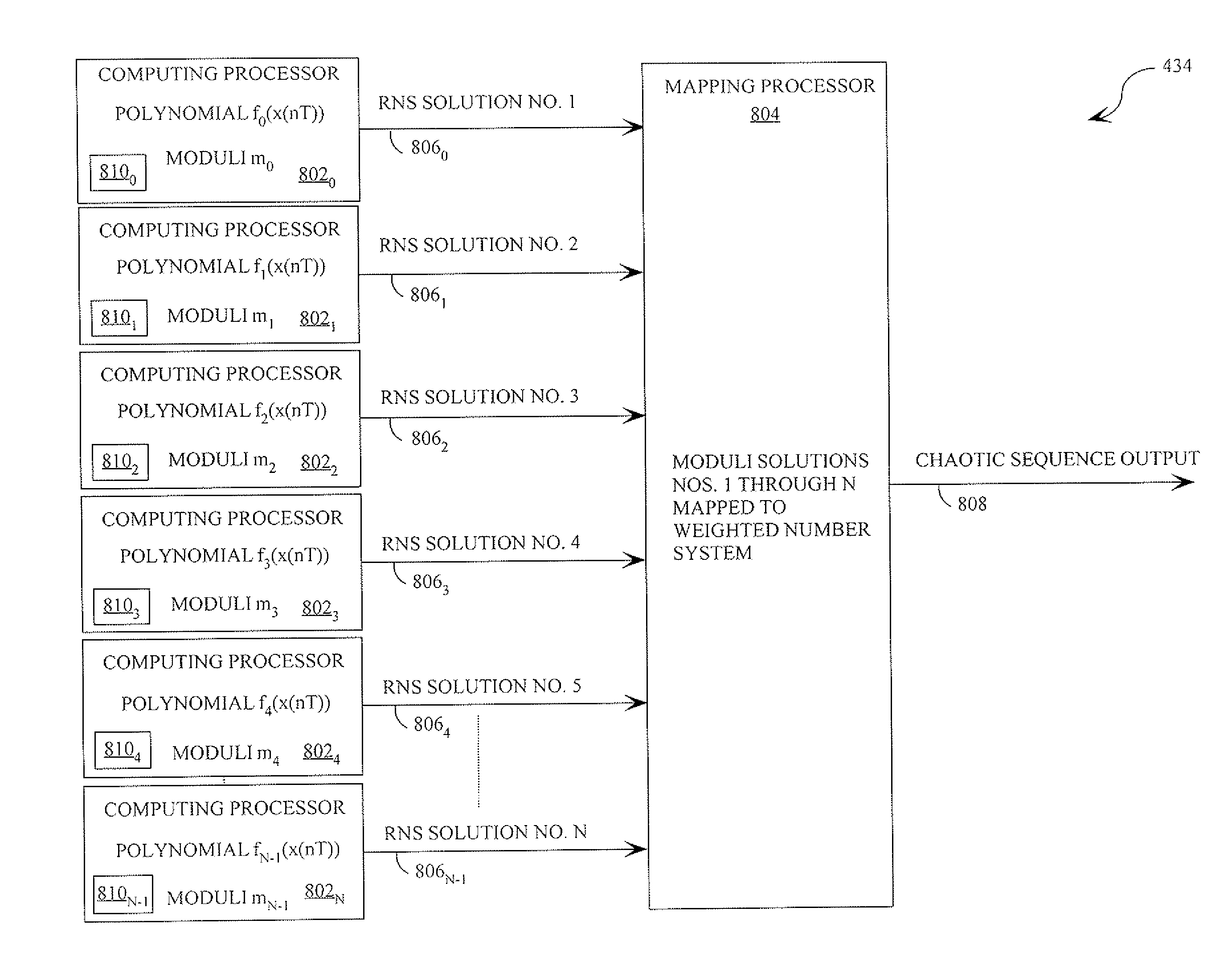
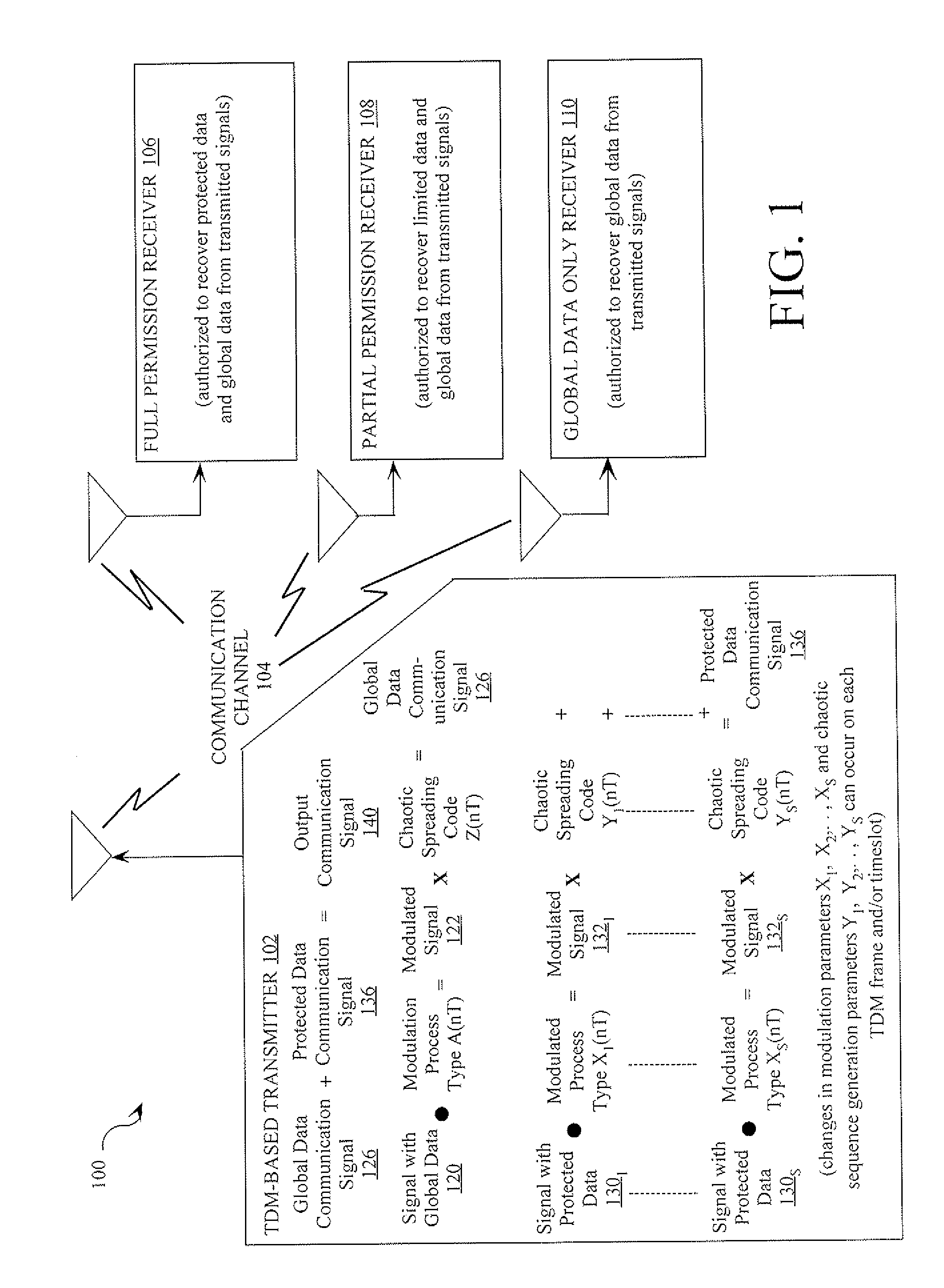
[0029]Embodiments of the present invention will now be described with respect to FIGS. 1-8. Embodiments of the present invention relate to Time Division Multiple Access (TDMA) permission-based communications systems. Signals containing protected data are modulated to form at least two modulated signals. Each of the modulated signals is combined with one or more orthogonal chaotic spreading codes to form a digital chaotic signal. The digital chaotic signals are additively combined to form a composite protected data communication signal. The composite protected data communication signal and a global data communication signal are time division multiplexed to form an output communication signal.
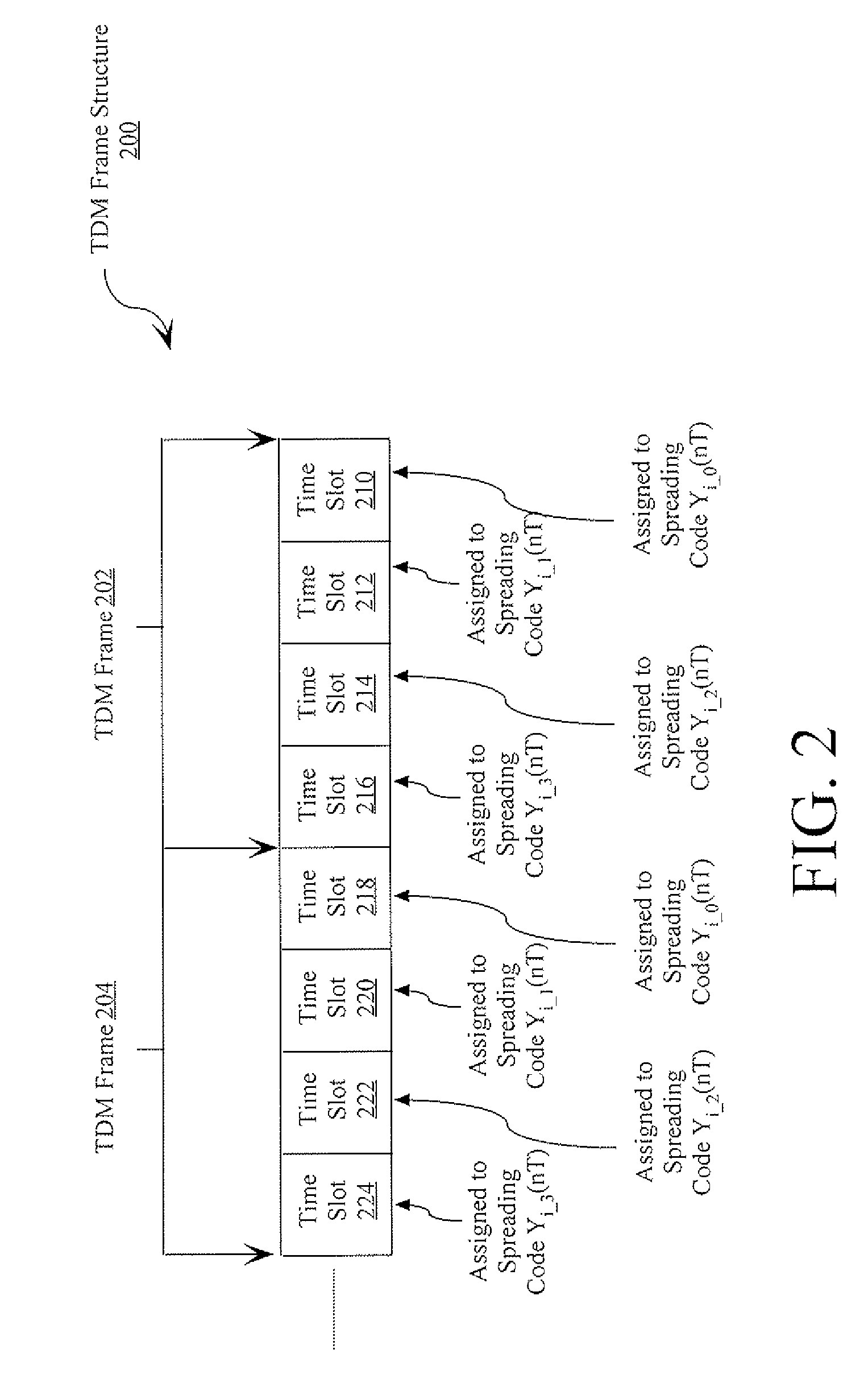
[0030]In one embodiment, different chaotic spreading codes are used during different timeslots of a Time Division Multiplex (TDM) frame. In another embodiment, a chaotic spreading code is cyclically shifted during the two or more timeslots of the TDM frame. It should be noted that chaotic spreadi...
PUM
 Login to View More
 Abstract
Description
Claims
Application Information
 Login to View More