

Aed faster time to shock method and device
a technology of aed and aed acceleration, applied in the field of improved methods and apparatus, can solve the problems of significant motion artifacts, many current aeds are not fully functional, and negatively affect the operation of an aed, so as to reduce the delay
- Summary
- Abstract
- Description
- Claims
- Application Information
AI Technical Summary
Benefits of technology
Problems solved by technology
Method used
Image

Examples
Embodiment Construction
[0022]The invention may be embodied in other specific forms without departing from the essential attributes thereof, therefore, the illustrated embodiments should be considered in all respects as illustrative and not restrictive.
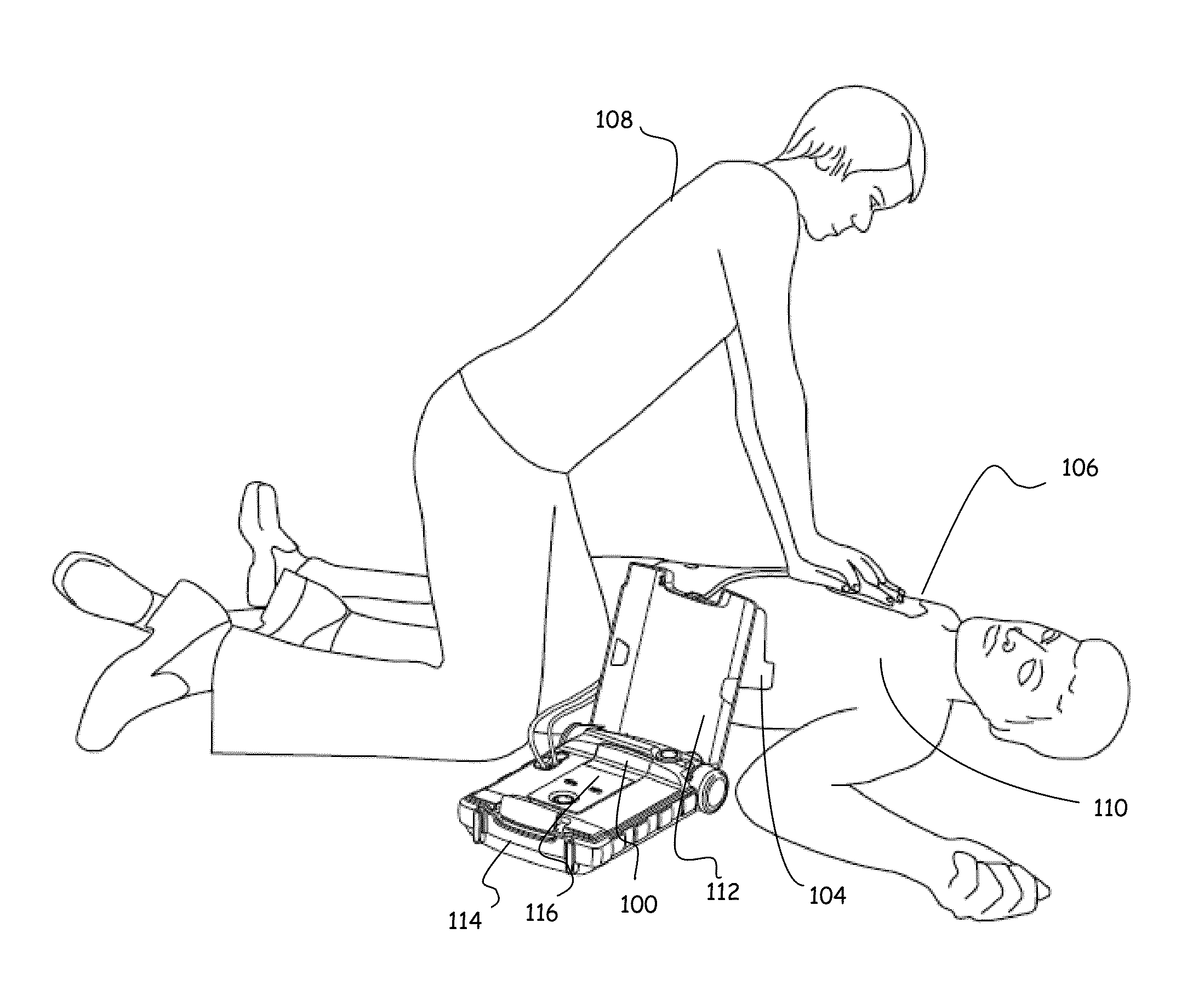
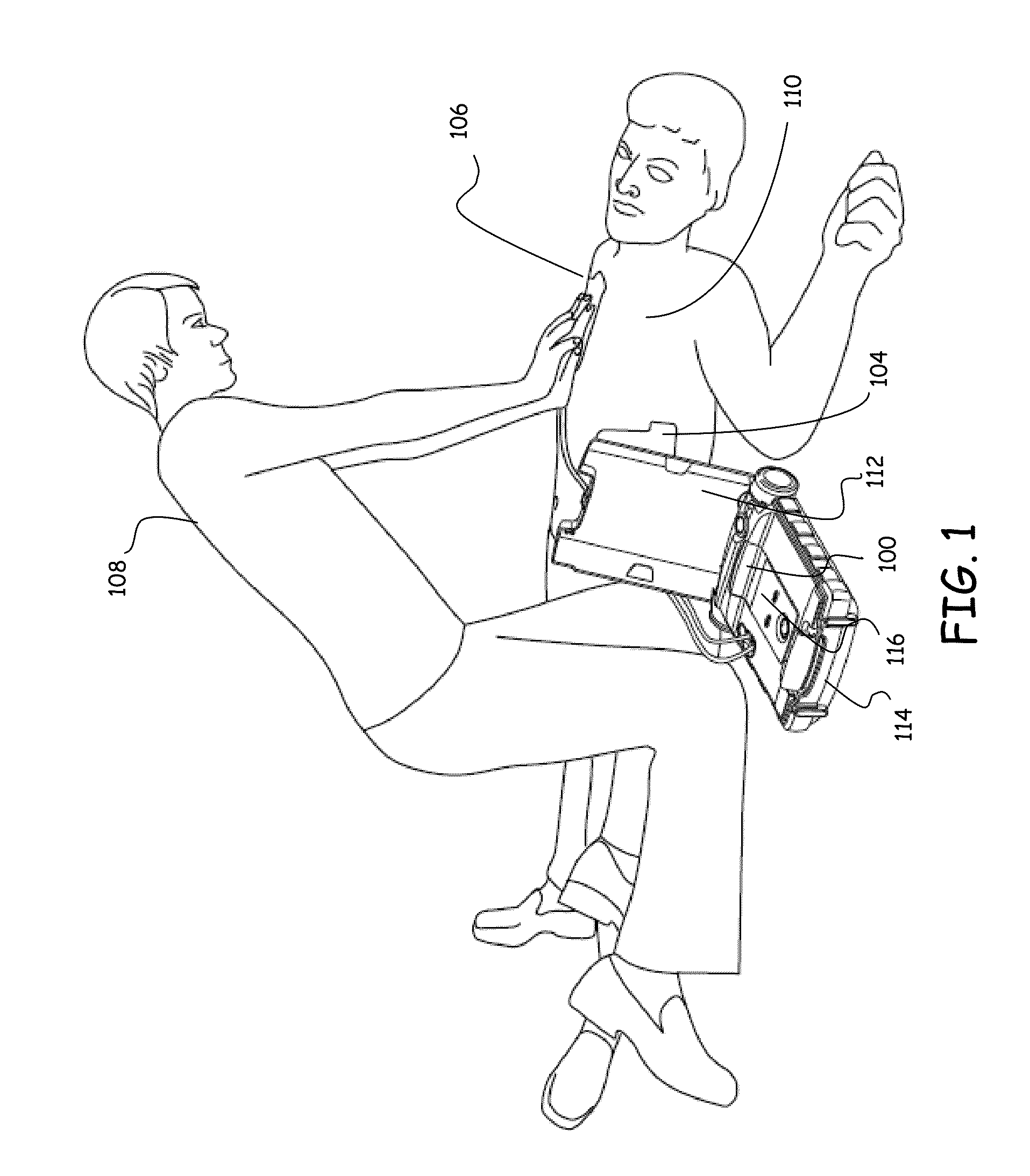
[0023]In various embodiments of this invention an apparatus and method are disclosed for rapidly and reliably evaluating an ECG signal from a patient such that minimal delay between CPR and delivery of a defibrillation shock is made possible. FIG. 1 depicts a cardiac arrest victim who is undergoing a resuscitation attempt and is being treated with an AED and CPR. The AED 100 is shown with electrode pads 104 and 106 coupled to the patient's chest and the rescuer 108 is shown in position for rapidly providing chest compressions to the patient 110.
[0024]The AHA currently recommends that all rescuers, regardless of training, should provide chest compressions to all cardiac arrest victims, and that chest compressions should be the initial CPR action for all victi...
PUM
 Login to View More
 Abstract
Description
Claims
Application Information
 Login to View More