System, method and computer program for simulating vehicle energy use

a vehicle energy use and simulation technology, applied in the field of simulation of vehicle energy use, can solve the problems of difficult determination of fuel savings, difficulty in identifying fuel savings by purchasing electrified or semi-electrified vehicles, and more capital-intensive vehicles to purchase. achieve the effect of accurately simulating the fuel consumption of a vehicl

Active Publication Date: 2014-07-31
GEOTAB
View PDF0 Cites 28 Cited by
  • Summary
  • Abstract
  • Description
  • Claims
  • Application Information

AI Technical Summary

Benefits of technology

Enables accurate prediction of fuel savings, vehicle range, and emissions reduction by using real-world driving conditions, benefiting both consumers and manufacturers with more reliable data for decision-making.

Problems solved by technology

However, these vehicles are typically more capital intensive to purchase than their conventional vehicle counterparts.
Identifying the fuel savings by purchasing an electrified or semi-electrified vehicle can be difficult.
Unfortunately, determination of these savings is difficult due to the high dependency of energy consumption on the real-world drive cycle.
Unfortunately, in most cases purchasers find the true fuel consumption to be greater than that advertised by the manufacturer.
This is typically due to a mismatch between the drive cycles that the vehicle is tested on, and the drive cycle that the vehicle is experiencing in use.
The net effect is disappointed vehicle purchasers, and negative publicity for these vehicles for not living up to advertised expectations.
These software packages are extremely complex and their use requires an engineer experienced in vehicle design.
They are, for this reason, limited to vehicle manufacturers.
While this is the obvious approach, experience with hybrid and electric vehicles indicates that these analyses can be very misleading since the advertised fuel consumption can be in significant error due to actual drive cycle.
This method is useful to determine fuel consumption of vehicles already in one's possession, however, it does not solve the issue of predicting fuel consumption of a vehicle (or set of vehicles) before their purchase.
Nevertheless, there is no currently existing technique for accurately simulating the fuel usage of a vehicle under consideration for purchase.

Method used

the structure of the environmentally friendly knitted fabric provided by the present invention; figure 2 Flow chart of the yarn wrapping machine for environmentally friendly knitted fabrics and storage devices; image 3 Is the parameter map of the yarn covering machine
View more

Image

Smart Image Click on the blue labels to locate them in the text.
Viewing Examples
Smart Image
  • System, method and computer program for simulating vehicle energy use
  • System, method and computer program for simulating vehicle energy use
  • System, method and computer program for simulating vehicle energy use

Examples

Experimental program
Comparison scheme
Effect test

Embodiment Construction

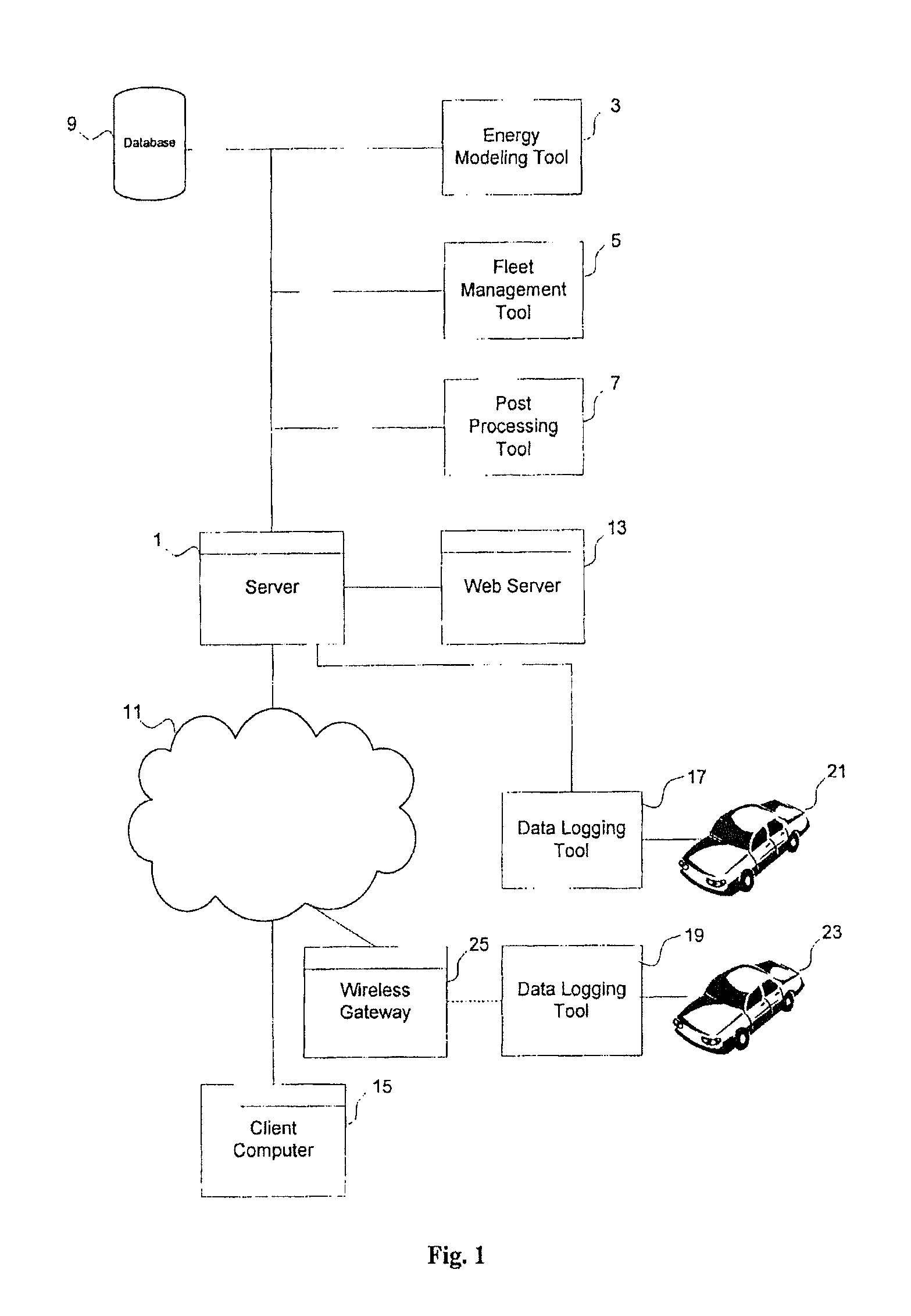
[0019]The present invention provides a system, method and computer program for simulating energy use of an asset under consideration, such as a vehicle, for example. The simulation uses vehicle modeling and drive cycle data to accurately reflect real-world conditions rather than relying on manufacturer-supplied data. The simulation allows prospective vehicle purchasers, for example, to more closely predict their return-on-investment, energy (fuel) savings, vehicle range, and reduction in emissions by generating higher accuracy energy consumption predictions than would otherwise be possible. The simulation also allows vehicle manufacturers, for example, to achieve significant benefits from obtaining real-world usage data from their customers that can be used to inform vehicle design decisions. The term ‘vehicle’ herein refers to any sort of powered mobile transportation device, including passenger vehicles as well as industrial equipment, commercial vehicles, automated equipment, rob...

the structure of the environmentally friendly knitted fabric provided by the present invention; figure 2 Flow chart of the yarn wrapping machine for environmentally friendly knitted fabrics and storage devices; image 3 Is the parameter map of the yarn covering machine
Login to View More

PUM

No PUM Login to View More

Abstract

A system, method and computer program for simulating vehicle energy use is provided. Drive cycle data collected during real-world driving of at least one vehicle is received by at least one computing device, and engine torque information associated with the real-world driving of the at least one vehicle is also received. Vehicle payload mass of the at least one vehicle is estimated based at least partly on the respective received engine torque information, and energy use of the at least one vehicle is estimated based at least partly on the respective drive cycle data, the respective torque information, and the estimated vehicle payload mass.

Description

CROSS-REFERENCE TO RELATED APPLICATIONS[0001]This application is a continuation of U.S. patent application Ser. No. 13 / 143,948, filed on Jul. 11, 2011, which is a National Stage entry from PCT patent application No. PCT / CA2010 / 001497, filed Sep. 24, 2010, claiming priority from U.S. patent application No. 61 / 245,868, filed Sep. 25, 2009, the entirety of each of which is hereby incorporated by reference in its entirety.FIELD OF THE INVENTION[0002]The present invention relates generally to simulating vehicle energy use. The present invention more specifically relates to accurately simulating vehicle energy use based on vehicle modeling and drive cycle data.BACKGROUND[0003]A vehicle purchaser can realize fuel savings by purchasing an electrified or semi-electrified vehicle. However, these vehicles are typically more capital intensive to purchase than their conventional vehicle counterparts. Identifying the fuel savings by purchasing an electrified or semi-electrified vehicle can be dif...

Claims

the structure of the environmentally friendly knitted fabric provided by the present invention; figure 2 Flow chart of the yarn wrapping machine for environmentally friendly knitted fabrics and storage devices; image 3 Is the parameter map of the yarn covering machine
Login to View More

Application Information

Patent Timeline
no application Login to View More
Patent Type & AuthorityApplications(United States)
IPC IPC(8): F02D19/02G06Q10/00
CPCG06Q10/04G07C5/008G07C5/0816F02D19/026
InventorSTEVENS, MATTHEWMENDES, CHRISTOPHER J.
OwnerGEOTAB