Padlock
- Summary
- Abstract
- Description
- Claims
- Application Information
AI Technical Summary
Benefits of technology
Problems solved by technology
Method used
Image



Examples
second embodiment
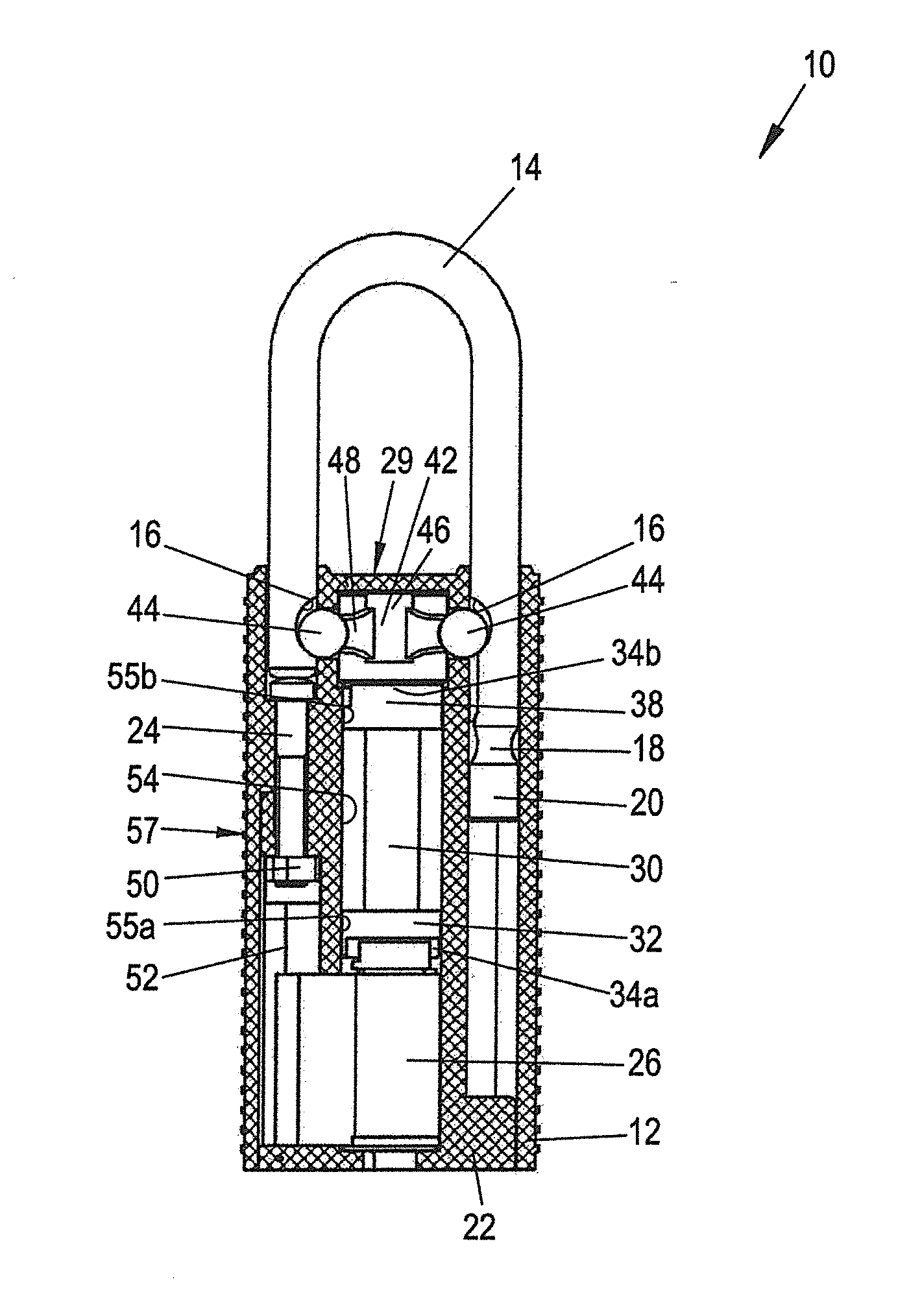
[0057]a padlock 10 shown in FIG. 3 is substantially identical with the padlock 10 of FIGS. 1 and 2, but the rotational bolt 42 and the coupling element 30 are configured as a single component, that is in one piece. The second coupling section 34b and the drive section 40 are thus omitted in the embodiment shown in FIG. 3.
[0058]FIG. 4a shows a perspective view of a possible embodiment of a coupling element 30 which has a first bearing section 32 as well as a second bearing section 38. The first and second bearing sections 32, 38 are connected to one another by a shaft section 56. The shaft section 56 as well as the first and second bearing sections 32, 38 are arranged substantially rotationally symmetrically along an axis 58. The shaft section 56 has a circular cross-section and additionally has a smaller diameter than the bearing sections 32,38 so that the shaft section 56 is directly adjacent to the facing end face of the respective bearing section 32, 38 and is set back radially w...
third embodiment
[0061]FIG. 4c shows a coupling element 30. Unlike the coupling element 30 of FIG. 4b, the coupling element 30 of FIG. 4c comprises a shaft section 56 whose cross-section is “+” shaped, i.e. is configured as a crossed bar. The shaft section 56 comprises four limbs 56a, 56b, 56c, 56d (also called wings) which extend away from a central point and which each include an angle of 90° with respect to the adjacent limbs 56a, 56b, 56c, 56d. The limbs 55a, 56b, 56c, 56d extend between the bearing sections 32, 38. The cross-section of the shaft section 56 along a plane A-A in accordance with FIG. 4c is shown in the sectional view of FIG. 4d, with the cross-section of the shaft section 56 not varying between the bearing sections 32, 38 in the embodiment of FIG. 4c.
[0062]Differing from the representation in accordance with FIG. 4c, the shaft section 56 can also have a different number of limbs 56a, 56b, 56c, 56d, for example three, five, six or eight limbs, so that in the event of a regular ang...
fourth embodiment
[0063]a coupling element 30 is shown in FIG. 4d. As in the embodiment of FIG. 4c, the coupling element 30 comprises a shaft section 56 which is formed as a cross-bar and which now, however, comprises two transition sections 60 in accordance with the embodiment of FIG. 4b which, for example, have a contour of part circular shape or of quarter-elliptical shape. The minimal diameter of the coupling element 30 can hereby be configured even smaller, with the diameter of the shaft section 56 becoming continuously larger on the transition into the bearing sections 32, 38 due to the transition sections 60. As in FIG. 4c, the shaft section 56 can also have a different number of limbs 56a, 56b, 56c, 56d.
[0064]A third embodiment of a padlock 10 is shown in FIG. 5. This embodiment is substantially identical with the first embodiment of FIGS. 1 and 2. However, the coupling element 30 is not configured in the form of a barbell, but as a cylinder. To avoid a large-area friction of the cylindrical...
PUM
 Login to View More
 Abstract
Description
Claims
Application Information
 Login to View More