For example, printers, which previously were used mainly in office environments, have also entered into use in severe environments, and the generation of stable images even under these circumstances has become critical.
When, for example, the coverage of the magnetic toner by an external additive is inadequate or the magnetic toner is used in a severe environment, e.g., a high-temperature, high-
humidity environment (in the following, a severe environment refers to conditions of 40° C. and 95% RH), its triboelectric charging may not proceed uniformly and charging of the magnetic toner may then become nonuniform.
As a result, a phenomenon can occur in which only a portion of the magnetic toner is excessively charged, so-called charge-up, and various image defects may then occur.
In particular, when the developing sleeve has been downsized as referenced above, the development zone of the development nip region is narrowed and the flight of the magnetic toner from the developing sleeve is made more difficult.
As a consequence, a portion of the magnetic toner is prone to remain on the developing sleeve and a trend of greater charging
instability sets in.
For example, a reduction in
image density can occur when charged-up toner remains on the developing sleeve, while an image defect such as
fogging in the nonimage areas can be caused when the toner charge is nonuniform.
Furthermore, when used after standing for a while in a severe environment, the aggregative behavior exhibited by the toner is increased due to the pressure on the toner in the developer container.
However, the flowability and aggregative behavior immediately after standing in a severe environment of higher temperature and higher
humidity are in particular not adequately addressed, and there is still room for improvement with regard to the reduced initial density after standing in a severe environment.
There is room for improvement with these problems in particular when a small-
diameter developing sleeve is installed since aggregation of the magnetic toner on the developing sleeve causes the developing performance to deteriorate.
However, the problem of charge up produced due to the detachment of large-diameter
strontium titanate particles is not adequately addressed, and there is room for improvement with these problems in particular when a small-diameter developing sleeve is installed since the developing zone is then narrow and the charged-up toner undergoes development with difficulty.
The charging stability of magnetic toners is again not adequately addressed in these cases.
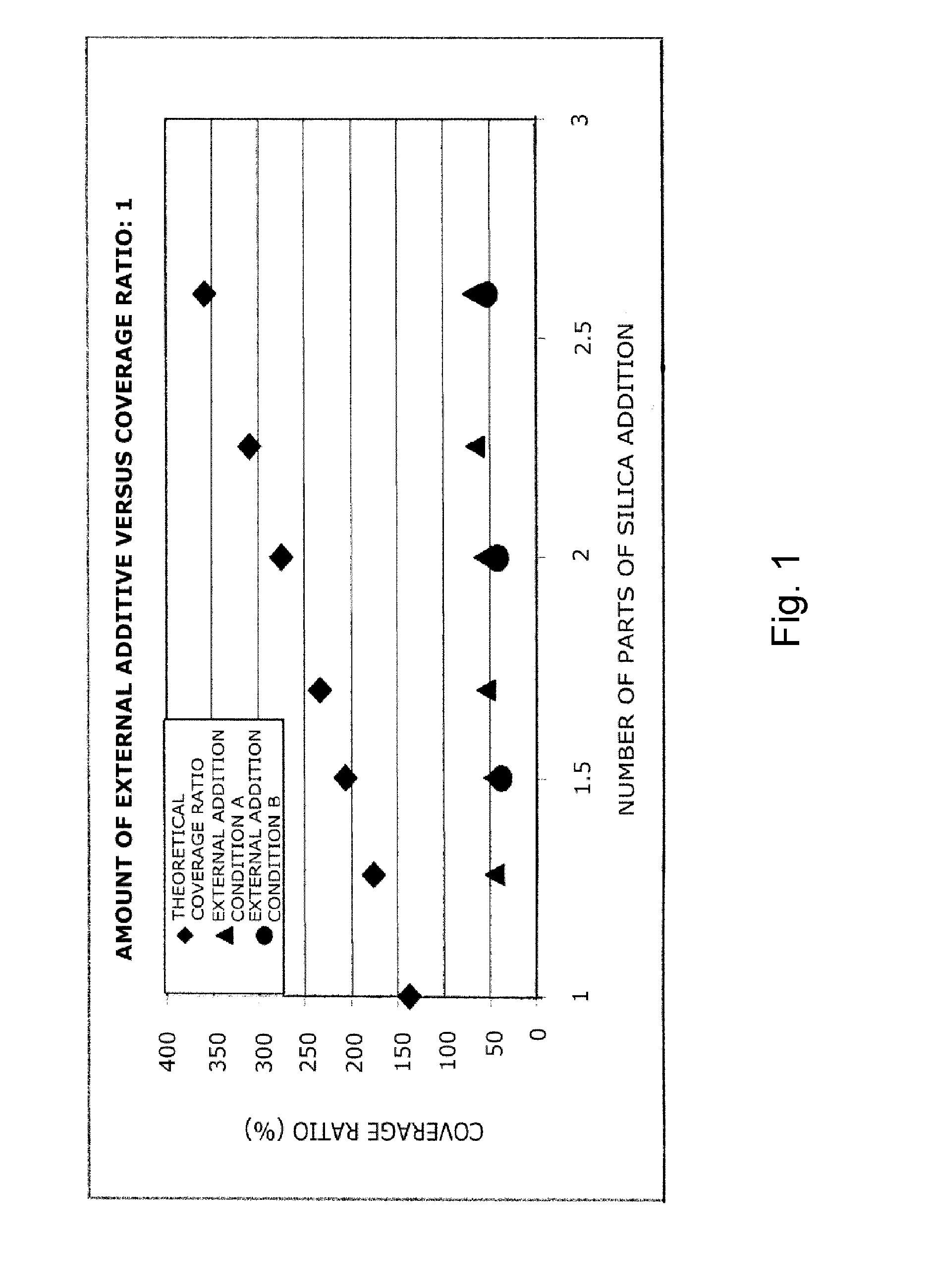
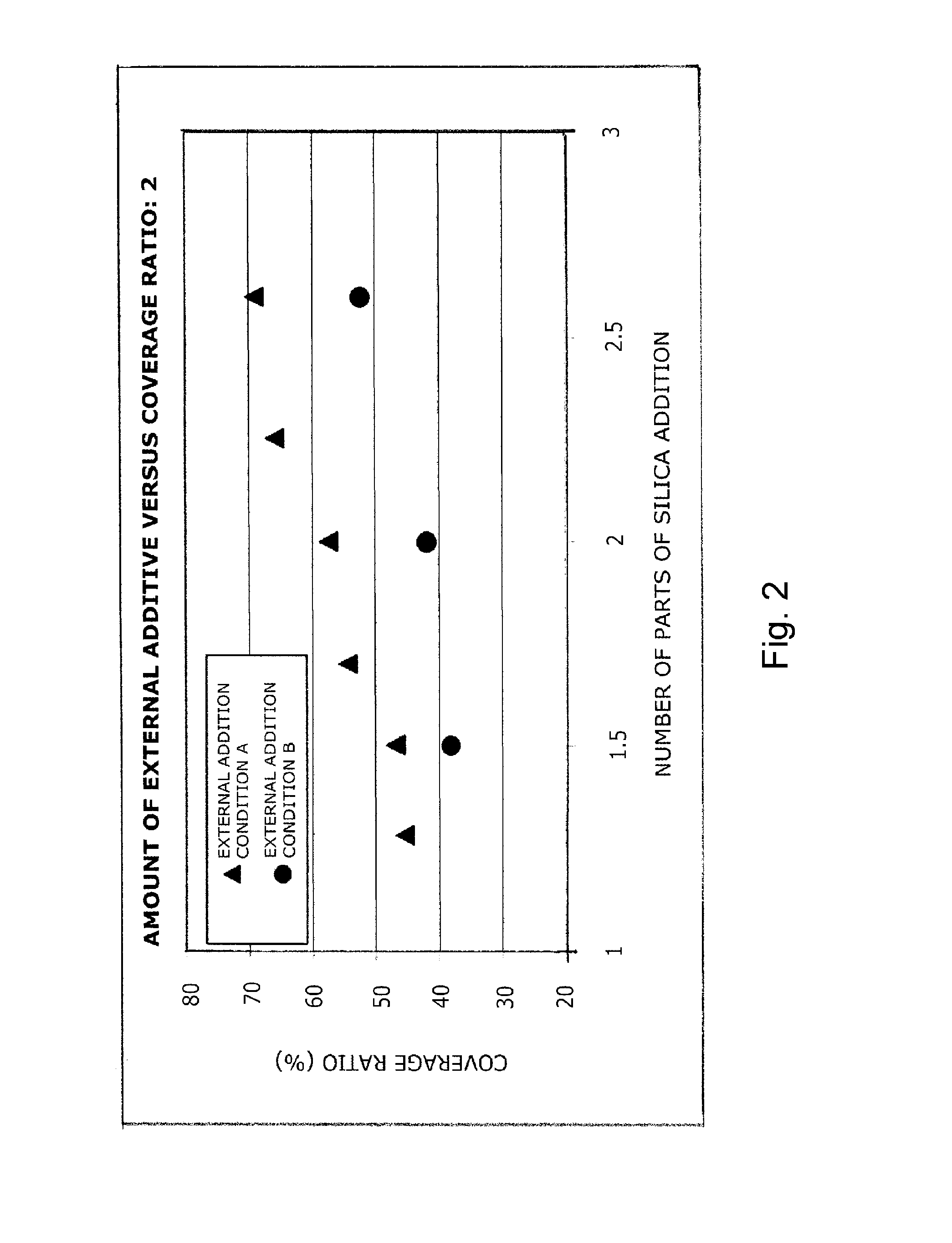
However, the actual state of binding by external additives may be substantially different from the value calculated assuming the toner to be a sphere, and, for magnetic toners in particular, achieving the effects of the present invention without controlling the actual state of external additive binding has proven to be entirely unsatisfactory.



 Login to View More
  Login to View More